
IMFSurvey Magazine: In the News
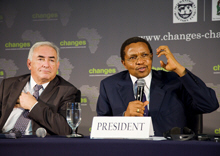
Tanzanian President Kikwete (r) addresses media with IMF Managing Director Strauss-Kahn after Dar es Salaam conference (photo: Stephen Jaffe/IMF)
TANZANIAN CONFERENCE
Amid Crisis, Africa Calls for Stronger Partnership With IMF
IMF Survey online
March 11, 2009
- Calls for increased support for Africa to ride out crisis
- IMF surveillance of world economy must be evenhanded
- Conference welcomes expanded IMF technical assistance
African leaders, meeting at a two-day conference in Tanzania to discuss the continent’s response to the global financial crisis, urged a stronger partnership between the region and the IMF and called for enhanced surveillance over the policies of all its members.
African ministers and central bank governors, convened in the Tanzanian city of Dar es Salaam March 10–11, identified six building blocks of a stronger partnership between Africa and the 185-member international institution that is playing a central role in the response to the global crisis.
• Enhancing IMF surveillance over the policies of all its members, in a spirit of evenhandedness;
• Expanding the IMF’s financing facilities and their accessibility to low-income countries;
• Consolidating the debt relief process by adjusting the IMF’s debt sustainability framework to accommodate Africa’s new financing needs and opportunities;
• Accelerating reforms of IMF governance to enhance Africa’s voice and representation at all levels of the institution;
• Enhancing the policy dialogue between the IMF and its African members, including through technical assistance, to ensure that African countries’ policies benefit from the IMF’s experience and expertise; and
• Reinforcing the IMF’s catalytic role to leverage public and private financing for Africa’s critical infrastructure needs.
Road to G-20
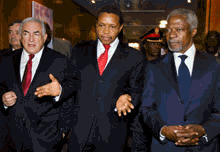
(from l) IMF’s Strauss-Kahn, Tanzanian President Kikwete, ex-UN secretary general Annan head to Dar es Salaam conference session (photo: Stephen Jaffe/IMF)
The conference, which brought together African business leaders, policymakers, civil society representatives, and academics as well as a number of well-known international figures, took place ahead of the meeting in London on April 2 of the Group of Twenty (G-20) leading industrialized and emerging market countries to follow up on the global policy response to the crisis.
Speaking in Dar es Salaam, IMF Managing Director Dominique Strauss-Kahn said the world was falling into a “Great Recession” of below-zero growth.
Tanzanian President Jakaya Kikwete said, with Africa facing intensified risks and a sharp decline in trade, there was an urgent need to rapidly respond to the crisis.
African leaders said their economies were under severe challenge. “The achievements of the past decade, which has seen robust economic growth, macroeconomic stability, and welcome progress in poverty reduction in a growing number of African countries, are now at risk as the world faces the gravest economic crisis in more than sixty years,” the joint declaration, issued by the African leaders and the IMF at the conclusion of the conference, noted.
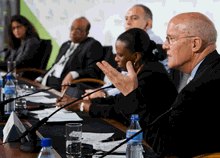
Bill & Melinda Gates Foundation Managing Director Geoffrey Lamb (r) addresses conference, with (from r) World Trade Organization Deputy Director General Valentine Rugwabiza, Moroccan Finance Minister Salaheddine Mezouar, Mo Ibrahim Foundation founder Mo Ibrahim, U.K. Department for International Development Permanent Secretary Nemat Shafik (photo: Stephen Jaffe/IMF)
