


IMF Youth Dialog Held at Ecole Supérieure des Sciences Economiques et Commerciales de Tunis
Roundtable SummaryMarch 10, 2010
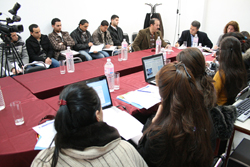 A group of 30 students met with two IMF staff members to share their views on what the economic priorities of the Tunisian government should be, the lessons from the global economic crisis, how they saw their economic future, and what role the Fund should play in their country. Not surprisingly, unemployment emerged as the students’ top concern, and several individuals proposed innovative solutions to the problem.
Tunisia presents a somewhat unique case, one of the professors noted before the session. While the overall unemployment rate is around 14 percent, joblessness among college graduates stands at roughly 24 percent. The participating students were therefore understandably preoccupied with how to improve the job prospects of youth.
Students stressed that the mismatch between the skills needed in the job market and the competencies students acquire is a big problem in Tunisia, as it is elsewhere in the region. University programs and vocational schools should place greater emphasis on “employability,” they said.
Given the dearth of available jobs within existing companies, many students pointed to entrepreneurship as a solution. The government should help young people create their own businesses, and banks should lend to youth at a low interest rate—or even provide interest-free loans—to those wishing to start a business. One student pointed out that financial support alone was not sufficient; young people also need technical assistance and follow-up support from more experienced businesspeople to avoid the common pitfalls of entrepreneurship.
 Other students proposed that the Tunisian government should lower the retirement age so that the older generation can step aside and give younger people a chance. They also suggested that the government give companies tax breaks for hiring youth. A third proposal—that the government develop projects in rural areas—would serve the dual purpose of creating employment opportunities and slowing down rural flight.
One student correctly pointed out that Tunisia’s growth rate currently hovers at 5 percent and unemployment is 14 percent. In order to bring about a meaningful reduction in unemployment, he said, the country’s growth rate would have to increase to 10 percent. To achieve this impressive feat—which would essentially mean matching China’s meteoric growth rate—the Tunisian government should focus its efforts on activities with high value-added, such as information technology and communication.
A recurrent theme was how to entice foreign companies to invest in Tunisia. One student suggested lowering the interest rate, which is high compared to that of advanced countries, to attract companies to come and set up shop. The government should also strive to improve the business climate, a vital step toward attracting investors. Students also cited improving infrastructure—such as roads—and other measures that would make it more likely that companies would want to invest in the country.
 On the lessons from the global economic crisis, students noted that the crisis has revealed the need for better risk management as well as the need to develop a culture of saving rather than a culture of credit. One student expressed the view that a socialist economy might be more viable than a capitalist one, and the country ought to consider adopting a regime that blends the two.
On whether they were pessimistic or optimistic about their economic future, students voiced diverse views, but most came down on the side of optimism. One student noted that she had a positive outlook because she saw evidence that the knowledge economy in Tunisia was taking shape, which gave her hope for the future. Others cited the series of recently initiated “mega-projects”—large investment projects funded by the UAE (such as Tunis Sports City, a giant sports complex, and “Porte de la Méditerranée,” a vast block of residential and office space complete with civic centers, spas, and golf courses) as helping to fuel their optimism about the future.
As for the IMF’s role, students proposed that the Fund become the world’s central bank. Under this scenario, the institution would continue to play its current role, but also impose prudential regulations that are applied worldwide.