How a Russian Natural Gas Cutoff Could Weigh on Europe’s Economies
IMF Blog, July 19, 2022
Source details
- Canonical URL
- How a Russian Natural Gas Cutoff Could Weigh on Europe’s Economies
Other formats
Bibliographic details
- Authors: Mark Flanagan, Alfred Kammer, Andrea Pescatori, Martin Stuermer
- Published: July 19, 2022
Overview
- Russia’s invasion of Ukraine and the partial shutoff of gas deliveries are affecting European growth.
- The prospect of a total shutoff raises risks of gas shortages, higher prices, and substantial economic impacts.
- Three IMF working papers examine market fragmentation and price pass-through, the role of the global liquefied natural gas (LNG) market, and implications for Germany.
Exposure and supply scenarios
- European gas deliveries from Russia fell by 60 percent since June 2021.
- Total gas consumption in the first quarter was down 9 percent from a year earlier.
- A reduction of up to 70 percent in Russian gas could be managed in the short term by accessing alternative supplies and energy sources and given reduced demand from previously high prices.
- In a total shutoff, infrastructure bottlenecks and transmission constraints could cause shortages of 15 percent to 40 percent of annual consumption in some Central and Eastern European countries.
Economic impacts and modeling approaches
- Two modeling approaches:
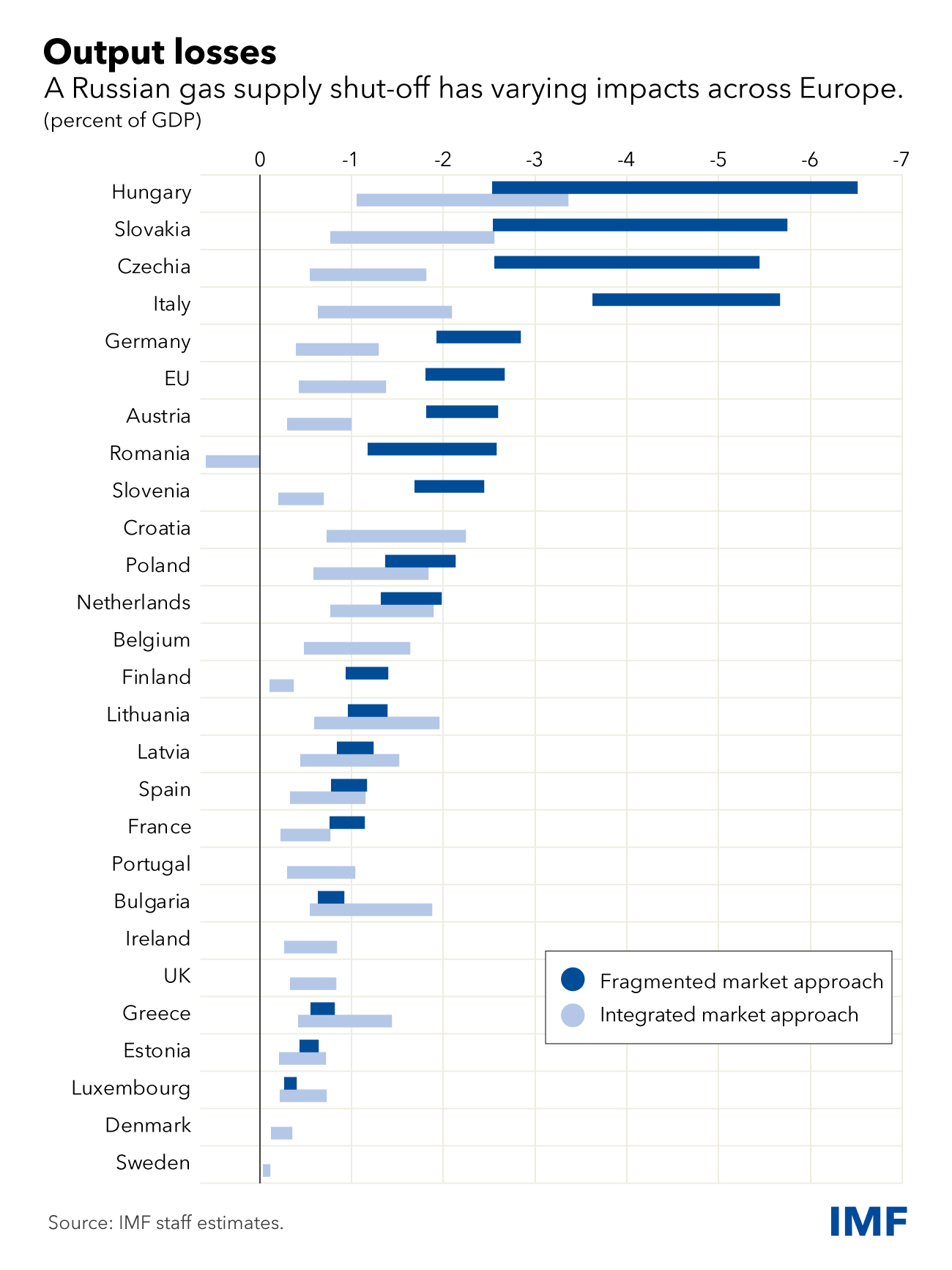
- Integrated-market approach: assumes gas can be reallocated where needed and prices adjust.
- Fragmented-market approach: assumes physical constraints prevent gas from reaching where it is needed regardless of price.
- Using the integrated-market approach to estimate the direct impact to date suggests a 0.2 percent reduction for European Union economic activity in the first half of 2022.
- For a full Russian gas shutoff from mid-July, impacts are assessed relative to a baseline of no supply disruption this year.
- If EU markets remain integrated and global LNG markets provide support, economic impacts would be buffered because reduced consumption is distributed across all connected countries.
- At the extreme, with no LNG support, soaring gas prices would need to depress consumption only in the EU, magnifying impacts.
- Under the fragmented-market approach, negative output impacts could be as much as 6 percent for some Central and Eastern European countries with high Russian gas intensity and scarce alternatives.
- Economic impacts for Austria and Germany would be less severe than the worst-affected Central and Eastern European countries but still significant, depending on alternative supply availability and the ability to lower household gas consumption.
- Economic impacts would be moderate, possibly under 1 percent, for countries with sufficient access to international LNG markets.
Country-specific findings
- Central and Eastern Europe:
- Hungary, the Slovak Republic, and the Czech Republic face risks of shortages of as much as 40 percent of gas consumption.
- Gross domestic product could shrink by up to 6 percent in some of these most-affected countries.
- Germany:
- IMF extended assessment through 2027 incorporating additional demand-side impacts from uncertainty that reduce aggregate consumption and investment.
- Uncertainty channels would notably add to economic impacts from a full shutoff, with impacts peaking next year then fading as alternative gas supplies become available.
- Simulations indicate voluntary consumer conservation could reduce economic losses by one-third.
- A well-designed rationing plan that shifts shortages toward downstream users and gas-intensive industries could reduce economic losses by up to three-fifths.
- The rise in wholesale gas prices could increase inflation significantly (explicitly studied in IMF work on Germany).
- Italy and other countries:
- Italy faces significant impacts due to its high reliance on gas in electricity production.
- Italy mandates minimum and maximum levels for heating and cooling to encourage household and business energy savings.
- Countries with sufficient access to international LNG markets may experience moderate impacts, possibly under 1 percent.
Policy recommendations and mitigation measures
- Secure alternative supplies from global LNG markets and other sources.
- Alleviate infrastructure bottlenecks to import and distribute gas (boost import capacity and transmission).
- Plan and expand solidarity agreements to share supplies in an emergency across the EU.
- Encourage energy savings while protecting vulnerable households:
- Allow greater wholesale-to-retail price passthrough to incentivize conservation.
- Offer targeted compensation to households that cannot afford higher prices.
- Prepare smart gas rationing programs that limit economic damage by allocating shortages toward less-sensitive users and industries.
- Continue decisive action and solidarity across Europe, building on pandemic-era cooperation.
Source: IMF blog post "How a Russian Natural Gas Cutoff Could Weigh on Europe’s Economies", July 19, 2022.