Strengthening Canada's Economic Toolkit: Improving the Inflation Targeting Framework
IMF Blog, November 1, 2016
Source details
- Canonical URL
- Strengthening Canada's Economic Toolkit: Improving the Inflation Targeting Framework
Other formats
Bibliographic details
- Authors: Maurice Obstfeld, Douglas Laxton, Yulia Ustyugova, Hou Wang
- Published: November 1, 2016
Background and recent performance
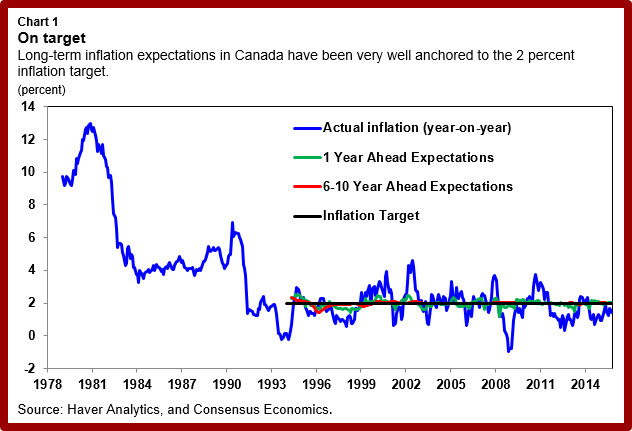
- For the past 25 years, Canada’s monetary policy framework has been working well.
- Headline inflation averaged 1.9 percent, 1994–2015.
- Long-term inflation expectations have been very well anchored to the 2 percent target.
- Authors: Maurice Obstfeld, Douglas Laxton, Yulia Ustyugova, Hou Wang.
- Date: November 1, 2016.
Current challenges to monetary policy
- Unusual global and domestic conditions: low and sub-zero interest rates; significant economic slack; risk that inflation might get stuck below target.
- Central bank unconventional tools under consideration include ad hoc forward guidance on the policy interest rate, quantitative easing, funding for credit, and negative interest rates.
- Such unconventional tools have disadvantages and communications risks.
Recommendation: Use conventional forward guidance before unconventional tools
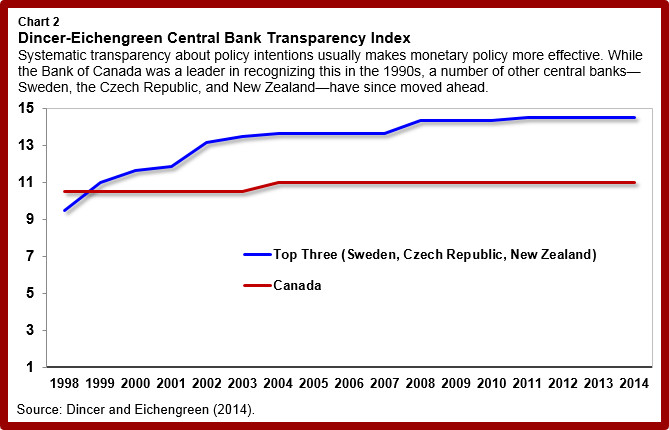
- Systematic transparency about policy intentions increases monetary policy effectiveness.
- Recommendation: The Bank of Canada should publish the path of the short-term interest rate from the forecast used at its policy meetings.
- The Bank holds 8 per year policy meetings.
- Guidance should be conventional (routine publication) and include usual caveats: not a commitment and conditional on the Bank’s latest forecast.
- Publication of a confidence band for the interest rate path, and alternative scenarios to the baseline forecast, is recommended to clarify conditionality.
Distinction: conventional forward guidance vs. ad hoc forward guidance
- Conventional forward guidance: routine publication of the forecast policy-rate path tied to the Bank’s conditional forecast.
- Ad hoc forward guidance: a conditional commitment to a very low rate used in past episodes (Bank of Canada in 2009; more extensively by the U.S. Federal Reserve and the Bank of England).
- Ad hoc guidance reduced longer-term interest rates but created communications problems about commitment duration and subsequent policy moves.
Rationale: how conventional forward guidance strengthens policy
- Point 1: The current money market overnight interest rate has negligible direct macroeconomic effect by itself; effectiveness depends on influence over expected future short-term rates and medium- and longer-term interest rates faced by households and firms.
- Policymakers therefore need a view on the whole medium-term path of the policy rate when making decisions.
- Point 2: The policy rate path that returns inflation to target is not unique; the chosen path reflects policymakers’ preferences about the short-run output and inflation trade-off.
- Only the central bank knows the intended path; without direct guidance, markets must guess intentions.
- Publishing the forecast interest rate path reveals how the central bank plans to navigate the output/inflation trade-off.
- If credible, this will move the term structure of interest rates and the exchange rate in support of policy objectives.
Policy scenario: using conventional forward guidance to avoid a low-inflation trap
- Risk: Further negative shocks when the policy interest rate is near zero could push the economy toward a low inflation trap that is hard to escape.
- Proposed strategy under conventional forward guidance:
- Explicit forecast for the policy rate to stay low for longer.
- Allow inflation to temporarily overshoot the target to raise inflation expectations, lower real interest rates, depreciate the exchange rate, and stimulate the economy.
- As economic growth improves, raise the desired interest rate and exit from ultra-low interest rates safely.
- Conventional forward guidance enables the central bank to give a credible public account of this strategy and reinforce confidence in the 2 percent inflation target.
Interaction with fiscal policy
- Current fiscal stimulus in light of Canada’s economic challenges is fully justified.
- Rationale: low government debt-to-GDP ratio and the exceptionally low cost of long-term government borrowing.
- Making monetary policy instruments more effective would complement fiscal efforts to boost growth, strengthening Canada’s resilience and ability to handle unexpected shocks.
Source: Strengthening Canada's Economic Toolkit: Improving the Inflation Targeting Framework (Maurice Obstfeld, Douglas Laxton, Yulia Ustyugova, Hou Wang), November 1, 2016.
Content in this bundle
- How to Improve Inflation Targeting in Canada