Chart of the Week: China’s Thrift, and What to Do About It
IMF Blog, February 26, 2018
Source details
- Canonical URL
- Chart of the Week: China’s Thrift, and What to Do About It
Other formats
Bibliographic details
- Authors: The Editors
- Published: February 26, 2018
Key facts and statistics
- China’s saving rate is 46 percent of GDP.
- Households account for about half of savings; corporations and the government make up the rest.
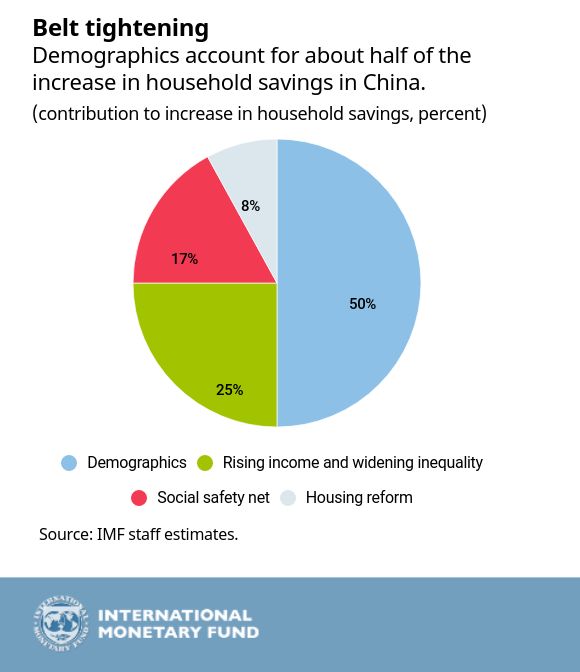
- Demographics explain about half the increase in saving.
- China’s saving rate started to soar in the late 1970s.
- Household debt, while still low, has risen rapidly in recent years (linked largely to asset price speculation).
- Declines in government spending on social services occurred during the economic transition in the 1980s and 90s.
Drivers of high saving
- Demographic change
- The “one child” policy led to dramatically smaller average family size.
- Smaller families reduced spending on children and increased precautionary saving because children are a traditional source of support in old age.
- Income inequality
- Greater income inequality from the transition to a more market-driven economy increased overall saving because wealthier households save a larger share of income.
- Economic and policy shifts
- More Chinese now own homes (rather than receive housing from state-owned enterprises), prompting savings for down payments and mortgages.
- Reduced government provision of social services during the 1980s and 90s raised the need for household saving for retirement and health care.
Implications and risks
- Excessive household saving implies low consumption and lower household welfare.
- High saving can fuel excessive investment and a buildup of debt in China.
- High domestic saving and relatively low imports by Chinese consumers contribute to global imbalances.
Policy recommendations to encourage spending
- Make the income tax more progressive and family friendly.
- Spend more on health care, pensions and education.
- Spend more on assistance to the poor to reduce income inequality.
- Raise revenue to finance these measures, for example by:
- Increasing dividends paid by state-owned enterprises.
- Transferring shares of state-owned firms to social security funds.
Closing observation
- With appropriate policies, China can encourage more domestic spending while avoiding the fate predicted by Confucius: “He who does not economize must agonize.”
Source: Chart of the Week: China’s Thrift, and What to Do About It (The Editors, February 26, 2018).