Fintech in Sub-Saharan Africa: A Potential Game Changer
IMF Blog, February 14, 2019
Source details
- Canonical URL
- Fintech in Sub-Saharan Africa: A Potential Game Changer
Other formats
Bibliographic details
- Published: February 14, 2019
Overview
- Blog published February 14, 2019.
- Highlights the rapid rise and diffusion of mobile money in Sub-Saharan Africa, led by M-Pesa (started in Kenya in 2007) and competitors such as MTN Money and Orange Money.
- Emphasizes fintech’s potential to democratize financial services, foster a digital economy, and support structural transformation and job creation.
Mobile money and financial inclusion
- Mobile money has grown exponentially over the past 10 years, making the region the global leader in mobile money innovation, adoption, and usage.
- M-Pesa now boasts 30 million users in 10 countries; M-Pesa services are offered in Albania, D.R. Congo, Egypt, Ghana, India, Kenya, Lesotho, Mozambique, Romania, and Tanzania.
- Prospective agreements with MTN Group would expand Orange Money and M-Pesa coverage across more countries in the continent.
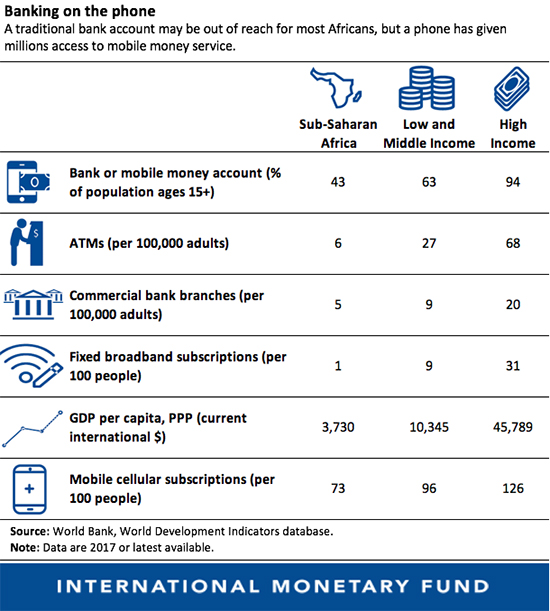
- Mobile money accounts now surpass bank accounts in the region and have expanded financial inclusion for the poor, the young, and women.
- Sub-Saharan Africa is the only region where close to 10 percent of GDP in transactions occur through mobile money; this compares with just 7 percent of GDP in Asia and less than 2 percent of GDP in other regions.
- Most African users rely on mobile payments for domestic transfers; use is increasingly extending to international remittances, bill payments, wage receipts, and payments for goods and services.
Moving up the financial services value chain
- Customers are progressing from mobile payments to mobile banking and other services: opening saving accounts, taking out loans, purchasing insurance, and investing in Government securities or in stock markets via mobile phones.
- Innovative services include pay-later models for essentials (example: “borrow” electricity and pay later).
- Foreign investors are increasing backing of African fintech firms; firms are developing region-adapted solutions (e.g., catering for relatively lower internet speed).
- Falling smartphone prices are expected to facilitate uptake of internet-based financial solutions.
Greater digital inclusion and policy recommendations
- The challenge is to leverage mobile money success to transition to broader fintech services and a digital economy, which can spur economic growth and job creation.
- Africa faces a large infrastructure gap that policymakers need to address, starting with electricity and internet services.
- Policymakers must balance the demands of fast-moving innovation against the slower pace of regulation: good regulation is needed, but stifling innovation would be costly.
- With the right policies, Africa could reap a “digital dividend”; this is especially salient as the continent will see more than half the world’s population growth by 2050.
Fintech beyond financial services
- Policymakers and entrepreneurs are urged to consider fintech’s potential beyond narrow financial services.
- Fintech can create jobs and increase productivity of workers and firms.
- If exploited well, fintech could be a critical stepping stone toward a digital economy for Africa, helping reduce overdependence on a few dominant sectors and supporting structural transformation.
Key statistics and factual points (exact values preserved)
- Publication date: February 14, 2019.
- M-Pesa start year: 2007.
- M-Pesa users: 30 million.
- Countries with M-Pesa services listed: Albania, D.R. Congo, Egypt, Ghana, India, Kenya, Lesotho, Mozambique, Romania, Tanzania.
- Mobile-money transaction share: close to 10 percent of GDP in Sub-Saharan Africa.
- Comparable shares: 7 percent of GDP in Asia; less than 2 percent of GDP in other regions.
- Projected demographic note: more than half the world’s population growth by 2050.
Source: Fintech in Sub-Saharan Africa: A Potential Game Changer (IMF blog, February 14, 2019).