Gender Budgeting Is More Widespread But Implementation Remains a Challenge
IMF Blog, March 8, 2022
Source details
- Canonical URL
- Gender Budgeting Is More Widespread But Implementation Remains a Challenge
Other formats
Bibliographic details
- Authors: Teresa Curristine, Nino Tchelishvili, Sureni Weerathunga
- Published: March 8, 2022
Overview
- Publication title: Gender Budgeting Is More Widespread But Implementation Remains a Challenge
- Authors: Teresa Curristine, Nino Tchelishvili, Sureni Weerathunga
- Date: March 8, 2022
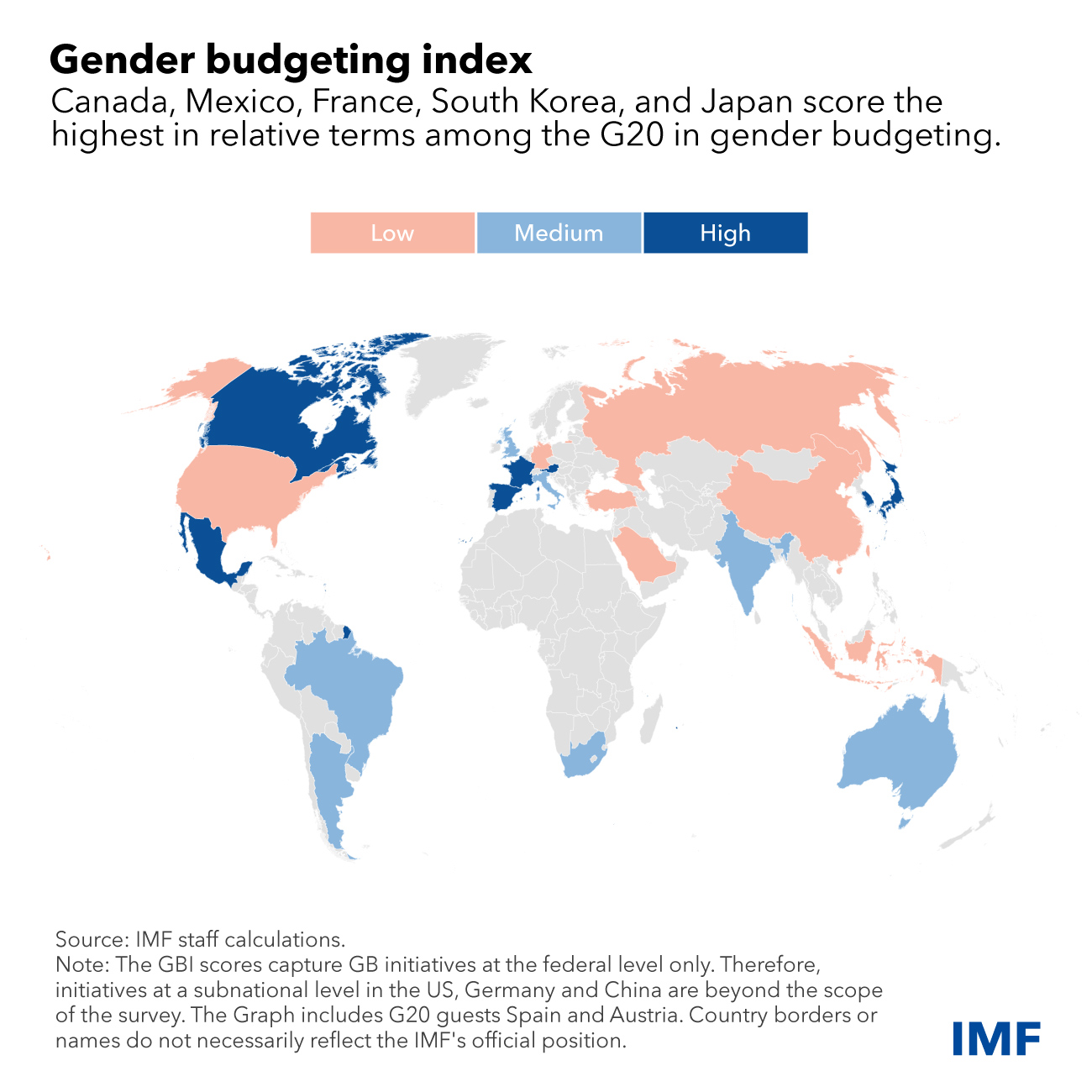
- Context: Chart of the Week takes stock of gender budgeting practices in Group of Twenty countries using data from a recent IMF survey. Focus is on structuring spending and taxation to advance gender equality (gender budgeting).
IMF survey and the Gender Budgeting Index (GBI)
- The IMF assessed country practices using a gender budgeting index (GBI) framed around the four pillars of the IMF’s gender budgeting framework.
- The index uses data collected from the IMF survey and ranks countries high, medium, or low, depending on how they score.
- As the Chart of the Week shows, relative to their G20 peers, Canada, Mexico, France, South Korea, and Japan score high on the GBI.
Key findings from the survey
- More than half of G20 countries have a legal framework in place requiring that gender goals and activities be incorporated in the budget.
- Almost all G20 countries collect gender-disaggregated statistics to some degree.
- Countries try to bring a gender perspective to budget preparation by:
- Linking goals and performance indicators to gender, or
- Issuing budget circulars with a gender lens.
- Just one third carry out up front gender assessments to understand the potential impact of new policies on gender equality.
- G20 countries score relatively low in integrating a gender perspective into budget execution:
- Gender information is rarely included in government annual financial reports.
- Only seven countries do ex-post gender impact assessments and seldom use them to improve policy design.
- Few countries audit gender activities and programs.
- There is some legislative oversight in about half of G20 countries.
Implementation challenges identified
- Lack of guidance on gender budgeting.
- Weak coordination across government institutions.
- Limited expertise in gender analysis and data.
Success factors and policy implications
- Survey responses highlight keys to success:
- Strong political backing.
- Legislative requirements.
- A ministry of finance that is firmly in the driver’s seat.
- Making the impact of policies on equality more visible through better analysis and reporting can make a real difference in women’s lives.
Source: IMF blog post "Gender Budgeting Is More Widespread But Implementation Remains a Challenge", March 8, 2022.