How Crypto and CBDCs Can Use Less Energy Than Existing Payment Systems
IMF Blog, June 17, 2022
Source details
- Canonical URL
- How Crypto and CBDCs Can Use Less Energy Than Existing Payment Systems
Other formats
Bibliographic details
- Authors: Itai Agur, Xavier Lavayssire, Germn Villegas Bauer
- Published: June 17, 2022
Overview and context
- Authors: Itai Agur, Xavier Lavayssière, Germán Villegas Bauer
- Date: June 17, 2022
- High-level point: Environmentally conscious design can make a major difference in the energy efficiency of digital currencies.
- Policy relevance: Most of the world’s central banks have already agreed they should help fight climate change; reducing energy consumption and associated carbon emissions is a central concern tied to payment-system design.
Key findings on energy drivers
- Payment-system energy use depends on technology choices, payment-chain size, and additional features.
- For distributed-ledger–based digital currencies, two main factors determine energy use:
- How network participants agree on transaction histories (consensus mechanism).
- Example: proof-of-work consensus mechanisms (as used by some crypto assets like Bitcoin) require substantial calculation power and energy.
- Alternative consensus mechanisms do not require as much computing power.
- Access model to the distributed-ledger system.
- Permissionless systems allow anyone to join and validate transactions.
- Permissioned systems require authorization from a central authority and enable greater control over the number and location of participants and software updates.
Comparative energy conclusions
- Research draws on academic and industry estimates to compare digital currencies, crypto assets, and existing payment systems.
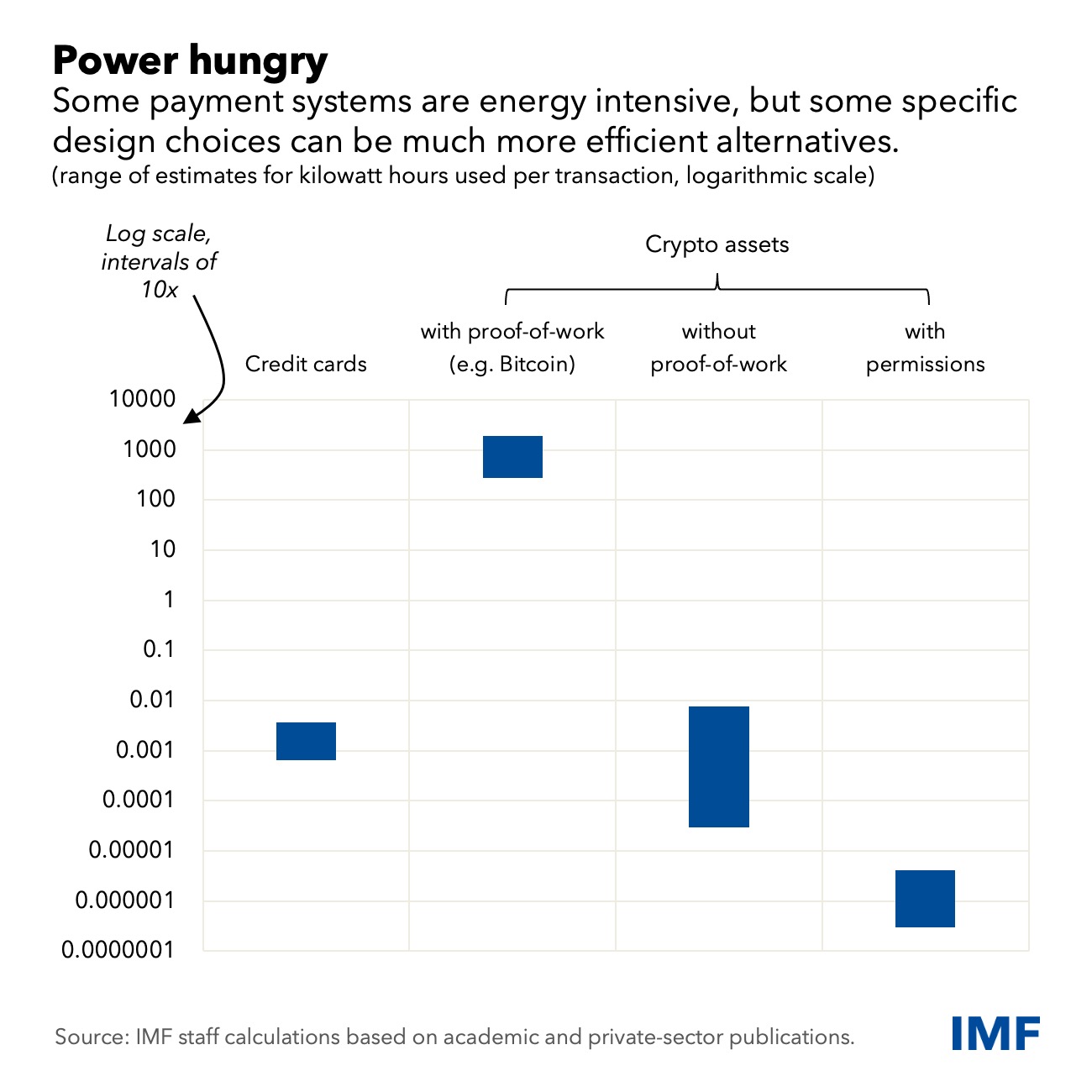
- Proof-of-work crypto uses vastly more energy than credit cards.
- Replacing proof-of-work with other consensus mechanisms is a first green leap for crypto.
- Using permissioned systems is a second green leap.
- Together, non-proof-of-work consensus mechanisms plus permissioned architectures can put crypto’s energy consumption well below that of credit cards.
- Depending on configuration, CBDCs and some kinds of crypto assets can be more energy efficient than much of the current payment landscape, including credit and debit cards.
- Credit and debit cards account for about three-quarters of cashless transactions (according to the most recent Red Book statistics from the Bank for International Settlements).
Implications for CBDC design
- Many CBDC projects build on energy-efficient distributed-ledger systems under which only permissioned institutions like commercial banks can join and validate without proof-of-work.
- Other non-distributed-ledger options are also being considered and can be promising from an energy-consumption standpoint.
- CBDCs have the potential to reduce the power needs for digital payments and even be more energy efficient than widely used credit card networks.
- Energy-saving potential of CBDCs will depend on additional design features chosen for compliance, security and integrity, or universal access.
Trade-offs and design considerations
- Card payments use more energy than digital-wallet–based payments (the latter is how most crypto transactions are made).
- Physical card access for CBDCs can increase energy use but may aid adoption and inclusion where digital literacy or mobile network connectivity are limited.
- Power use is one among many considerations; policymakers should weigh energy needs alongside other benefits and risks when designing CBDCs or regulating crypto.
Research scope and contributors
- The blog synthesizes academic and industry estimates on processing technologies and energy use.
- Additional research contributions: Jose Deodoro, Soledad Martinez Peria, Damiano Sandri and Hervé Tourpe.
IMF Blog: How Crypto and CBDCs Can Use Less Energy Than Existing Payment Systems