More Countries Are Pricing Carbon, but Emissions Are Still Too Cheap
IMF Blog, July 21, 2022
Source details
- Canonical URL
- More Countries Are Pricing Carbon, but Emissions Are Still Too Cheap
Other formats
Bibliographic details
- Authors: Simon Black, Ian Parry, Karlygash Zhunussova
- Published: July 21, 2022
Overview and context
- As the world gears up to avoid a climate catastrophe by limiting global warming to 1.5 to 2 degrees Celsius, more countries are putting carbon pricing at the center of their mitigation strategies.
- Carbon pricing, in one form or another, is likely to be an essential element of mitigation strategies as the world transitions to net zero over the next three decades.
- Credit (Photo: Andrzej Rostek/iStock by Getty Images)
- Simon Black, Ian Parry, Karlygash Zhunussova — July 21, 2022
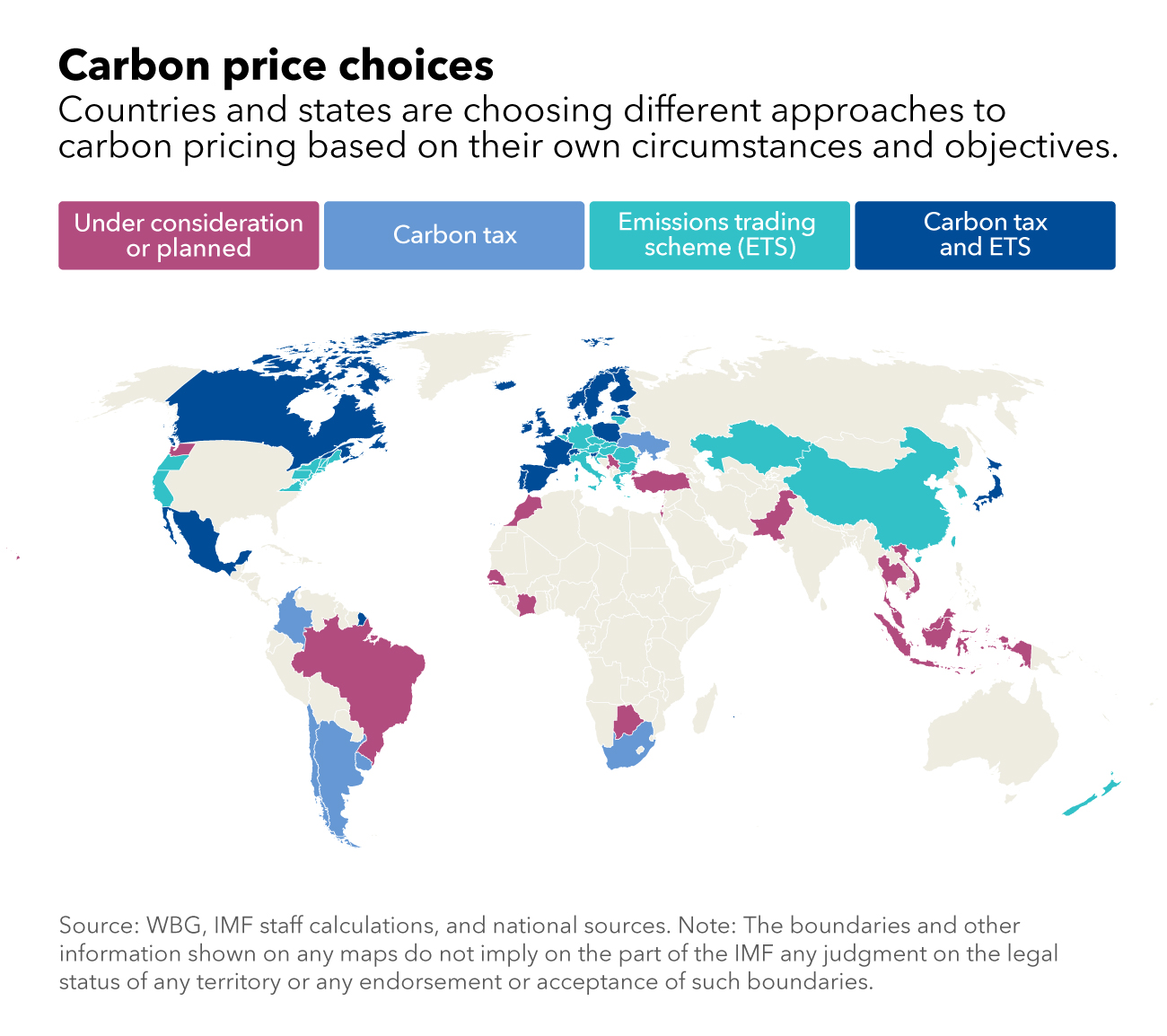
- The chart for this blog, originally published July 21, 2022, has been updated to reflect Indonesia's status as under consideration or planned.
Current coverage and price levels
- 46 countries are pricing emissions through carbon taxes or emissions trading schemes (ETS).
- ETSs and carbon taxes cover 30 percent of emissions globally.
- Prices rise as high as $90 per ton (in the European Union).
- Global average price of carbon today is $6 per ton of CO2.
- To limit global warming, prices need to rise from $6 per ton of CO2 today to $75 by 2030.
Policy choices and trade-offs
- Key decisions for policymakers considering introducing or scaling up carbon pricing:
- Ease of implementation.
- Price levels.
- Competitiveness concerns.
- Alignment with other mitigation instruments.
- Coordination across countries.
- Countries may choose different approaches based on their own circumstances and objectives.
Taxes versus emissions trading schemes (ETS)
- Carbon taxes:
- Provide certainty over future emissions prices, helping encourage green investments and energy conservation.
- Can be simple to implement by tweaking existing fuel taxes.
- Provide revenues that finance ministries can use to assist the poor, cut other taxes, or boost productive investments.
- Could be extended to broader emissions sources (for example, methane emissions from extractive industries and, in some cases, agriculture).
- Emissions trading schemes (ETS):
- Appeal to policymakers who prefer certainty over future emission levels.
- Can mimic some advantages of taxes, including through price floors and allowance auctions.
- Allocating some allowances initially for free may garner support from affected firms.
- Present significant complexity in design, implementation, and administration, making them challenging for many countries.
Commonalities and social considerations
- Both carbon taxes and ETSs operate on the “polluter pays” principle and efficiently encourage switching to more sustainable energy sources and reducing emissions-intensive activities.
- Political acceptability is vital for the rise in carbon prices needed to tackle climate change.
- Carbon pricing reforms can protect the poor while supporting economic growth, for example:
- Using some of the revenues to compensate vulnerable households.
- Using remaining revenues for labor tax cuts or productive investments.
- With careful design, implementation and coordination, the economic costs of carbon pricing can be manageable.
- For some countries, costs are more than offset by domestic environmental co-benefits (such as fewer deaths from local air pollution) even before counting the global climate benefits.
Source: IMF Blog — "More Countries Are Pricing Carbon, but Emissions Are Still Too Cheap" (July 21, 2022).