Global Economic Growth Slows Amid Gloomy And More Uncertain Outlook
IMF Blog, July 26, 2022
Source details
- Canonical URL
- Global Economic Growth Slows Amid Gloomy And More Uncertain Outlook
Other formats
Bibliographic details
- Authors: Pierre-Olivier Gourinchas
- Published: July 26, 2022
Global outlook and growth projections
- The global economy is facing an increasingly gloomy and uncertain outlook, with many downside risks flagged in the April World Economic Outlook beginning to materialize.
- Global output contracted in the second quarter of this year.
- Baseline forecast:
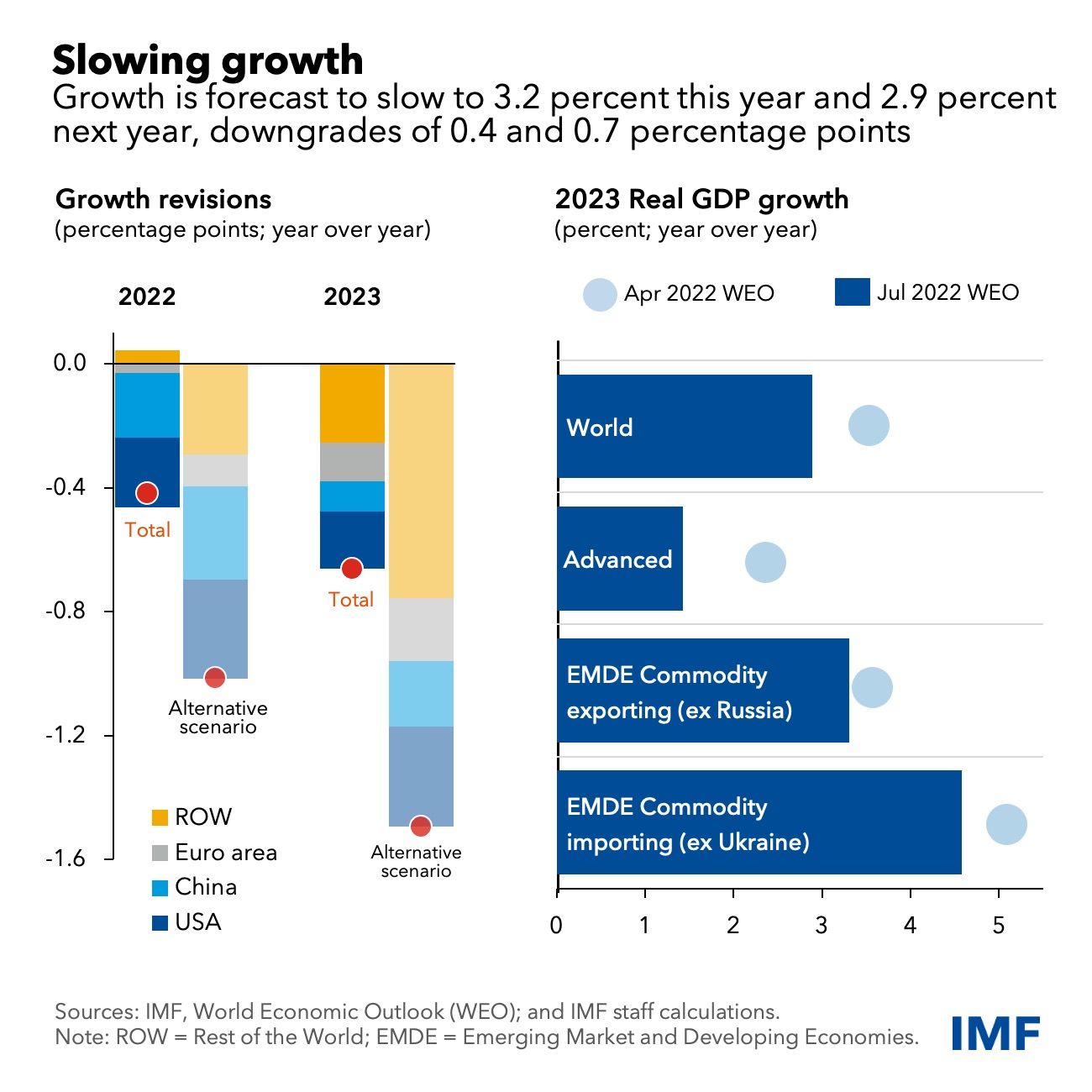
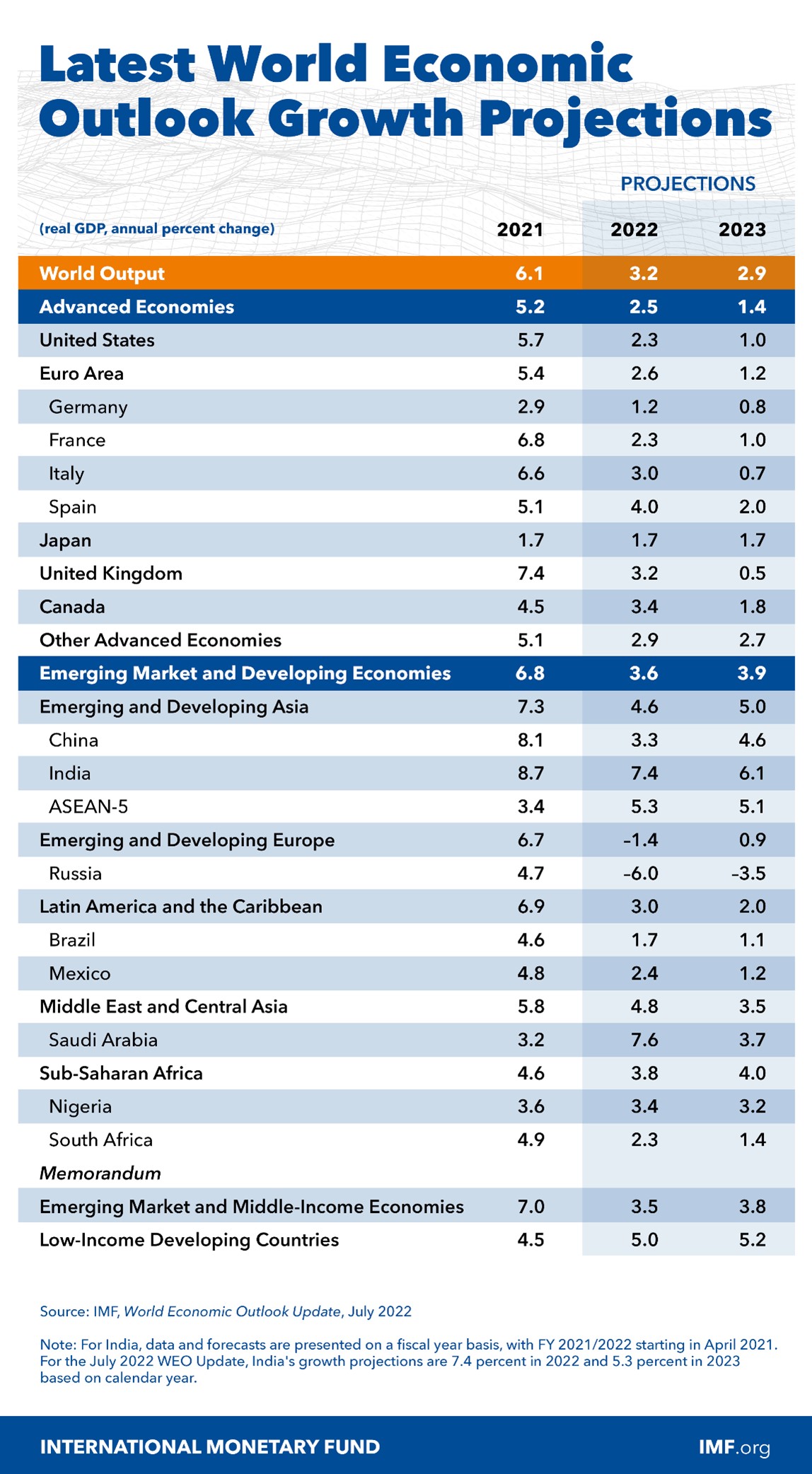
- Growth slows from last year’s 6.1 percent to 3.2 percent this year and 2.9 percent next year, downgrades of 0.4 and 0.7 percentage points from April.
- The slowdown reflects stalling growth in the world’s three largest economies—the United States, China and the euro area.
- Country-level projections in the baseline:
- United States: growth will be 2.3 percent this year and 1 percent next year.
- China: growth is pushed down to 3.3 percent this year—the slowest in more than four decades, excluding the pandemic.
- Euro area: growth is revised down to 2.6 percent this year and 1.2 percent in 2023.
Inflation dynamics
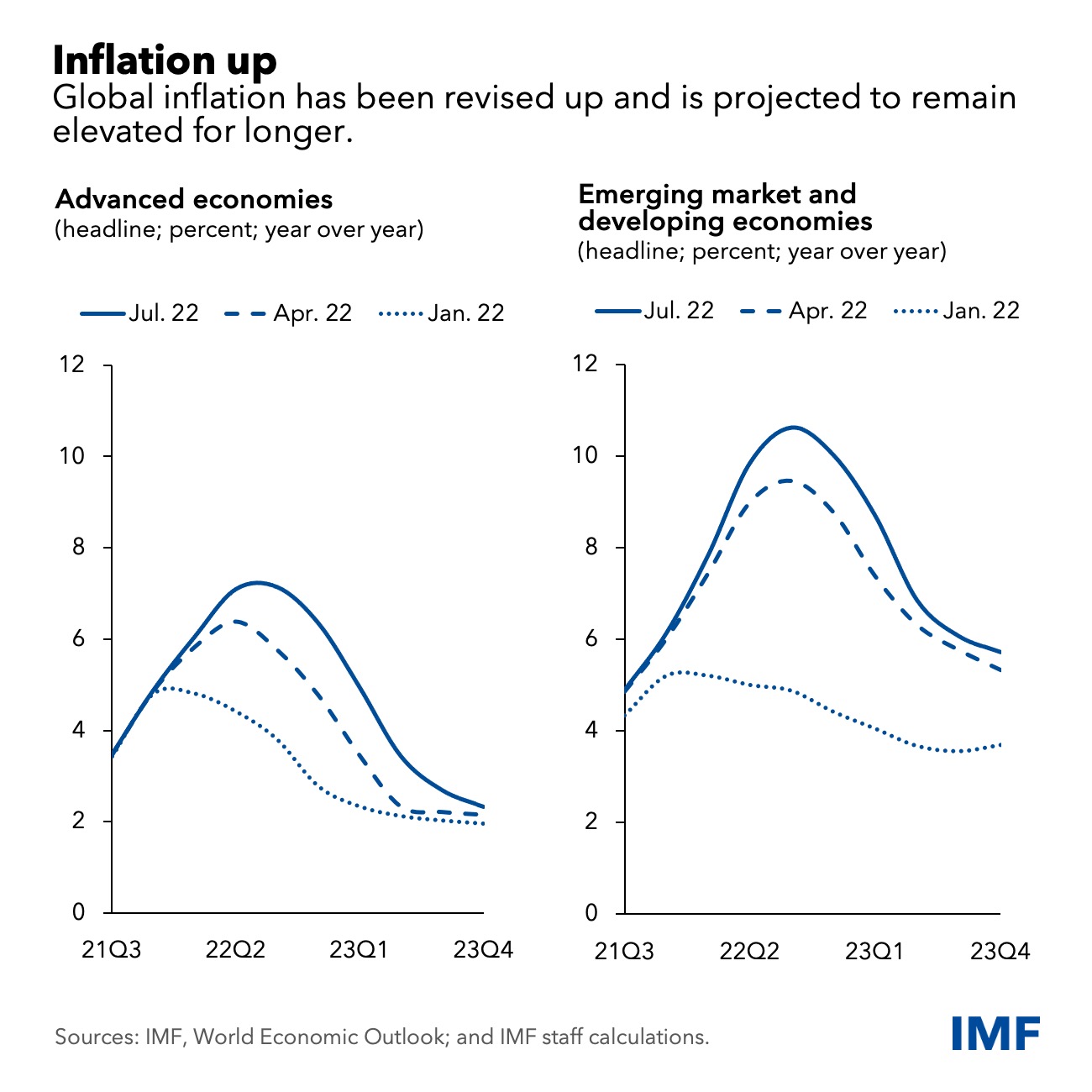
- Despite slowing activity, global inflation has been revised up, in part due to rising food and energy prices.
- Inflation projections and revisions:
- Inflation this year is anticipated to reach 6.6 percent in advanced economies and 9.5 percent in emerging market and developing economies—upward revisions of 0.9 and 0.8 percentage points respectively.
- Inflation is projected to remain elevated longer and has broadened in many economies, reflecting cost pressures from disrupted supply chains and historically tight labor markets.
Downside risks and alternative scenario
- Risks are overwhelmingly tilted to the downside, including:
- The war in Ukraine could lead to a sudden stop of European gas flows from Russia.
- Inflation could remain stubbornly high if labor markets remain overly tight or inflation expectations de-anchor, or disinflation proves more costly than expected.
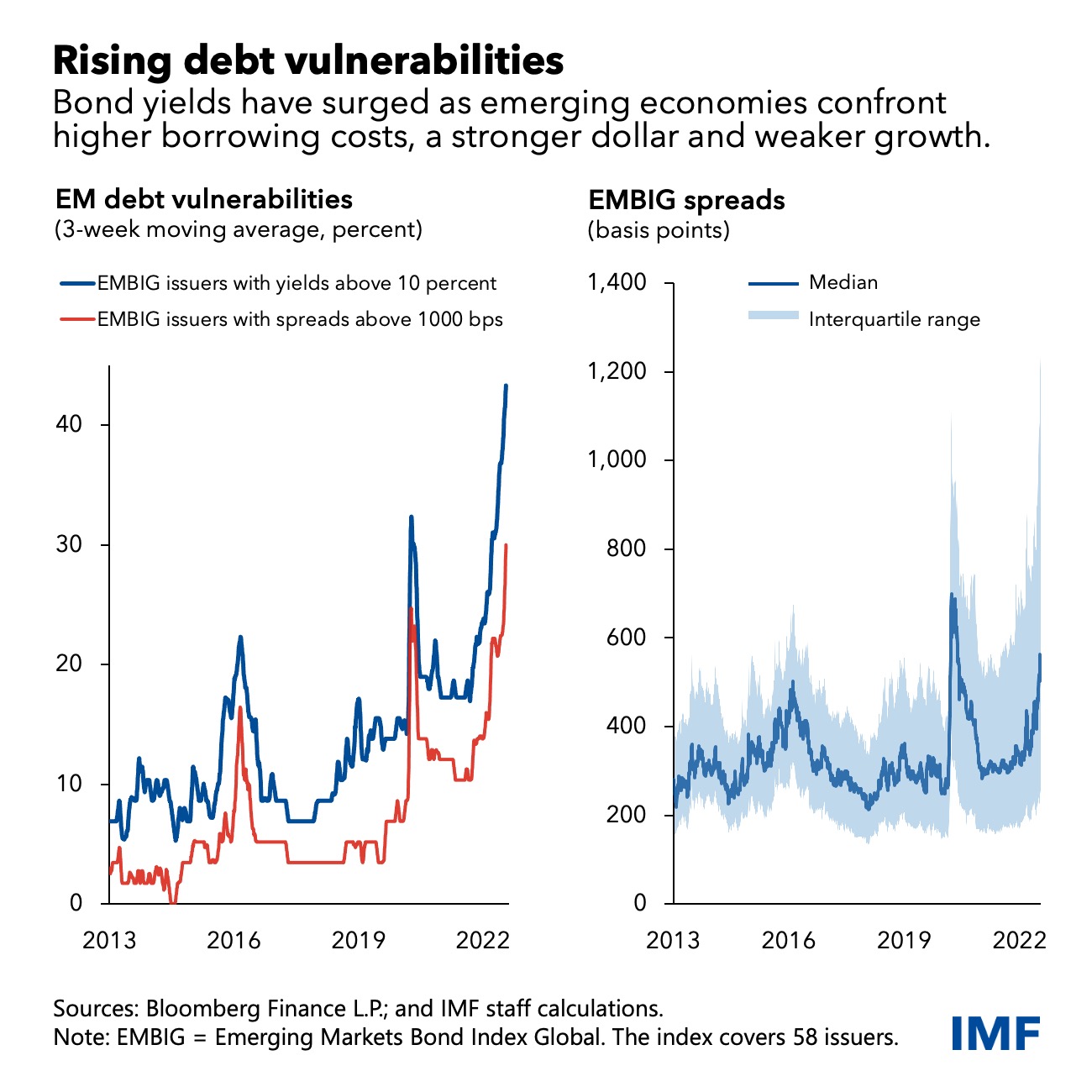
- Tighter global financial conditions could induce a surge in debt distress in emerging market and developing economies.
- Renewed COVID-19 outbreaks and lockdowns might further suppress China’s growth.
- Rising food and energy prices could cause widespread food insecurity and social unrest.
- Geopolitical fragmentation might impede global trade and cooperation.
- Plausible adverse scenario:
- If some risks materialize, including a full shutdown of Russian gas flows to Europe, inflation will rise and global growth will decelerate further to about 2.6 percent this year and 2 percent next year—a pace that growth has fallen below just five times since 1970.
- Under this scenario, both the United States and the euro area experience near-zero growth next year, with negative knock-on effects for the rest of the world.
Policy priorities — monetary and fiscal
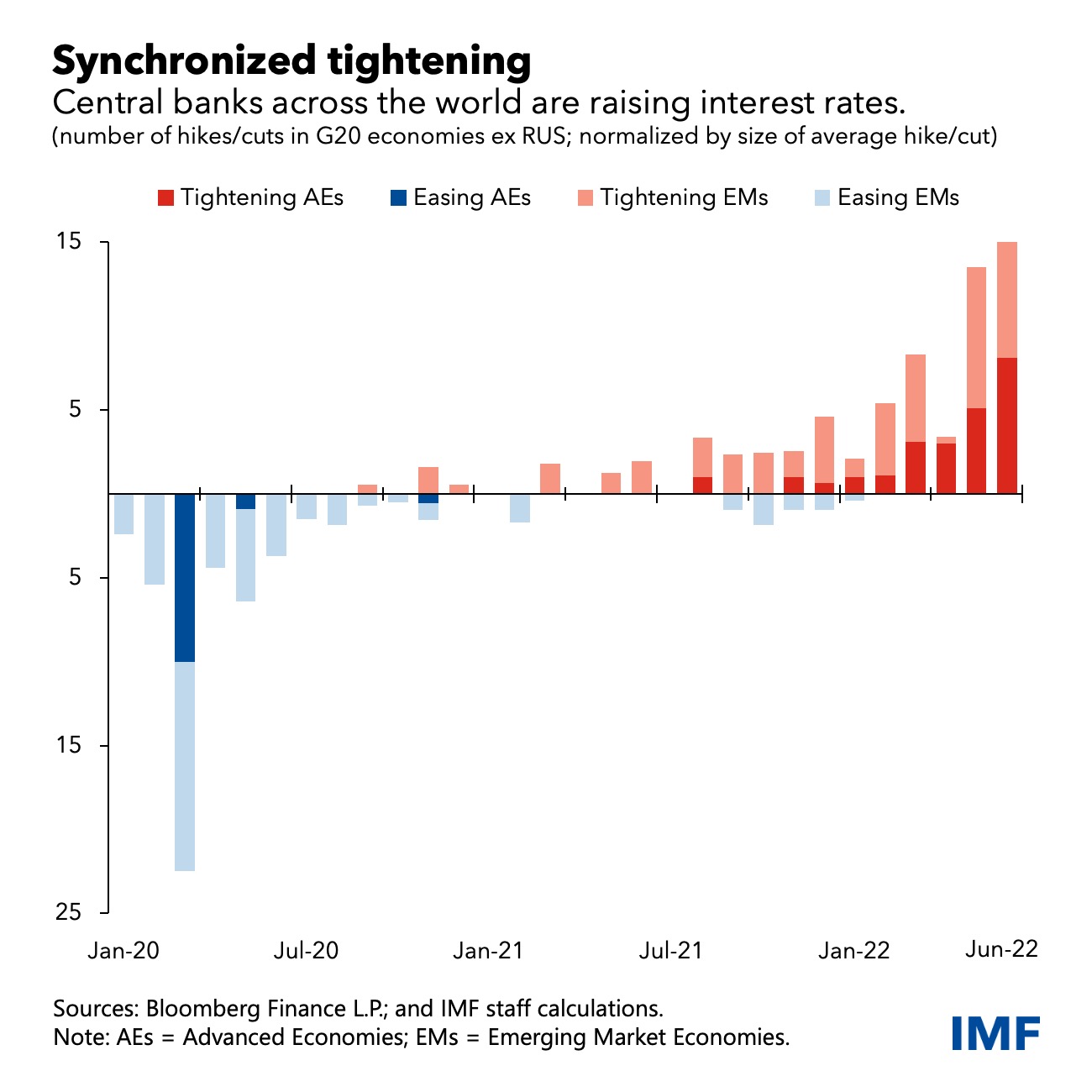
- Top priority: bring inflation back to central bank targets; central banks of major advanced economies are withdrawing monetary support faster than expected in April.
- Synchronized monetary tightening is historically unprecedented and is expected to slow global growth next year and decelerate inflation.
- Guidance on monetary policy:
- Central banks that have started tightening should stay the course until inflation is tamed.
- Fiscal policy role:
- Targeted fiscal support can help cushion the impact on the most vulnerable.
- Given stretched government budgets and the need for an overall disinflationary macroeconomic policy stance, targeted support should be offset with higher taxes or lower government spending so fiscal policy does not make monetary policy’s job harder.
Financial stability, exchange rates, and debt
- As advanced economies raise interest rates, financial conditions are tightening, especially for emerging-market counterparts.
- Policy responses:
- Appropriately use macroprudential tools to safeguard financial stability.
- Where flexible exchange rates are insufficient, be ready to implement foreign exchange interventions or capital flow management measures in a crisis scenario.
- Debt distress:
- The share of low-income countries in or at high risk of debt distress is at 60 percent, up from about 20 percent a decade ago.
- Higher borrowing costs, diminished credit flows, a stronger dollar and weaker growth will push even more countries into distress.
- Debt-resolution mechanisms remain slow and unpredictable; progress in implementing the Group of Twenty’s Common Framework is encouraging but further improvements are urgently needed.
Domestic policies for price shocks, pandemic response, and climate
- Domestic measures for high energy and food prices:
- Focus on those most affected without distorting prices.
- Governments should refrain from hoarding food and energy and instead unwind barriers to trade such as food export bans, which drive world prices higher.
- Pandemic-related actions:
- Step up vaccination campaigns, resolve vaccine distribution bottlenecks and ensure equitable access to treatment.
- Climate policy:
- Prompt multilateral action is required to limit emissions and raise investment to hasten the green transition.
- Recent pressure to turn to fossil fuels such as coal should be temporary and only cover energy shortfalls, not increase emissions overall.
- Credible and comprehensive climate policies to increase green energy supply should be accelerated urgently.
- The energy crisis illustrates that clean, green energy independence can be compatible with national security objectives.
Conclusion
- The outlook has darkened significantly since April; the world may soon be teetering on the edge of a global recession, only two years after the last one.
- Multilateral cooperation is key across climate transition, pandemic preparedness, food security and debt distress to improve prospects and mitigate the risk of geoeconomic fragmentation.
Source: Pierre-Olivier Gourinchas, "Global Economic Growth Slows Amid Gloomy and More Uncertain Outlook", July 26, 2022.
References
- our baseline forecast
- https://www.imf.org/wp-content/uploads/2022/07/WEO-Blog-Chart-1.jpeg
- https://www.imf.org/wp-content/uploads/2022/07/WEO-Blog-Chart-2.jpeg
- The war in Ukraine
- full shutdown of Russian gas flows to Europe
- https://www.imf.org/wp-content/uploads/2022/07/WEO-Blog-Chart-3.jpeg
- https://www.imf.org/wp-content/uploads/2022/07/WEO-Blog-Chart-4..jpeg
- Group of Twenty’s Common Framework
- geoeconomic fragmentation
- https://www.imf.org/wp-content/uploads/2022/07/Projections-Table-July-2022-FINAL.jpg