
IMFSurvey Magazine: Countries & Regions
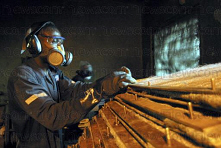
Gold worker in Obuasi, Ghana: resilient commodity exports, strong farm yields seen cushioning country from global recession (photo: Luc Gnago/Reuters)
POVERTY REDUCTION LOAN
Ghana Gets $602 Million IMF Loan, Readies Oil Production
By Peter Allum
IMF African Department
July 16, 2009
- High gold, cocoa prices help Ghana weather global recession
- Lower budget deficit to cut inflation, ease balance of payments pressures
- Fiscal administration reforms to promote prudent use of oil wealth from 2011
The IMF approved a $602.6 million loan to Ghana July 15 to help the West African nation tackle budget imbalances while preparing for the start of oil production.
The loan is the largest IMF financing package to date for an African country during the current global financial crisis.
Ghana’s 24 million people have shared Africa’s growth upswing over the past decade. Its governance and business climate ratings are among the best in sub-Saharan Africa, and its human development indicators rank in the top quarter. But, although poverty has fallen sharply, 30 percent of the population still live on less than $1.25 a day, and nearly 10 percent of the population remain undernourished.
IMF support is being provided under the Poverty Reduction and Growth Facility (PRGF). Under the PRGF-supported program, the government is targeting a substantial phased reduction of the fiscal deficit. This would cut public sector borrowing and allow Ghana to reverse the sharp deterioration in the public debt-to-GDP ratio since 2006 (see Box 1).
Program targets
• Fiscal deficit to be reduced to 9.4 percent of GDP in 2009, then to 6 percent of GDP in 2010, and 4½ percent of GDP in 2011.
• Net public debt would rise to 67 percent of GDP in 2010, up from 42 percent in 2006. By 2014, the projected fiscal correction would help reduce debt to under 60 percent of GDP.
• Inflation is targeted at 14½ percent at end-2009, falling to single digits before end-2010.
• GDP growth (excluding oil) is projected at 4½ percent in 2009, rising to 6 percent in 2011.
• Oil production is projected to start in 2011, with initial output equivalent to 17 percent of non-oil GDP.
• Net international reserves would be stabilized in 2009, before rising in 2010-11. The resulting gross reserve cover would approach 3 months of imports by end-2011. The proposed new allocation of IMF Special Drawing Rights is anticipated to strengthen reserve cover further.
Economic stewardship passed to a new government in 2009. The new administration’s first priority was to address the macroeconomic imbalances caused by highly expansionary fiscal policies in 2007–08, and respond to the risks from the emerging global recession.
Domestic overheating
Ghana’s inflation—already higher than the African average—rose from the 10 percent range in 2007 to more than 20 percent by early 2009. This partly reflected global food and fuel price shocks, but more importantly an overheated domestic economy due to highly expansionary fiscal policies and rapid credit growth.
The fiscal deficit, which had already risen to 9 percent of GDP in 2007, rose to 14½ percent of GDP in 2008, boosted by strong pre-election government spending growth, notably including high public sector wage increases, petroleum product subsidies, and new infrastructure projects.
Despite some tightening of monetary policy, rising import demand increased the external current account deficit to more than 19 percent of GDP in 2008. Notwithstanding generally strong capital inflows, this deficit proved unfinanceable, resulting in a drawdown of official reserves and a 25 percent depreciation of the currency through 2008.
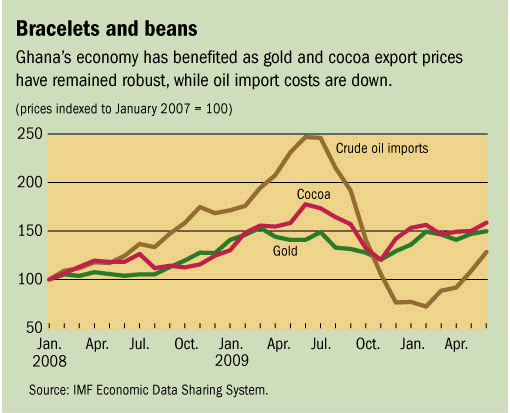
Ghana’s macroeconomic imbalances were compounded from end-2008 by the global financial crisis. Commodity prices moved in Ghana’s favor, with gold and cocoa prices—its main exports—remaining strong, while oil import costs receded (see chart). However, this is projected to be more than offset in 2009 by a slump in private remittances and foreign direct investments. Consistent with this, the currency remained under pressure through May 2009, and official reserves declined further in the first quarter, to a little under 2 months of import cover.
Resilient commodity exports, combined with strong, rain-fed agricultural yields, are projected to cushion Ghana from the global recession. Provisionally, growth is projected to slow to 4½ percent in 2009, rising to 5 percent in 2010, but risks may be on the downside. Spillovers from the weak global economy may broaden, and a pullback in banking credit is possible following a recent deterioration in loan performance.
Adjustment program
In June 2009, the authorities adopted new budget measures to ensure that the 2009 deficit target is met. Given the limited scope to expand public borrowing, Ghana has no scope for countercyclical fiscal policy, and the government stands ready to cut spending further if the slowing economy leads to revenue shortfalls.
Structural reforms
• Public expenditure management. Steps are being taken to use information technology more effectively to monitor and control public spending. This will be critical to avoid the past tendency for spending to exceed budgeted levels, giving rise to distortions and domestic payments arrears.
• Public sector reform and payroll management. Ghana’s public sector wage bill has risen sharply over the past decade, in relation to GDP. Planned reforms to the wage structure will be complemented by steps to strengthen oversight and control of recruitment, and initiate a rightsizing of public agency staffing.
• Tax policy and revenue administration. Although oil revenues will provide near-term relief, fiscal sustainability requires steps to modernize revenue administration, notably by integrating Ghana’s three tax agencies. The government also intends to scale back tax exemptions, and simplify administration of the value-added tax.
For 2010, further budget savings of about 3½ percent of GDP will be needed. The government intends to meet this goal through new revenue mobilization, tight oversight over the public sector wage bill, and by avoiding energy subsidies, which have been costly in the past.
The start of oil production in 2011 is projected to generate new budget resources of up to 7 percent of GDP, on an annual basis. The government intends to dedicate revenues partly to reduce Ghana’s fiscal deficit and strengthen debt sustainability, and partly to finance growth-promoting infrastructure investments, helping Ghana meet its goal of middle-income status over the next decade.
Since proven oil reserves are modest, and peak production could be relatively short lived, there will be a premium on using oil wealth wisely. The government’s reform program includes a number of steps to help in this regard (see Box 2).
Comments on this article should be sent to imfsurvey@imf.org