Where the IMF Gets its Money
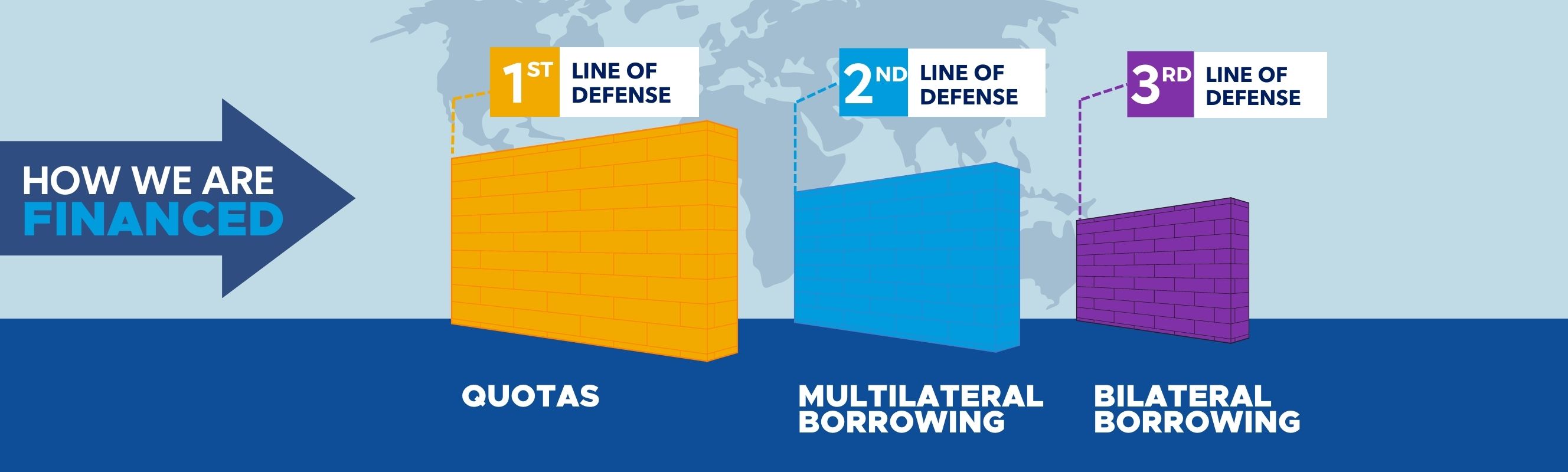
Most resources for IMF loans are provided by member countries, primarily through their payment of quotas. Concessional lending and debt relief for low-income countries are financed through separate contribution-based trust funds. |
The quota system
Each member of the IMF is assigned a quota, based broadly on its relative size in the world economy, which determines its maximum contribution to the IMF's financial resources. Upon joining the IMF, a country normally pays up to one-quarter of its quota in the form of widely accepted foreign currencies (such as the U.S. dollar, euro, yen, or pound sterling) or Special Drawing Rights (SDRs). The remaining three-quarters is paid in the country's own currency.
Quotas are reviewed at least every five years. The 1998 quota review led to a 45 percent increase in IMF quotas. The reviews concluded in January 2003 and January 2008 resulted in no change in quotas. Initial ad hoc quota increases in 2006 as the first step in a two-year program of reforms raised quotas by another 1.8 percent. Total quotas are SDR 217.4 billion (about $358 billion as of end-March 2008). As part of the quota and voice reform process, further ad hoc quota increases were recommended to the Board of Governors on March 28, 2008.
Gold holdings
Valued at current market prices, the IMF's gold holdings are worth about $103 billion as of end-March 2008, making the Fund the third largest official holder of gold in the world. However, the IMF's Articles of Agreement strictly limit its use. If approved by an 85 percent majority of voting power of member countries, the IMF may sell gold or may accept gold as payment by member countries; but the IMF is prohibited from buying gold or engaging in other gold transactions.
The IMF's lending capacity
The IMF can only use its quota-funded holdings of currencies of financially strong economies to finance lending. The IMF's Executive Board selects these currencies every three months. Most are issued by industrial countries, but the list also has included currencies of developing countries such as Botswana, China, and India. The IMF's holdings of these currencies, together with its own SDR holdings, make up its usable resources.
The amount the IMF has readily available for new (non-concessional) lending is indicated by its one-year forward commitment capacity. This is determined by its usable resources, plus projected loan repayments over the subsequent twelve months, less the resources that have already been committed under existing arrangements, less a precautionary balance. As of end-February 2008, the Fund's one-year forward commitment capacity was SDR127.8 billion (or about $206 billion).
Borrowing arrangements
The IMF maintains two standing borrowing arrangements-the New Arrangements to Borrow (NAB) and the General Arrangements to Borrow (GAB)-with a total borrowing capacity of SDR 34 billion (about $55 billion). If the IMF believes that its forward commitment capacity might fall short of its members' needs-for example, in the event of a major financial crisis-it can activate these arrangements. Their renewal was approved in 2007 for another five years starting in 2008.
IMF concessional lending and debt relief
The IMF provides two primary types of financial assistance to low-income countries: low-interest loans under the Poverty Reduction and Growth Facility (PRGF), and the Exogenous Shocks Facility (ESF), and debt relief under the Heavily Indebted Poor Countries (HIPC) Initiative and the Multilateral Debt Relief Initiative (MDRI). These resources come from member contributions and the IMF itself, rather than from the quota subscriptions. They are administered under the PRGF-ESF, PRGF-HIPC, MDRI-I and MDRI-II Trusts, for which the IMF acts as Trustee.
The PRGF-ESF Trust was established to provide lending in support of PRGF and ESF arrangements and to subsidize the market rate of interest down to the concessional interest rate of 0.5 percent per annum. Loan resources close to $24 billion have been committed by 17 contributors to the Trust, while a larger number of IMF member countries have made subsidy contributions.
The PRGF-HIPC Trust was established to provide debt relief under the HIPC Initiative and to subsidize PRGF lending. The resources available to the Trust consist of grants and deposits pledged from 93 member countries and contributions from the IMF itself. The bulk of the IMF's contribution comes from off-market gold transactions made during 1999-2000.
The MDRI-I and MDRI-II Trusts were established to provide debt relief under the MDRI. Financed from the IMF's own resources of SDR 1.5 billion in the Special Disbursement Account (SDA), the MDRI-I Trust is to provide debt relief to countries (both HIPCs and non-HIPCs) with per capita incomes at or below $380 a year (on the basis of 2004 gross national income). The MDRI-II Trust is to provide debt relief to HIPCs with per capita incomes above $380 a year, with financing from bilateral resources of SDR 1.12 billion transferred from the PRGF-ESF Trust.
In addition to the above, there is a separate administered account financed by a group of member countries for interest subsidies on IMF emergency assistance to PRGF-eligible countries in post-conflict or natural disaster situations.
| Fast facts on IMF Resources | |
|---|---|
| (as of end-February, 2008) | |
| Total resources: | $362 billion |
| Total usable resources: | $267 billion |
| IMF one-year forward commitment capacity: | $206 billion |
| Non-concessional credit outstanding: | $10 billion |
| Concessional credit outstanding: | $6.1 billion |
| Gold holdings: | 103.4 million fine ounces |