|
Speeches
People's Republic of China and the IMF India and the IMF Japan and the IMF Republic of Korea and the IMF Free Email Notification Receive emails when we post new
items of interest to you.  |
|
|
|
The Unfinished Reform Agenda in Asia:
Address by Hubert Neiss |
|
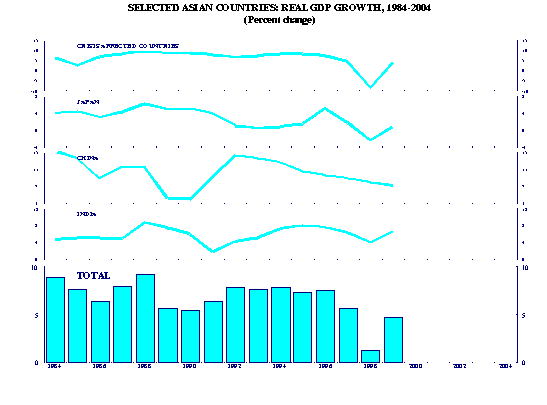
Just as the crisis came unexpectedly and proved to be sharper than initially envisaged, the recovery has generally come more quickly--and more strongly--than expected. Seen in the larger context of Asia's long-term growth performance, the recent crisis could almost be seen as a temporary dent in Asia's sustained economic growth (Chart 3). Whether or not this is the case will depend on how strongly the present recovery can be carried forward in the coming years.
There are a number of preconditions for sustaining the resurgence of the Asian economies. The most important ones are:
I will concentrate on the third point because this is fully within the power of Asian governments, and probably the most crucial among the conditions. * * * Sound macroeconomic management has been crucial to help stabilize the financial markets in the crisis countries and support an early return to growth. There can be no doubt that safeguarding and entrenching macroeconomic stability will remain essential. However, by itself, it will not be sufficient to restore vibrant economies in Asia. A much stronger emphasis on structural, institutional, and other governance-related reforms is needed to sustain high growth. With macroeconomic policies already supportive of recovery in virtually all the countries, the further contribution that can be made by macro policies alone is quite limited. In Japan, fiscal and monetary policies to stimulate demand are already reaching their limits, and the same is possibly true in China. And, over the medium term, most countries, including India, will have to move towards fiscal consolidation to maintain financial stability and a manageable debt position of the public sector. The unfinished structural agenda in all Asian countries, not just the crisis countries, will, therefore dominate the economic policy discussions over the next years, and structural policies will be a major part of the IMF's policy advice in program negotiations as well as in the annual consultation discussions. Structural policies include a wide range of measures, and the particular emphasis will depend on the specific country, as all countries have different features and different needs. Nevertheless, there are at least three important areas which call for action in most Asian countries:
Substantial progress has been made in financial sector restructuring in the crisis countries and in Japan, and efforts are also being made in India and China. The remaining agenda for Japan includes strengthening the smaller regional banks and credit co-operatives, introducing a limited deposit insurance scheme, and going ahead with the planned mergers of larger banks. The crisis countries must complete the recapitalization of banks, collect debts, and dispose of collateral assets. The resulting revenue will help offset the high budgetary cost of bank restructuring. In addition, all countries have to build up a more competent and independent banking supervision authority. China will also have to deal with non-performing loans, and recapitalize financial institutions. Corporate restructuring is the other side of the coin of bank restructuring. To finance the renewed growth in output, corporations need credit, and the restructured banks should be in a position to lend again. But to make damaged corporations credit worthy, their balance sheets have first to be cleaned up through debt restructuring, debt write offs, and conversion of debt to equity. This will bring down the high debt-to-equity ratio. However, broader corporate restructuring is also needed to restore efficiency, competitiveness, and profitability. The measures include changes in management structure, closure of non-profitable assets, elimination of excess capacity, concentration on core activities, sale of affiliates, and mergers. Many countries also need to move forward with broader economic restructuring, and institutional reforms. These are needed to improve the environment for private investment, especially to attract new direct foreign investments, and enhance productivity growth. Institution building in some key sectors is also an essential part of the agenda in some of the crisis countries. For example, there is much consensus on the need for reforms to the court system in Indonesia and Thailand, in order to underpin the forward movement that is needed in corporate restructuring. Most countries need a variety of measures to raise the efficiency of their economies through further deregulation, competition and anti-monopoly policies, and trade liberalization. Liberalization of the capital account remains on the agenda for most crisis countries as well as for China and India. It has to be carefully implemented and must go hand in hand with the strengthening of the banking system. There are other important structural areas. Liberalization of the labor market is urgent for the more advanced economies of Japan and Korea (just as it is urgent for most European economies). The crisis-affected countries, as well as China and India, should also give priority to establish an effective social safety net. This includes unemployment insurance, retraining schemes, and old age pensions. Adequate social protection is not only necessary to maintain fairness and human dignity. It also allows governments to proceed with needed structural reforms, without causing social hardships that inevitably lead to social disturbances and instability. * * * To look into the future, let's make two assumptions:
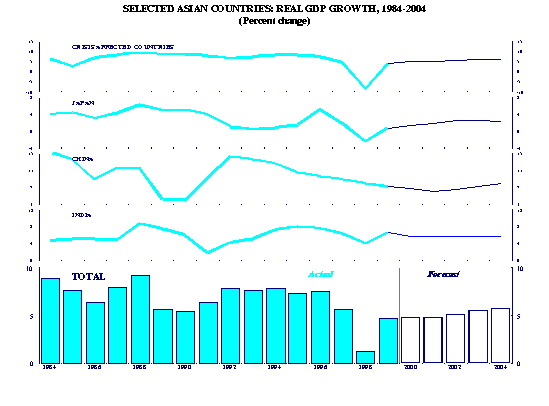
With regard to the second assumption, our present forecasts point, indeed, in this direction: while growth in the US economy will inevitably slow down at some stage, the impact on world growth could be more than offset by stronger growth in Europe and in Japan. World growth, which rose from some 2 ½ percent to 3 ½ percent last year, is expected to further accelerate to close to 4 percent this year. A correction in the US stock market has been widely expected and, were it to occur, there is every reason to believe that it could take place without a general loss of confidence and a major disruption in financial markets. With regard to the first assumption, on policy performance, we have to wait and see how vigorously governments will continue their present reform course, and whether they will avoid reform fatigue and complacency. If they are successful, we can be confident about the sustainability of Asia's resurgence, and we can look at a scenario where the Asian crisis marks only a temporary interruption of the region's rapid development (Chart 4).
IMF EXTERNAL RELATIONS DEPARTMENT
| |||||||||||||