




Transcript -- Press Conference on the World Economic Outlook
April 26, 2001
Thursday, April 26, 2001
Washington, D.C.
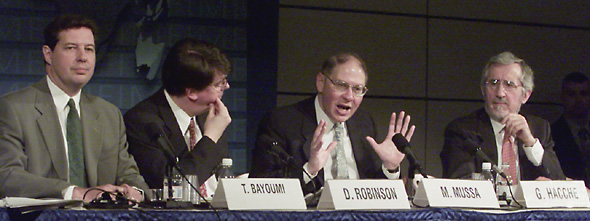 from left to right: Tamim Bayoumi, David Robinson, Michael Mussa, Graham Hacche |
Participants:
Michael MUSSA, Economic Counselor and Director of the Research Department, IMF
David ROBINSON, Assistant Director, Research Department, IMF
Tamim BAYOUMI, Division Chief, World Economic Studies Division,
Research Department, IMF
Graham HACCHE, Deputy Director, External Relations Department, IMF
Proceedings:
MR. HACCHE: Good morning. Let me say, first, that there is simultaneous translation of this briefing. You will find Spanish on channel 2, French on channel 3, and English on channel 4 of your headsets.
Welcome to this press briefing on the IMF's latest report on the World Economic Outlook, which will provide part of the documentation in the usual way for the meeting of ministers and central bank governors at the IMFC on Sunday.
The contents of the World Economic Outlook and this press briefing are under embargo until 11 a.m. today.
I am Graham Hacche, Deputy Director of the External Relations Department of the IMF. To my right, to answer your questions, are, first, Michael Mussa, Economic Counselor and Director of the Research Department, under whose general direction the WEO is prepared. To his right is David Robinson, Senior Advisor in the Research Department, who directs the World Economic Outlook project. And to David's right, is Tamim Bayoumi, Chief of the World Economic Studies Division.
Before turning to Mr. Mussa for his opening remarks, perhaps I could draw your attention to something that he may omit to mention. It is easy to miss it.
On pages 145 to 149 of the report, you will find the Chairman's summing up of the Executive Board's discussion of this report. On page 149 you will see in the last paragraph the Board's expression of their appreciation for the outstanding contribution of Mr. Mussa to the work of the Fund, and particularly for his oversight and direction of the World Economic Outlook over the past ten years.
That paragraph is there because this is Mike's last WEO as he will be leaving his current position in the coming months.
By my count, this is also his 22nd WEO, if you include the three interim reports written to assess the implication of some inconveniently timed financial crises.
As a former member of the WEO team myself for ten of those 22 issues I know how much Mike has contributed to the development of this series of reports: His intellectual leadership; his insistence that the projections we publish should be as realistic as possible; his openness about how he views the risks around the projections; his insistence that the WEO focus directly on the issues faced by policy makers; and his rare ability to see and explain with clarity things that to most others seem more difficult and complex. All these have contributed vitally to the avid attention that the WEO receives, perhaps including the demand for leaks, which our indicators suggest has recently been at an all-time high.
His anecdotes and jokes have probably contributed somewhat less to the WEO's success, but they have certainly improved our job satisfaction. I have sometimes wondered if the reports that you, the press, have written about the WEO over the past decade would have been as interesting and as extensive as they have been if it had not been for his ability to make the economic outlook more entertaining than we ever had a right to expect.
So, thank you, Mike.
MR. MUSSA: Thank you very much, Graham. It has been a pleasure over the years to participate in the preparation and dissemination of the World Economic Outlook. And, I am proud that in the ten years that I have served, we have had the only decade in which we have not had something that would have been classified as a world recession. That is primarily because the crises were more distributed in time and space, so we never got them coordinated at the same moment. Hopefully we'll be able to avoid that in the future.
In my remarks this morning, I will comment briefly on the global economic outlook and key policy issues for the main industrial countries, then turn to David Robinson and Tam Bayoumi for some brief remarks on the rest of the policy and analytical content of the present WEO.
At the WEO press conference last September in Prague, we anticipated that global growth this year would slow somewhat from the 5 percent pace of last year to a still vigorous 4.2 percent growth rate, a broadly desirable slowing in view of overheating pressures beginning to emerge in some key economies. Now, it is clear that global growth is slowing more than was anticipated, or is desirable.
The IMF staff's forecast for world economic growth for the year has been cut a full percentage point to 3.2 percent. For the United States, which has been the mainstay of global expansion in the past decade, growth this year is forecast to be only 1.5 percent, down from almost 5 percent last year and from an earlier forecast of over 3 percent for this year. With economic sluggishness now expected to persist into the second half of this year, the projection for year-over-year growth for the U.S. in 2002 has been reduced to 2.5 percent, still about a percentage point below the estimated potential growth rate of the U.S. economy.
The slowdown in the U.S. economy is expected to be reflected, although to a somewhat lesser extent, in Canada, where growth both this year and next is projected to be just under 2.5 percent. The U.K. economy also appears to be slowing somewhat, with growth now expected to fall somewhere below 3 percent.
In the euro area, growth this year is now expected to be only 2.4 percent, a full percentage point less than we expected last September.
In Japan, the situation is even more worrying. Growth for this year is now forecast to be barely over 1/2 percent, and growth for next year is now projected to reach only 1.5 percent.
Among developing and emerging market economies, Asia is expected to be hit by the slowdowns in North America and Japan, by the global downturn in telecoms and high technology, and by adverse domestic developments in several countries. Growth forecasts for this year have generally been cut by between 1 and 3 percentage points, relative to six months ago.
China and India are important exceptions where, with greater relative isolation from the rest of the global economy, growth is expected to be reasonably well sustained.
Latin America, Mexico, Central America and the Caribbean, will feel the effects of the pronounced U.S. economic slowdown. So far, growth forecasts for most of South America have been relatively little revised.
However, with the global slowdown, and with the recent problems in Argentina, I expect that by the time of the next WEO reality will have made a somewhat greater dent on the IMF staff's continued optimism for South America.
For the Middle East and North Africa, the continued relative buoyancy of world oil prices, supported by OPEC production cuts, is reason for relative optimism about growth. This also applies to the oil exporters south of the Sahara, but not generally to exporters of other commodities.
For the transition countries, relative optimism still seems warranted provided that growth prospects for Western Europe do not deteriorate significantly further.
Adding it together, we are clearly looking at a substantial and broadly distributed slowdown in global economic growth this year. But not, or at least not yet, at a likely global recession. There are clearly risks on the downside, but there is also some potential for upside surprises relative to our baseline.
Relative optimism is importantly supported by the vigorous policy responses already undertaken in several key countries. And, by the room that generally exists for even more vigorous action should downside risks appear more threatening.
The U.S. Federal Reserve has already appropriately cut overnight interest rates 200 basis points, and further moderate cuts may be anticipated if incoming evidence confirms continuing weakness. Meanwhile, enactment of substantial tax cuts now seems certain to begin to provide support to demand later this year.
In Japan, policy room is clearly more limited. Under the new monetary policy framework, stimulative actions beyond the return to zero short-term interest rates can and should be used to combat deflation. And, the new prime minister has usefully placed very high priority on aggressive efforts to recognize and to resolve problems in the Japanese financial system. This is essential to lay the foundation for stronger sustained growth and to signal the type of change in policy approach that is needed to reinvigorate confidence.
In most other industrial countries, improvements in fiscal positions in recent years are now allowing for tax reforms that will help to support demand in a period of global slowdown. Also, with inflation generally well contained in most other industrial countries, central banks have begun to cut policy interest rates in measured efforts to combat economic weakening.
The euro area is so far the one important exception to the move toward monetary, but not an exception for fiscal easing. With growth appearing likely to be better sustained than in the United States or Japan, and with headline inflation still running above its medium-term desired ceiling, the ECB has kept policy interest rates on hold since last autumn, and did so again today. This generally has been a prudent policy. However, as growth and growth prospects have softened for the euro area, and for the global economy, with the implications that inflationary pressures should be expected to be less of a concern going forward, the balance of considerations for ECB policy has clearly been shifting toward the desirability of easing. In my view, last month that balance reached the point where an initial step of easing was called for. On purely domestic grounds, the balance was at least neutral, and from a global perspective the case for easing was unambiguous.
From the global perspective, it is noteworthy that in recent quarters, GDP growth in the euro area has exceeded domestic demand growth, implying that the euro area has been subtracting demand net from the rest of the world. Moreover, according to virtually all market commentaries, disappointment about the lack of a more forceful pro-growth policy in the euro area is the key reason why the exchange rate of the euro has depreciated again in recent weeks, a development that seems likely to keep the euro area in the posture of subtracting demand net from the rest of the world. In a period when general economic slowdown is the main problem and when inflation is not likely to be a continuing threat, the euro area, the second largest economic area in the world, needs to become part of the solution rather than part of the problem of slowing global growth.
MR. ROBINSON: Tam and I will briefly review the remaining chapters in the World Economic Outlook. Before I do this, I would like to very much on behalf of the WEO team second the remarks that Graham has made about Mike and his contribution to the World Economic Outlook which those of us inside know is extremely substantial, and state that he will be very greatly missed.
Chapter 2 consists of three essays on current policy issues. The first looks at the impact of the global correction on technology stocks, which has averaged 20 to 30 percent of GDP in many advanced economies, and its impact on growth and demand. It finds that there are indeed significant effects in North America and the United Kingdom, although they're not very different from those from nontechnology stocks. Interestingly, in Europe there is also a significant effect, although we find that the impact of nontechnology stocks there is actually rather small.
Nonetheless, this suggests that the decline in technology stocks will have a significant impact on demand looking forward.
The second essay, building on earlier work in the last WEO, looks at the determinants of exchange rate movements among the major currencies, and particularly the strength of the U.S. dollar and the weakness of the euro. The essay sets out some evidence supporting the new conventional wisdom, if you like, that movements in the euro dollar exchange rate have been associated with equity flows from the euro area to the United States, and with relative expected growth rates between the two areas.
Equity flows do not, however, explain movements in the yen-dollar rate, which appear to be more affected by current account developments and long-term interest rate differentials.
The last essay is on a rather different topic. It looks at Africa's integration into the global economy. Africa's share of global trade has declined steadily, and the World Bank has calculated that the loss of market share since 1950 has cost about one fifth of GDP. The essay finds evidence that Africa does, indeed, "undertrade" relative to other developing countries, despite substantial trade liberalization efforts by many countries in Africa during the 1990s.
This suggests that further trade liberalization, and I would say streamlining of what has become a very complex network of regional trade agreements in Africa, is an important element of the policy agenda.
But, Africa's trading partners, importantly, must also play their role through eliminating barriers to African and other developing country exports. And here, I think the recent moves by the European Union and some other countries are, indeed, welcome, but certainly much more remains to be done.
MR. BAYOUMI: The remaining two chapters of the World Economic Outlook look at two specific issues, namely the recent improvement in fiscal balances in most advanced countries and the same phenomena in terms of inflation performance in emerging markets. In terms of the fiscal performance in advanced countries, several issues stand out. The first is that these improvements rest largely on expenditure restraints rather than tax increases. There is a substantial body of evidence indicating that expenditure restraint can have longer lasting impact on the fiscal position than tax increases.
In addition, the present improvement has occurred in a context of a range of newly adopted fiscal rules, which also tend to make improvements, will also tend to make the improvements longer lasting, although it will be interesting to see how fiscal positions respond to the current global economic slowdown.
The last part of the essay looks at the fiscal challenges crated by population aging in the advanced countries. On an international level, the increased numbers of dependents to workers in advanced economies can be contrasted with the fall in this ratio in developing countries. This implies that, in addition to domestic pension system reforms, part of the solution to population aging can come through international movements of financial assets, trading goods, and migration.
Turning to chapter 4, this documents extraordinary improvement in the price performance in emerging markets, where inflation on average across all markets has fallen to rates not seen since the 1930s. This improvement seems to reflect a number of factors. On a global scale, the improvements in inflation in advanced countries has clearly held both in terms of providing a more stable anchor for developing countries in terms of their monetary policies, and also providing improved operating rules for the monetary regime, including through inflation targeting.
On the domestic side, the move to hard pegs or inflation targeting has also helped, particularly when accompanied by substantial fiscal consolidation effort. Here, I would particularly stress the connection between these regimes and using seigniorage to fund fiscal operations. In a hard peg, the use of seigniorage is largely eliminated, while an inflation-targeting regime requires an independent central bank, which also implies that the government does not have direct recourse to monetary financing. These regime changes are important as fiscal profligacy is often associated with high inflation.
QUESTION: Regarding your policy recommendations to the new Japanese government, the prime minister has been saying that his economic reforms would involve real pain, namely negative economic growth for a year or two. Is such a scenario acceptable given the current state of the world economy? Also, if the Bank of Japan would implement its new monetary policy framework aggressively as you have suggested, are you expecting that the yen will depreciate further and that Japan would rely more on exports? Is such a scenario acceptable to you also?
MR. MUSSA: I think it is true, that the Japanese economy does need important structural reform, and a number of those structural reforms do involve short-term economic pain. However, I do not think that negative growth in the Japanese economy overall is necessarily associated with those adjustments. A key area in which adjustment is needed is in the balance sheets of Japanese financial institutions, where a large volume of nonperforming loans needs to be now more fully recognized and dealt with in a financial sense, and where some of the firms that have been kept afloat by so-called evergreening of those loans need to be dealt with.
The adjustment of balance sheets, including possibly the injection of further public funds, does not in and of itself harm economic growth. Making the Japanese financial system more profitable on a sustained basis, which does necessarily involve some downsizing of their staffs and so forth, in number of offices, is likely to involve some negative impact on growth in that sector, but not for the economy as a whole. Some of the corporate sector restructuring, the closing down of businesses that are not now and probably have not been for sometime economically viable, would also imply some loss of jobs. We don't think that is of such a broad scale that it would imply negative growth for two years for the economy as a whole.
In terms of the impact of the Bank of Japan's use of its room for maneuver to expand liquidity under the new monetary policy framework, I think it is reasonable to anticipate, as we have already seen, that will tend to put downward pressure on the yen. Modest further depreciation of the yen should not in our judgment be a matter of concern for Japan or for the international community, in view of the very high priority that we all need to put on seeing a reinvigoration of growth in Japan.
If depreciation were to become very large, say, toward or even beyond the low point of the yen in June of 1998, then probably some signal of official resistance to excessive depreciation would be useful; a weak yen does assist the Japanese economy in terms of export growth, but, given the weakness that already exists, further weakening beyond a certain point is not productive in that regard, and tends to create problems elsewhere in the world economy.
QUESTION: Back in 1998, when the world economy was facing certain difficulties, the U.S. acted as a locomotive of world economic growth and helped pull the world economy out of possible recession. Obviously, neither the U.S. nor Japan is really in a position to do that at the moment given imbalances and the problems they have. You seem to be suggesting, you think Europe could take up some of that slack, if only it changed its policy mindset, that it has the potential to act as a locomotive for world growth. Do you think that is the case, and is there anything from stopping Europe from doing that, apart from its problem realizing that inflation is probably not that big of a problem in the euro zone or globally?
MR. MUSSA: I think that with the U.S. economy, which is slightly more now than a 10 trillion dollar economy, and Japan, which is a 5 trillion dollar economy, both slowing down quite considerably, I think it is unreasonable to expect that the euro area or anything else is going to keep global growth near 5 percent or even near 4 percent in the current year. When we had the Asian economic slowdown, the combined GDPs at market exchange rates of the Asian economies that were in deep crisis was about 1 trillion dollars, so it is not the same issue of relative magnitude.
We don't think the euro area in that sense can replace the slowdown that is occurring elsewhere among the major industrial countries, nor should euro area economic policies be directed at such an objective that would be in our judgment unachievable. There is the problem that with GDP growth slowing in Europe, and indeed with demand growth in Europe slowing even below GDP growth, Europe is, the euro area in particular, actually making a negative contribution vis-a-vis the rest of the world, and we think they should be able to do somewhat better than that and contribute something positive, not only to strengthen their own growth performance some, but also to contribute a net positive contribution to growth in the rest of the world at a time when other things are going through a period of consolidation. We think there is room for that contribution, but one should not overestimate its quantitative magnitude.
QUESTION: Last year at this time while the spring meetings were being conducted simultaneously there was a call in Cuba of 80 African nations, the Group of 77, and others were represented there, calling for a united Africa or united states of Africa to help handle some of these challenges and concerns that you raised here. Earlier this week the Bank as well as IMF said we have gone as far as you could in providing debt relief to those poor countries, and the onus is now on richer countries to assist in that effort, and that continuing aid flows and access to rich country markets were more important to poor country's plans to escape poverty, and debt relief. The question basically is, with this in mind and with the elements Mr. Robinson cited in the report, how important is it for an organized Africa or united states of Africa or African united front, how critical is that to the crisis that you recognize in Africa, being that you do have this GDP off by a fifth in relative terms to other poor countries?
MR. MUSSA: In terms of the impact on Africa of the global slowdown, and Mr. Bayoumi may comment more, it is not expected to be exceptionally large. There has been some weakening of non-oil commodity prices, and that is a negative factor for a number of African economies, but the weakening in commodity prices has not been that great as of this stage. And, the principle trade links of much of Africa are much more with Europe than they are with either North America or Japan.
That being said, the situation in Africa in terms of the magnitude of the economic problems that it continues to confront is immense, so one certainly takes solace from the fact that they're not much affected by the present global economic slowdown. What is needed to get both going on a better sustained basis across broader regions of Africa, the international community has devoted considerable attention to this effort, and no one has denied that debt relief is an important contribution to that from the international community.
Most of the debt of sub-Saharan Africa is to the bilaterals. The debt to the multilateral institutions is a comparatively small fraction of that total, and the debt to the Fund is a very small fraction of that total; significant for a couple of countries, but not more broadly.
And the broad-based effort to give relief on the debt is a useful one, but the international community insists, and we believe rightly so, that needs to be combined with efforts within these countries to use the flexibility that is provided by debt relief to address issues of poverty and social development, not, for example, to build bigger armies.
Even more important, in terms of the economic impact on Africa in terms of an external contribution, is the opening to trade, and the provision of financial assistance other than debt relief. And, those combined external contributions are small relatively speaking in comparison to what African countries need to do themselves in their own interest.
The chapters in the World Economic Outlook comment on the issue of trade, and I think we probably will hear a little bit more about that. And trade among African countries can be an engine of growth as well as trade with the industrial countries. And, it is clearly the case that in several important African countries, extreme problems of either conflict, or very poor governance, are major impediments to economic advance. And those issues need to be addressed, in some cases with the assistance of the international community, but it cannot be solved here in Washington, or in Brussels.
MR. BAYOUMI: In terms of domestic policies, Fig. 1.10 provides some interesting data on growth across different groups, and it is clear that strong domestic policies do seem to have been associated with higher growth.
Turning to trade, the essay in chapter 2 which Mr. Robinson discussed does identify the patchwork of trade arrangements, particularly in eastern and southern Africa as an issue. I would note that the analysis indicates that a large part, that there is more "undertrading" relative to other developing countries with the advanced world, than with the other countries within Africa, which does indicate that some kind of advanced, some kind of united states of Africa, which included relatively high tariff barriers, might not be a good solution. An important part of Africa's trade is with the rest of the world, and that is relatively low.
And, in terms of domestic debt relief, I think that we would all agree that it is an important part, and it is part of the solution in addition to stronger domestic policies, where the poverty reduction and growth initiative is an important part of our efforts to improve domestic policies, as well as trade.
QUESTION: Mr. Mussa, I would like to have your views on the financial prospects in the short term for Argentina and Brazil.
MR. MUSSA: We opened this year with improving financial prospects for many emerging market countries when the Federal Reserve, in a surprise move, cut U.S. interest rates by an initial 50 basis points, and that provided a window of opportunity for many emerging market countries to improve their financial situation. Argentina, along with Mexico and Brazil, took advantage of that opportunity in January and early February to do a major part of their required external financing for the present year.
Now, subsequently, we have had less desirable developments in global financial markets for emerging market borrowers. Partly there was the crisis in Turkey with the devaluation of the lira, but that was largely felt by Turkey and with limited spillover elsewhere, and very limited spillover to Latin America. However, a variety of events in Argentina-and this included political events, controversies, so forth, a change, the failure of the new finance minister to have his stabilization program achieve the requisite political support, and then his departure and so forth-clearly raised a lot of concerns about whether Argentina was going to be able to live up to the commitments that it had made in conjunction with the large international support package, the support package enabling Argentina this year to deal with its external financing problems, but still leaving to the Argentines the necessity to rollover a modest amount of their internal financing. And, in the face of these uncertainties, the interest rates at which Argentine paper was traded in international markets and the interest rates at which the Argentine government needed to float new paper domestically began to spike upward, and they went up from 600, 700 points above U.S. treasuries to a thousand points above U.S. treasuries, and then after the disturbances of a week ago, they peaked at 1300 basis points above U.S. treasuries, suggesting a substantial loss of confidence among not only foreign, but also domestic investors in the policy program of Argentina. Those spreads have begun to come down over the last couple of days, and today we seem to be trading around a thousand basis points above treasuries.
That situation needs to improve further. The Argentine authorities need to, through action and through the statements they make, reestablish a greater degree of confidence in their capacity through their policies to manage the economic and financial systems situation, in a way that enables those interest rate spreads to come down to more reasonable levels, not only as a matter of government financing, because the value of debt that actually needs to be rolled is comparatively small, but because it is going to be very difficult to get the domestic economy moving forward if interest rates remain a thousand basis points above U.S. treasuries. So that is a challenge that the Argentine authorities clearly face and need to deal with.
There has been an adverse spillover clearly from Argentina onto other emerging markets, particularly in Latin America and including especially Brazil, and we have seen the Brazilian currency come under significant downward pressure. We have seen interest rate spreads for Brazil also increase, and we have seen the Brazilian central bank respond to the inflationary implications of a weaker currency by raising short-term interest rates within Brazil. And, successful resolution of the difficulties in Argentina is clearly something that the Brazilians are looking forward to as something that will help them get past this period of difficulties, as well.
QUESTION: I wanted to ask about the other strong economy in Latin America, the other big economy, Mexico. You say it is going to be very dependent on the situation with the U.S. economy. I would like to see if you could expand a little bit on this phrase that you have where you say Mexico should maintain and, if possible, strengthen its prudent fiscal stance.
Could you explain a little bit more what you mean by that? You talk about tax reform in another sentence, but in terms of improving the fiscal stance.
MR. MUSSA: Mexico has made substantial progress since the Tequila Crisis of 1994/95 in dealing with a number of problems that were worsened as a consequence of that crisis. There remains some question about the measurement of the size of the fiscal imbalance, the official measurements put at around 1 percent of GDP, but there is the continuing problem of dealing with the difficulties in the financial sector and what their implications may be.
Nevertheless, the overall fiscal situation of the Mexican Government does remain pretty good. President Fox has additional reform measures pending before the congress. And, we think it is important that action proceed rapidly to enact those reforms. The present economic and financial environment for emerging market economies generally is one where the markets are very sensitive and very nervous. They will, we believe, reward strength and penalize weakness. Mexico, I think, is benefiting because it has a strong fiscal position and a strong policy record. It looks forward to an upgrade of its status to investment grade in terms of its sovereign credits. It will be important to achieve that upgrade, especially if the environment for emerging markets generally in global financial markets remains relatively tense.
QUESTION: Mr. Mussa, it seems that yourself and Wall Street and every economist has been caught by surprise by this slowdown. In the last WEO you said the prospects were the best in a decade. Now you say we'll avoid recession. Given the situation is so fluid, how can you be so certain that we won't actually dip into U.S. recession and possibly global recession?
MR. MUSSA: Well, there is no certainty in this business. And, when your baseline forecast for growth this year is 1.5 percent, and the standard deviation around that forecast even at this stage is probably still 3/4 of a percent, and a growth rate of only 3/4 would probably mean a technical recession, there is obviously some risk in that baseline forecast that you would actually see a recession.
There is also risk on the other side. The forecast of 1.5 percent has built into it the assumption that only very sluggish growth occurred in the first quarter, will occur this quarter, and will occur in the summer quarter. A little bit of a pickup at the end of the year and a more substantial pickup next year. So, it is certainly not a forecast of a buoyant U.S. economy, and with the degree of easing we have already seen by the Federal Reserve with significant tax cuts which we believe will be enacted, policy is doing a substantial amount to guard against the downside risks of an actual recession. It doesn't seem that necessarily will be avoided, but it also potentially means that we'll get a stronger outcome than what we have allowed for in our forecasts. So there is a forecast, but there are risks, both below and above in terms of what the actual outcome may turn out to be.
But it is, as I emphasized in my opening remarks, I think reassuring in the face of this global slowdown that policy in most countries that have policy flexibility has responded promptly and reasonably aggressively to the threat that things might be even somewhat worse than we have allowed for in the baseline.
QUESTION: I was wondering if I could ask what exactly you think the ECB should do and when it should do it to become part of the solution rather than the problem.
MR. MUSSA: Well, as I indicated, I think that the conditions since roughly the past month or so have been such that from a domestic standpoint within the euro area, although headline inflation does remain high, wages have been very well contained virtually throughout the euro area. And the slowing of growth in the euro area and elsewhere, I think, suggests rather strongly that going forward inflation is not a key threat, growth has been slowing down. So we think that on balance there is room to begin a process of easing with a modest cut in the overnight interest rate.
Whether further cuts would be called for down the road would obviously depend on how the economic data evolve. If the slowdown turns out to be significantly larger than what we now expect, than a rather substantial easing of monetary policy would be called for. However, if growth is sustained around 2.5 percent, then one or two steps of monetary easing would probably be appropriate in the course of this year.
I don't want to exaggerate that we're going to get a large bang from that, either on euro area growth or on global growth. But, in a slowdown such as we're now experiencing, every little bit helps, and it is desirable that the central bank of the second largest monetary area in the world be part of the solution rather than part of the problem going forward.
QUESTION: The calls for cuts in interest rates to the ECB from the Managing Director and from the Secretary of the Treasury of the United States have found reactions in Europe somewhat annoyed with this interference and reaction that seems to say that they knew better. I wonder if you could comment on this attitude on the part of the European policy makers.
MR. MUSSA: Here in the IMF we don't call that interference. We call it surveillance. And it is mandated by the Articles of Agreement.
QUESTION: Mr. Mussa, you seem to be fairly sanguine about the ability of the current monetary and fiscal policy mix or perspective, fiscal policy mix in the United States to generate a turnaround by the fourth quarter, but in last week's FOMC statement, the Fed seemed to introduce a new area of concern, which was capital spending, and this has implications possibly for future productivity growth. If businesses as a result of the current environment are not going to buy as many computers, buy as many high tech products, what is the prospect for productivity growth going forward? I would like to get your views on when, you think business capital spending in the U.S. would recover, and how much damage lower current capital spending will do to future productivity growth.
MR. MUSSA: I think there is very little doubt that we will see, we have seen last quarter and probably this quarter negative contributions from business investment spending to overall GDP growth. Part of that, of course, will be the inventory correction, with inventory investment still running above the sustainable level in the fourth quarter is estimated no doubt is corrected downward in the first quarter. Business fixed investment already turned in negative growth in the fourth quarter. It may well do so again in the first quarter. Now, that is selective and not general. The telecommunications sector in which there was a big boom in investment in the year 2000 has suffered a quite substantial hit, and there are other areas of the manufacturing sector which have also been hit as well. But, more broadly, investment spending has held up in the face of a substantial slowdown, reasonably well. Now, I do anticipate, as does the Federal Reserve, that the sluggishness that we are seeing in the U.S. economy, undoubtedly the first quarter of this year and almost assuredly continuing in the second quarter, is not going to end on the 1st of July; that the second half is also likely to be pretty weak on the investment spending side of things.
And, consumer spending also is unlikely to return to the buoyancy that we saw in the preceding four or five years. For the remainder of this year, I think we're looking at a relatively sluggish U.S. economy, that is why our forecast is 1.5 percent this year and 2.5 percent for next year. The 2.5 really is encompassing the fact that the second half of this year is expected to continue to be fairly slow, before the economy returns to something closer to potential growth in the early part of next year.
There are, however, areas of strength in the U.S. economy. The reduction in short-term interest rates is clearly one of the factors that kept housing investment relatively buoyant. The stock market has recovered some of the losses that it took in February and March and that will help to contain the downside negative wealth effects on consumption and on broader investment spending. And, fiscal policy will provide, I think, a meaningful boost to demand, either late this year or early next year.
Now, if we're asking what is going to return the U.S. economy to 5 percent growth, well, the answer is, I don't see it, and I think that is probably a good thing, because the U.S. economy was overheating in the middle of last year, and some slowdown to a more sustainable pace of advance is desirable.
In terms of productivity growth, no doubt as the economy slows down on a cyclical basis, we will have the usual cyclical downturn in productivity. But, most analysts believe that the underlying basis for more rapid productivity growth in the medium term in the United States remains in place. And while investment levels as a share of GDP in real terms may not return quite to the peak of last year, that even if they come down a modest amount, they would still remain significantly higher than they were, say, in the 1980s as a share of business fixed investment, real business fixed investment to real GDP, and that would be an important factor keeping labor productivity growth relatively strong, so we can see investment come off somewhat on a sustained basis beyond the present cyclical slowing, and nevertheless continue to see capital deepening in addition to total factor productivity growth as something that keeps labor productivity expanding at a moderate pace. Though, again, not as rapid as we have seen in a couple of recent years.
QUESTION: Mr. Mussa, Turkey is of some concern this week and weekend to many of your colleagues. You indicated in your remarks earlier that what had already gone on in Turkey seemed to have had not much effect, contagion effect elsewhere. What has been your advice to your colleagues about the potential for contagion if they turn down the request for additional funding and there is some continuing crisis in Turkey?
MR. MUSSA: It depends on what the evolution of the events is in Turkey, and more broadly. I do think at this stage, if the official community said despite the Turkish Government's commitment, which is now almost complete but a few of the details still remain, so a very vigorous adjustment program, despite that, that the international community is not prepared to provide additional meaningful support, and prefers instead as a matter of general policy, with Turkey being one example and the first of many yet to come, that there should be an involuntary restructuring of the Turkish sovereign's financial obligations, that could send a very negative message to global financial markets. That would not be just the situation in Turkey that would do that, but the implications that the international community going forward is going to have a substantially different attitude toward dealing with countries in crisis, even countries that are prepared to take very determined policy actions to correct their own difficulties.
QUESTION: To compare your forecast in this publication to the World Bank's recent forecast in their GDP, I notice that for this year your forecast for world growth is about 1 percentage points higher than theirs, and for next year, it is about 1/2 a percent. Last year's estimate was 3/4 of a percent higher. To what extent is that sort of a technical factor in terms of country coverage and the weightings? And to what extent does that reflect a more underlying difference in opinion of where the economy is going to? And what are those differences?
MR. MUSSA: We don't have a joint forecast with the World Bank. Technical differences do account for an important part of it, as many of you know, and as outlined in the appendix to the World Economic Outlook, we add together the growth forecast of different countries, using a PPP-based exchange rate index. One of the consequences of that is that China's weight in our global measure is about 11 percent of world GDP, and Japan's weight is about 6.5 percent of GDP.
So, China, by that measure, is roughly half the size of the U.S. economy, and Japan is less than a third.
Now, when you use instead market exchange rates, the situation is very different. At market exchange rates, the Chinese economy is 10 percent the size of the U.S. economy, not half the size of the U.S. economy, and the Japanese economy is about half as big as the U.S. economy, not a third as big.
Now, you begin to reweight things and you say, okay, let me raise Japan's weight modestly; so I'm going to raise the weight of an economy whose growth forecasts for us is .6, that tends to knock down the global growth forecast. Let me reduce China's weight. China has the highest growth forecast of virtually any country, at 7 percent, okay, and you cut that 7 percent weight from 11 to 1, you knock 7/10 of a percentage point off the global growth forecast. So, the technical issues about how you add together the growth projections for different countries have a significant impact on what you give as the global growth forecast. If we were giving our forecast based on current market exchange rates, rather than the WEO PPP-based exchange rates, rather than 3.2 percent global growth this year, we would be forecasting 2.5 percent or a little less, 2.3.
For each country, the number is what it is, but it is how you add them together, the different weights; so the U.S. forecast is 1.5 percent. And, in our weighting scheme, since we put the U.S. at the center of it, its weight is about 22 percent in global growth.
QUESTION: I want to know if you think Mexico has some risks, and if you think Mexico has potential for a greater slowdown than the rest of Latin America?
MR. MUSSA: Mexico, like every country, has some risks. That is an unavoidable fact of being an economy. One, when you think of it as risk, is that last year Mexico had very strong growth, was running around 7 percent or thereabouts, and that was not a pace of economic advance that could be sustained. And, inflation was going up and not down, and the Bank of Mexico was tightening monetary policy in order to cool off the economy and rightly so. So, we would certainly be expecting that the Mexican economy's growth rate would slow this year and it would be very undesirable if it kept growing at 7 percent. And we got an increase in inflationary pressures, which then required an even more aggressive policy tightening. So, a significant slowdown from an unsustainable pace of growth in Mexico was clearly desirable, and is happening.
Will the slowdown be more than desirable? I think there is a meaningful risk of that, because trade is now a very important fraction of Mexico's GDP, and trade with the United States is over 80 percent of Mexico's total trade. So when the U.S. economy slows down, inevitably, there is some negative effect on Mexico. So far, that effect appears to be quite limited. But, it remains to be seen whether that keeps up or not. So it is a little hard to judge, but a slowdown to 1.5 percent growth in the U.S. this year cannot be a positive overall for Mexico. So we'll see some slowing of the Mexican economy.
But, we don't see a serious danger of a return of financial crisis in Mexico because the exchange rate is now floating, it is not fixed. So, if the economy slows down, and people become more pessimistic, the exchange rate can adjust downward without crisis. Mexico does not have a large volume of short-term foreign currency debt, which was a difficulty in the last crisis. There is room for maneuver on monetary policy and the slowing economy, inflation will be less of a threat, even if the peso does depreciate.
So, while there are risks, we think that those risks should be reasonably well contained.
QUESTION: There is growing talk in Canada about Canada dumping its own dollar and adopting the U.S. dollar, including a major report yesterday from one of the major Canadian banks. Given current growth prospects that you see, would it be an advantage, do you think, for Canada to employ that?
MR. MUSSA: This is an issue that needs to be addressed by the Canadian government and Canadian people. My impression is that the floating exchange rate of the Canadian dollar versus the U.S. dollar has on the whole worked pretty well. And, so I wouldn't say that whatever problems the Canadian economy has experienced in the last 30 years now since the float of the Canadian dollar, and there have been problems over that 30-year period, have been primarily related to the exchange rate policy that has been pursued. The inflation that occurred earlier was the consequence of a monetary policy that was too lax under a floating exchange rate. Arguably, the disinflation at the end of the last decade and the beginning of this decade may have been too aggressive. Peoples' views differ on that. But, that was not a consequence of having a floating exchange rate as opposed to a pegged exchange rate.
A pegged exchange rate or adoption of the dollar does imply a certain rigidity of monetary policy and a surrender of national monetary policy independence, sometimes that can be helpful. But, sometimes it can also get you into difficulty as well. So, it seems to me this is an issue which the Canadians would be well advised to debate for awhile and assess carefully before making a judgment to change a long-standing policy.
MR. HACCHE: Thank you. Can I remind you that the embargo is until 11 a.m. today and the Managing Director will be giving his press conference here tomorrow morning at 10:30.
IMF EXTERNAL RELATIONS DEPARTMENT
| Public Affairs | Media Relations | |||
|---|---|---|---|---|
| E-mail: | publicaffairs@imf.org | E-mail: | media@imf.org | |
| Fax: | 202-623-6278 | Phone: | 202-623-7100 | |