IMFSurvey Magazine: Countries & Regions
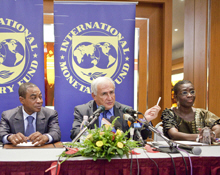
IMF’s Strauss-Kahn in Abidjan with Cote d'Ivoire Finance Minister Charles Koffi Diby (l), IMF African Department Director Antoinette Sayeh (photo: Eugene Salazar/IMF)
GLOBAL ECONOMIC CRISIS
IMF Pledges Stronger Partnership to Help Africa Through Crisis
IMF Survey online
May 28, 2009
- IMF pledges to help Africa through crisis “as a friend”
- IMF steps up lending to Africa, tops $1.5 billion in 2009
- Ready to further increase concessional lending
Dominique Strauss-Kahn, Managing Director of the International Monetary Fund (IMF), has pledged a stronger partnership with African countries to prevent the global economic crisis undoing years of progress in their fight against poverty.
Speaking at the end of a trip to the Democratic Republic of Congo and Côte d’Ivoire on May 27, he said the IMF had already doubled borrowing limits for the poorest countries and was working to provide them with even greater and more flexible lending.
“Africa currently finds itself the innocent victim of a financial crisis that has its origin in advanced economies. Coming so soon after last year’s food and fuel price shock, the global recession adds to the vulnerabilities of low income countries through falling commodity prices, reduced trade and investment, and threats to development assistance,” said Strauss-Kahn at the conclusion of his visit to Abidjan.
Stronger partnership
“In response, the IMF is strengthening its partnership with Africa,” he said in a press statement. “Africa will find in the IMF a good friend, ready with support and candid in advice.”
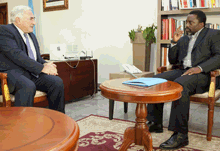
IMF’s Strauss-Kahn (l) confers with Democratic Republic of Congo President Joseph Kabila in Kinshasa May 24 (photo: Eugene Salazar/IMF)
After industrial countries and emerging markets, the poorest and most vulnerable countries are being hit hard by a third wave of the global crisis, causing Africa’s export earnings to plunge and reducing foreign investment. Growth in sub-Saharan Africa is projected to decline from just under 5½ percent in 2008 to 1½ percent in 2009 before recovering to about 3¾ percent in 2010—still below its precrisis level, the IMF says in its regional outlook, released on April 24.
But progress made in recent years showed that Africa could respond by ensuring political stability and strengthening governance to attract investors.
Strauss-Kahn said that the IMF had “substantially increased our financing to Africa and are ready to do more.”
African finance ministers and central bank governors at a meeting with the IMF in March in Dar es Salaam had mandated Strauss-Kahn to argue their case for increased aid flows and financial assistance at April’s Group of Twenty (G-20) summit of advanced and emerging market leaders in London.
Strauss-Kahn addresses students at University of Abidjan May 26 during his visit to Cote d’Ivoire (photo: Eugene Salazar/IMF)