Haves and Have Less—Why Inequality Throws Us Off Balance
IMF Blog, September 14, 2011
Source details
- Canonical URL
- Haves and Have Less—Why Inequality Throws Us Off Balance
Other formats
Bibliographic details
- Authors: Jeremy Clift
- Published: September 14, 2011
Overview and framing
- Author: Jeremy Clift
- Date: September 14, 2011
- Core premise: Research shows that in many countries inequality is on the rise and the gap between the rich and the poor is widening, particularly over the past quarter-century.
- Historical view challenged: The long-held belief that overall economic growth would pull everyone up is questioned — while the rich might be getting richer, everyone would not necessarily see higher living standards.
Recent patterns and consequences
- Overall growth vs. distribution:
- The world has seen an unprecedented era of economic growth over the past decades, which has made people better off on average.
- However, overall the rich have done much better than the poor.
- Social and political effects:
- According to the Organization for Economic Cooperation and Development (OECD), growing inequality breeds social resentment and generates political instability.
- It also fuels populist, protectionist, and anti-globalization sentiments.
- Quotation: “People will no longer support open trade and free markets if they feel that they are losing out while a small group of winners is getting richer and richer,” says Angel Gurría, the OECD Secretary-General.
- Crisis-era dynamics:
- Taxpayers footing the bill for troubles in the financial industry in advanced economies during the global economic crisis heightens perceptions of unfairness among wage-earners who have seen pay stagnate or worse.
Research highlights and findings
- Global inequality changes:
- Branko Milanovic (lead economist at the World Bank) argues that the global economic crisis may have narrowed global inequality somewhat between people around the world because most emerging and developing economies continued to maintain strong growth.
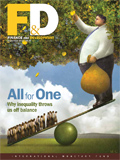
- Milanovic’s analysis was the cover article for the September 2011 issue of Finance & Development (F&D).
- Fiscal adjustment risks:
- Laurence Ball, Daniel Leigh, and Prakash Loungani find that “slamming on the budget brakes too quickly will hurt incomes and job prospects.”
- This finding has drawn attention from commentators including Paul Krugman, the Washington Post, and Huffington Post.
- Inequality and growth:
- IMF economists Andrew Berg and Jonathan Ostry argue that inequality is counterproductive; a more equal society has a greater likelihood of sustaining longer-term growth.
- Empirical snapshots:
- F&D’s regular Picture This section draws on results from the World Top Incomes database to provide a snapshot of patterns of inequality over the past century.
Related topical findings presented in the issue
- How developing the financial sector can accelerate economic growth and enhance income equality.
- Why the most vulnerable Europeans were also the most susceptible to losing their jobs, exacerbating inequality in the region.
- How higher income inequality in developed countries is associated with higher domestic and foreign indebtedness.
Publication context
- Finance & Development (F&D) is a quarterly magazine of the IMF, publishing analysis of issues related to the international financial system, monetary policy, economic development, poverty reduction, and other world economic issues.
- The print and web editions are published quarterly in English, Arabic, Chinese, French, Russian, and Spanish.
IMF blog page: Haves and Have Less—Why Inequality Throws Us Off Balance (Jeremy Clift, September 14, 2011).
Content in this bundle
- More or Less – Finance & Development – September 2011 – Branko Milanovic
References
- https://www.imf.org/wp-content/uploads/2011/09/fd-sept2011.jpg
- Finance & Development
- explains
- podcast
- Painful Medicine
- Andrew Berg
- Jonathan Ostry
- blogged on the topic of inequality for iMFdirect
- inequality is counterproductive
- Picture This
- How developing the financial sector can accelerate economic growth and enhance income equality
- Why the most vulnerable Europeans were also the most susceptible to losing their jobs, which exacerbated inequality in the region
- How higher income inequality in developed countries is associated with higher domestic and foreign indebtedness
- http://www.imf.org/external/pubs/ft/fandd/fda.htm