Adapting to Climate Change—Three Success Stories
IMF Blog, March 20, 2018
Source details
- Canonical URL
- Adapting to Climate Change—Three Success Stories
Other formats
Bibliographic details
- Authors: Evgenia Pugacheva, Mico Mrkaic
- Published: March 20, 2018
Major findings and model results
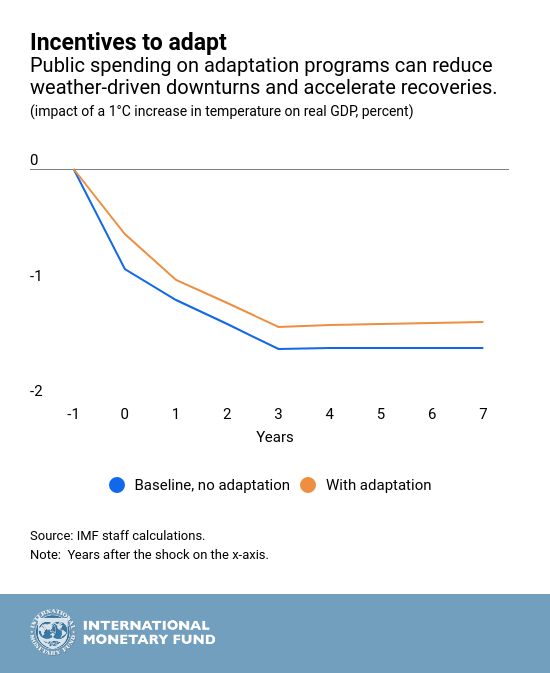
- Public investment in adaptation can partially reduce the economic costs of severe weather events.
- Historical evidence: a 1°C increase in temperature in a country with an average annual temperature of 25°C would reduce per capita output by 1.5 percent — a loss that persists for at least 7 years.
- Model simulations indicate that if governments subsidize private investment in adaptation, the economic burden of weather shocks could be partially reduced.
- The reduced losses from weather shocks as a result of investing in adaptation measures could significantly exceed the cost to the public coffers over time.
- Many adaptation measures generate social benefits that accrue to non-investors (positive externalities), which justifies government intervention.
Role of government and rationale for subsidies
- Households and firms invest in adaptation (for example, planting more heat-resistant crops or investing in green infrastructure), but they do not capture the full social benefits.
- Examples of non-excludable benefits: an early-warning system for extreme weather will be enjoyed freely by everyone living in the area.
- Because private actors do not internalize full social benefits, governments need to step in by subsidizing private investment in adaptation to improve resilience and reduce the impact of weather-related shocks.
Success stories (case studies)
- Social safety nets in Ethiopia
- Productive Safety Net Program (established in 2006) provides cash and food to families unable to feed themselves due to droughts, delayed rains, and flooding.
- Aid is contingent on participation in local productivity-enhancing or environmental programs (for example, land rehabilitation, improvement of water sources, construction of infrastructure such as roads and hospitals).
- Program beneficiaries experience a 25 percent smaller drop in consumption after droughts relative to those not in the program.
- The program has reduced soil loss by more than 40 percent, improved availability of water, and increased land productivity.
- Climate-smart infrastructure in Malaysia
- Stormwater Management and Road Tunnel (SMART Tunnel) in Kuala Lumpur serves a dual purpose: carries traffic and helps combat flash floods.
- Tunnel consists of three levels; normally the top two levels carry road traffic but can be temporarily used as storm drains.
- At a cost of about $500 million, the SMART Tunnel is expected to prevent more than $1.5 billion in flood damage and reduce the costs of traffic congestion by more than $1 billion over the next 30 years.
- Centralized air conditioning in India
- District cooling (centrally chilled water distributed through underground pipes) reduces negative effects of decentralized air-conditioning (energy consumption and pollution) and lowers up-front costs for users.
- Under construction by the Government of Gujarat in the Gujarat International Finance Tec-City.
- Centralized cooling systems consume 35 to 50 percent less energy than individual air cooling units.
- These systems unburden the electricity sector and make indoor climate control more accessible by eliminating the up-front cost for users.
Policy implications and recommendations
- Governments should support adaptation to improve resilience and reduce the impact of weather-related shocks.
- Public subsidies for private adaptation investment can be welfare-improving because private actors underinvest relative to socially optimal levels due to positive externalities.
- Many successful adaptation strategies exist and can be scaled or adapted to local conditions, but investing in them is expensive and will further stretch the budgets of very poor countries.
- The international community, particularly advanced economies that have emitted the lion’s share of greenhouse gasses, should help finance adaptation-related projects in poorer countries.
- Adaptation is necessary but not sufficient: the only long-term solution is to sharply reduce the greenhouse gas emissions responsible for Earth’s warming.
IMF Blog post by Evgenia Pugacheva and Mico Mrkaic, March 20, 2018.