Trade and Remittances Within Africa
IMF Blog, August 1, 2018
Source details
- Canonical URL
- Trade and Remittances Within Africa
Other formats
Bibliographic details
- Authors: Francisco Arizala, Matthieu Bellon, Margaux MacDonald, Montfort Mlachila, Mustafa Y Yenice
- Published: August 1, 2018
Remittances and regional integration
- Countries in sub-Saharan Africa are more closely tied than ever through rising trade and remittances.
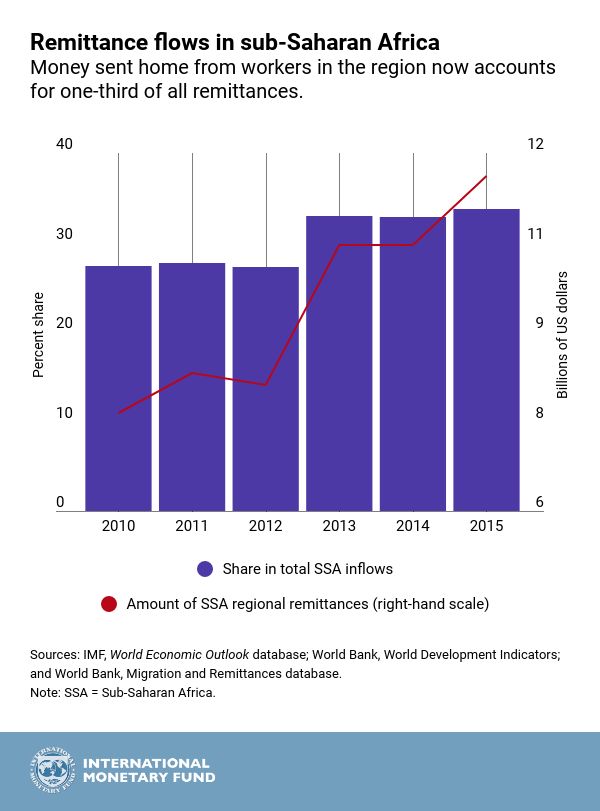
- In 2015, intra-regional remittance flows to sub-Saharan Africa amounted to about US$11.5 billion.
- Total remittances to sub-Saharan Africa have been broadly stable in percent of GDP over the last ten years, but by 2015 intra-regional remittance flows accounted for one third of total remittances.
- Intra-regional remittance flows are about 0.6 percent of GDP, and greater than those in emerging and developing Asia, Europe, and the Americas, which are all less than 0.3 percent of GDP.
- Developments in financial technology—notably mobile banking—reduce the cost of sending remittances, but remittance flows still mostly take place within the sub-region.
- Major sources of remittances within the continent include Cameroon (Central Africa), Côte d’Ivoire and Ghana (West Africa), South Africa (South), and, to some extent, Kenya (East).
Trade integration: trends and patterns
- Regional exports from sub-Saharan Africa rose from 6 percent of total exports in 1980 to 20 percent in 2016.
- The region’s level of regional integration is as high as in any other emerging and developing region.
- Drivers of increased trade integration include the region’s higher growth relative to the world, reduction of tariffs, and stronger institutions and economic policy relative to the past.
- The bulk of trade occurs within sub-regions (geographically close country groups). Example: the five members of the Southern African Customs Union (Botswana, Lesotho, Namibia, South Africa, and Swaziland) account for 50 percent of total sub-Saharan African trade.
Impact on growth
- Trade is the strongest conduit for cross-country impact on growth.
- Estimated effect: a 1 percent increase in the weighted growth rate of intra-regional partners is associated with an increase of 0.11 in domestic growth.
- Large economies in the region, such as Nigeria and South Africa, when sluggish, negatively affect partner countries through reduced demand for traded goods and lower remittance flows.
- Fast-growing economies, such as Côte d’Ivoire and Kenya, buoy neighboring West and East African economies through higher demand for traded goods and larger remittance inflows.
Policy recommendations to boost integration and manage risks
- Reduce tariff and non-tariff barriers, including reducing administrative burdens and improving the ease of doing business, and pursue broad ratification and implementation of the African Continental Free Trade Agreement.
- Prioritize infrastructure development (for countries with fiscal space) to make trade easier between countries and sub-regions.
- To address increased risks from closer ties:
- Diversify economies through structural transformation and diversification of exports while building on comparative advantage.
- Ensure policies are in place to monitor and regulate, where necessary, cross-border trade of goods and services, including effective and efficient customs and border procedures.
Outlook and implications
- Greater integration, including leveraging the continental free trade agreement, can broaden the base for business expansion and create more employment opportunities.
- Through expanded trade and remittance channels, integration has the potential to significantly raise medium-term growth, foster stability, and reduce debt sustainability concerns for many countries.
- The region’s more collective economic engagement increases the chances of shared economic growth.
Source: Trade and Remittances Within Africa — IMF blog, August 1, 2018.
References
- Português
- https://www.imf.org/wp-content/uploads/2018/07/BLOG-1024x600-AFR-kids-Africa-images-gettyimages-iStock-176978535.jpg
- new study
- https://www.imf.org/wp-content/uploads/2018/07/eng-july-2-intra-ssa-spillovers_1.jpg
- https://www.imf.org/wp-content/uploads/2018/07/eng-july-2-intra-ssa-spillovers_2.jpg
- structural transformation
- Managing Debt Vulnerabilities in Low-Income and Developing Countries
- Money Sent Home by Migrants Buffers Income Shocks