Sounding the Alarm on Leveraged Lending
IMF Blog, November 15, 2018
Source details
- Canonical URL
- Sounding the Alarm on Leveraged Lending
Other formats
Bibliographic details
- Authors: Tobias Adrian, Fabio Natalucci, Thomas Piontek
- Published: November 15, 2018
Overview
- The growing leveraged-loan market is identified as a potential source of speculative excess and systemic risk.
- Characterization of leveraged loans: loans, usually arranged by a syndicate of banks, to companies that are heavily indebted or have weak credit ratings; called “leveraged” because the ratio of the borrower’s debt to assets or earnings significantly exceeds industry norms.
- Context: interest rates were extremely low for years, encouraging yield-hungry investors to tolerate higher risk and speculative instruments.
Market size and issuance
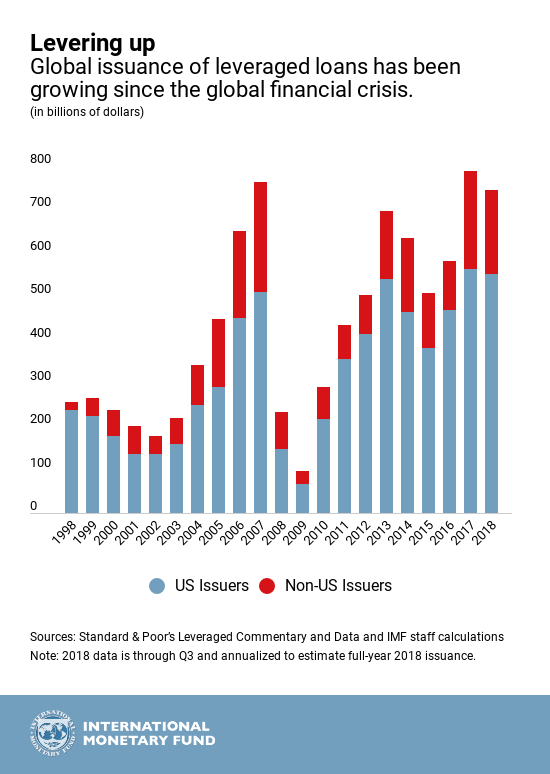
- Global leveraged-loan market described as "$1.3 trillion".
- New issuance records:
- "new issuance of leveraged loans hit a record $788 billion in 2017", surpassing the pre-crisis high of "$762 billion in 2007".
- "The United States was by far the largest market last year, accounting for $564 billion of new loans."
- "So far this year, issuance has reached an annual rate of $745 billion."
- Use of proceeds: "More than half of this year’s total involves money borrowed to fund mergers and acquisitions and leveraged buyouts (LBOs), pay dividends, and buy back shares from investor—in other words, for financial risk-taking rather than plain-vanilla productive investment."
Deterioration in underwriting standards and credit quality
- Underwriting and credit quality have "deteriorated."
- Composition shift: "the most highly indebted speculative grade firms now account for a larger share of new issuance than before the crisis."
- Covenant trends:
- "so-called covenant-lite loans account for up 80 percent of new loans arranged for nonbank lenders (so-called 'institutional investors'), up from about 30 percent in 2007."
- "Not only the number, but also the quality of covenants has deteriorated."
- Nonprice term loosening: weaker covenants have "reportedly allowed borrowers to inflate projections of earnings" and "allowed them to borrow more after the closing of the deal."
- Recovery rates: "average recovery rates for defaulted loans have fallen to 69 percent from the pre-crisis average of 82 percent."
Investor base shift and implications
- Institutional holdings and growth:
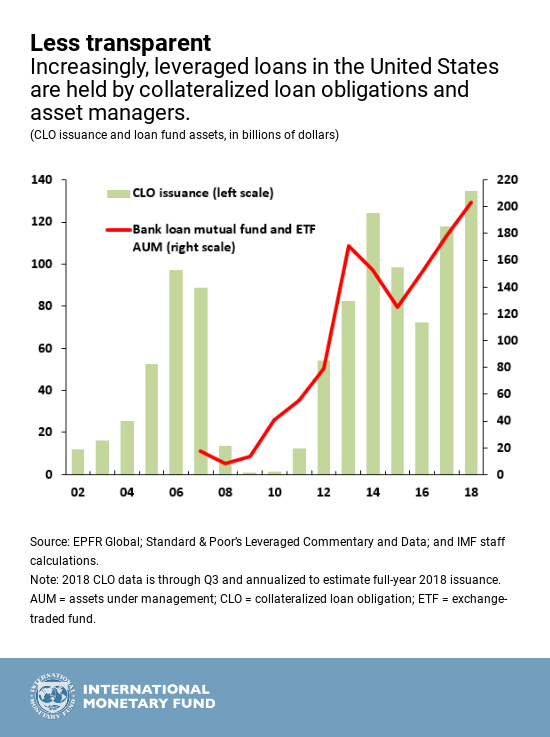
- "Institutions now hold about $1.1 trillion of leveraged loans in the United States, almost double the pre-crisis level."
- This compares with "$1.2 trillion in high yield, or junk bonds, outstanding."
- "CLOs buy more than half of overall leveraged loan issuance in the United States."
- Mutual fund growth: "Mutual funds that invest in leveraged loans have grown from roughly $20 billion in assets in 2006 to about $200 billion this year, accounting for over 20 percent of loans outstanding."
- Institutional investor types listed: "loan mutual funds, insurance companies, pension funds, and collateralized loan obligations (CLOs)."
- Regulatory complication: "Institutional ownership makes it harder for banking regulators to address potential risk to the financial system if things go wrong."
- Sectoral shift concern: evidence that regulatory steps to reduce bank exposures have "contributed to a shift of activities from banks to institutional investors"; such investors "have different risk profiles and may pose different risks to the financial system than banks."
- Unclear linkages: "it is unclear whether institutional investors retain a link to the banking sector, which could inflict losses at banks during market disruptions."
Potential economic and financial stability impact
- A sharp rise in defaults could have "a large negative impact on the real economy given the importance of leveraged loans as a source of corporate funding."
- Key vulnerabilities identified:
- rising leverage
- weakening investor protections (weaker covenants)
- eroding debt cushions
- falling recovery rates (69 percent versus pre-crisis 82 percent)
- Policy tool limitation: "few tools are available to address credit and liquidity risks in global capital markets."
Policy implications and recommendations
- Regulators in the United States and Europe "have taken steps in recent years to reduce banks’ exposures and to curb market excesses more broadly."
- Effectiveness of those steps "remains an open question."
- Policy prescriptions stressed:
- "it is crucial for policymakers to develop and deploy new tools to address deteriorating underwriting standards."
- Policymakers should not overlook another potential threat, having "learned a painful lesson a decade ago about unforeseen threats to the financial system."
Tobias Adrian, Fabio Natalucci, Thomas Piontek — November 15, 2018
Content in this bundle
- Guidance on leveraged transactions
- Interagency Guidance on Leveraged Lending
References
- Global Financial Stability Report
- https://www.imf.org/wp-content/uploads/2018/11/eng-nov-9-globalleverage1-1.png
- https://www.imf.org/wp-content/uploads/2018/11/eng-nov-9-globalleverage2-1.png
- https://www.imf.org/wp-content/uploads/2018/11/eng-nov-9-globalleverage3-1.png
- https://www.imf.org/wp-content/uploads/2018/11/eng-nov-9-globalleverage4.png
- https://www.imf.org/wp-content/uploads/2018/11/eng-nov-9-globalleverage5.png