Mind the Gap in SDG Financing
IMF Blog, January 31, 2019
Source details
- Canonical URL
- Mind the Gap in SDG Financing
Other formats
Bibliographic details
- Authors: The Editors
- Published: January 31, 2019
Key findings on financing needs
- Progress in achieving the Sustainable Development Goals (SDGs) requires scaling up spending in areas like health, education, and infrastructure.
- The required scale-up varies widely across countries:
- For emerging market economies, the average additional annual spending required in 2030 to reach key SDGs stands at 4 percentage points of GDP.
- For the average low-income developing country, the average additional annual spending required in 2030 to reach key SDGs stands at 15 percentage points of GDP.
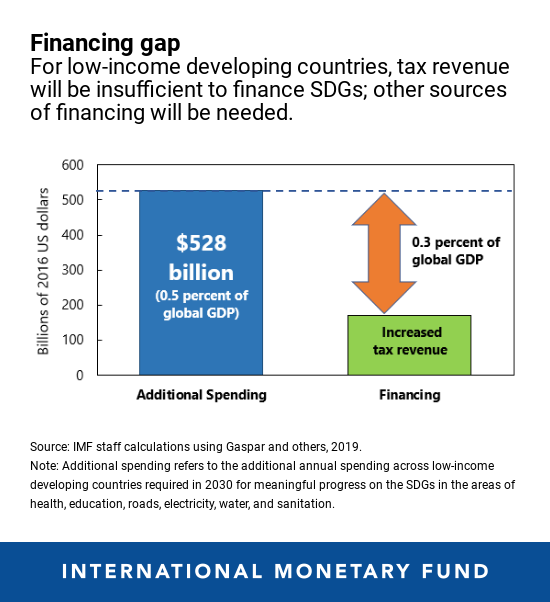
- Low-income countries’ combined needs amount to half a trillion, or 0.5 percent of global GDP.
- If extra tax revenues are successfully realized, they could finance one-third of the total additional needs for low-income countries, leaving a gap of 0.3 percent of global GDP.
Revenue mobilization and tax capacity
- Many developing countries still collect very little tax revenue; building tax capacity is the first line of action.
- Increasing the tax-to-GDP ratio by 5 percentage points of GDP in the next decade is described as an ambitious but reasonable target in many countries.
- For most emerging market economies, this additional tax revenue would be sufficient to finance the increase in spending.
- Achieving this requires strong administrative and policy reforms, where the IMF and other development partners can play a supporting role.
Efficiency, institutions, and complementary actions
- Closing the remaining gap requires more than revenue increases:
- Increasing the efficiency of public spending can result in significant savings and ensure spending is redirected to areas with the greatest impact.
- Developing political and societal consensus and building strong and effective public institutions are necessary to ensure spending is both increased and efficient.
- Principles to instill include transparency, accountability, and responsiveness across public and private sectors.
- A variety of global public goods will be important, including geopolitical stability, open trade, and climate initiatives.
- Addressing corruption requires tackling both supply and demand elements.
Roles of stakeholders
- Low-income developing countries must own responsibility for achieving the SDGs.
- The private sector, official development assistance, philanthropists, and international financing institutions can help accelerate efforts to close the remaining gap.
- The piece calls for joint action by all stakeholders.
Study referenced
- IMF staff study: Fiscal Policy and Development: Human, Social, and Physical Investment for the SDGs, authored by Vitor Gaspar, David Amaglobeli, Mercedes Garcia-Escribano, Delphine Prady, and Mauricio Soto.
Mind the Gap in SDG Financing — IMF blog, January 31, 2019.