Waste Woes in the World
IMF Blog, January 31, 2020
Source details
- Canonical URL
- Waste Woes in the World
Other formats
Bibliographic details
- Authors: The Editors
- Published: January 31, 2020
Key findings on waste generation
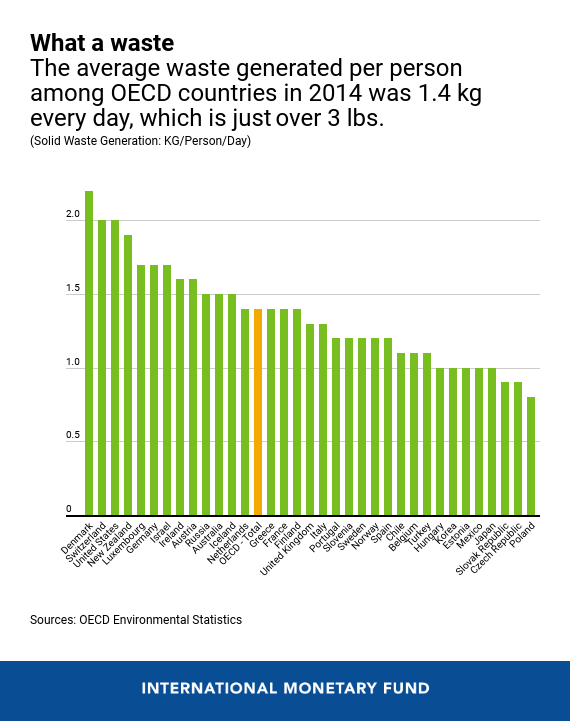
- Higher-income countries like the United States, Denmark, and New Zealand generate at least twice as much waste per capita than developing countries.
- Most waste in middle- and high-income countries consists of inorganic materials, notably paper and plastic.
- While high-income countries generate more waste per capita, developing countries produce more than half of total solid waste in aggregate volume.
- Many of the world’s highest waste generation rates per person are found in developing island nations, where tourism plays a large role and scarcity of land for landfilling (or dumping) makes disposal problems especially acute. Rising sea levels due to global warming exacerbate this scarcity.
- In low-income developing countries, most waste is biodegradable organic material; this share shrinks as income rises.
Evidence from policy experiments and outcomes
- Plastic bag taxes are an example of an advanced disposal fee: you pay up front for the waste you are about to create. To date 30 countries have a plastic bag tax to help reduce waste and help save the environment.
- “Pay-as-you-throw” systems charge by the garbage bin, plastic bag, or weight of garbage; studies show these schemes can significantly reduce the amount of waste people generate.
- South Korea case study:
- Solid waste generation rose with incomes and consumption until policy change.
- In 1995 the government introduced a system requiring payment for official bags to dispose of garbage; the price varied by municipality and reflected local disposal cost.
- Waste generation fell from 1.3kg per person per day in 1994 to 0.95 kg in 2014.
- Recycling rate rose from 15.4 percent to 59 percent over the same period.
- A 2013 composting program to separate food waste coincided with landfill food waste falling from 97 percent in 1994 to about 2 percent in 2014.
Projections and policy implications
- Global waste volume is projected to double to 2.3 billion tons in 2025.
- Fiscal policies that change the price signals facing consumers—such as plastic bag taxes and pay-as-you-throw schemes—can change people’s choices and behavior and help reduce waste volumes.
Context and authorship
- Publication date: January 31, 2020.
- Publication: Chart of the Week, Climate change; author: The Editors.
- IMFBlog is a forum for views of IMF staff and officials; the IMF is an organization of 191 countries.
Source: Waste Woes in the World (IMF, January 31, 2020).