Pandemic’s E-commerce Surge Proves Less Persistent, More Varied
IMF Blog, March 17, 2022
Source details
- Canonical URL
- Pandemic’s E-commerce Surge Proves Less Persistent, More Varied
Other formats
Bibliographic details
- Authors: Joel Alcedo, Alberto Cavallo, Bricklin Dwyer, Prachi Mishra, Antonio Spilimbergo
- Published: March 17, 2022
Data and scope
- Database: aggregated and anonymized transactions through the Mastercard network across 47 countries from January 2018 to September 2021.
- Study partnership: Mastercard, the International Monetary Fund and Harvard Business School.
Aggregate findings on online spending shares
- Average online share of total spending:
- 10.3 percent in 2019
- 14.9 percent at the peak of the pandemic
- 12.2 percent in 2021
- Change relative to pre-pandemic trend:
- Peak was 4.3 percentage points above the level predicted before the pandemic
- By the end of the sample period the difference dropped to 0.3 point
- The latest online share of spending is 0.6 percentage points above the growth trend that would have been expected had the crisis not happened
Cross-country variation and the digital divide
- E-commerce rose more in economies with a higher pre-COVID share of online transactions in total consumption, worsening the digital divide across economies.
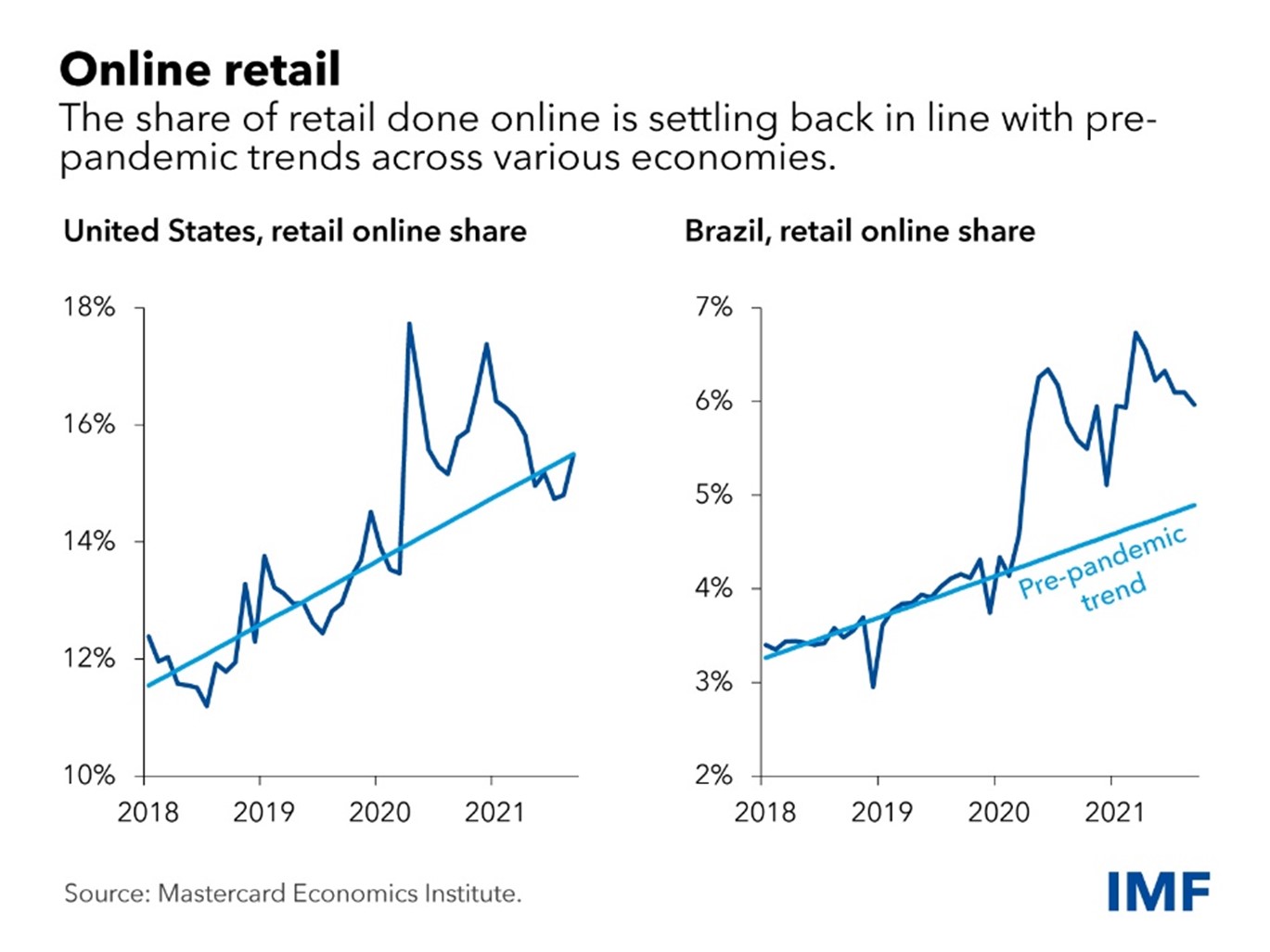
- Countries where online share remained above pre-pandemic trends include Brazil, India, Bahrain, and Jamaica.
- Countries where online shares are now at or below predicted pre-COVID trend levels include the United States and many advanced economies.
- Examples of economies with high pre-COVID online penetration that increased further: Singapore, Canada, and the United Kingdom.
- Examples of economies with low pre-COVID online shares that experienced less acceleration: Brazil and Thailand.
Role of pandemic restrictions and fiscal support
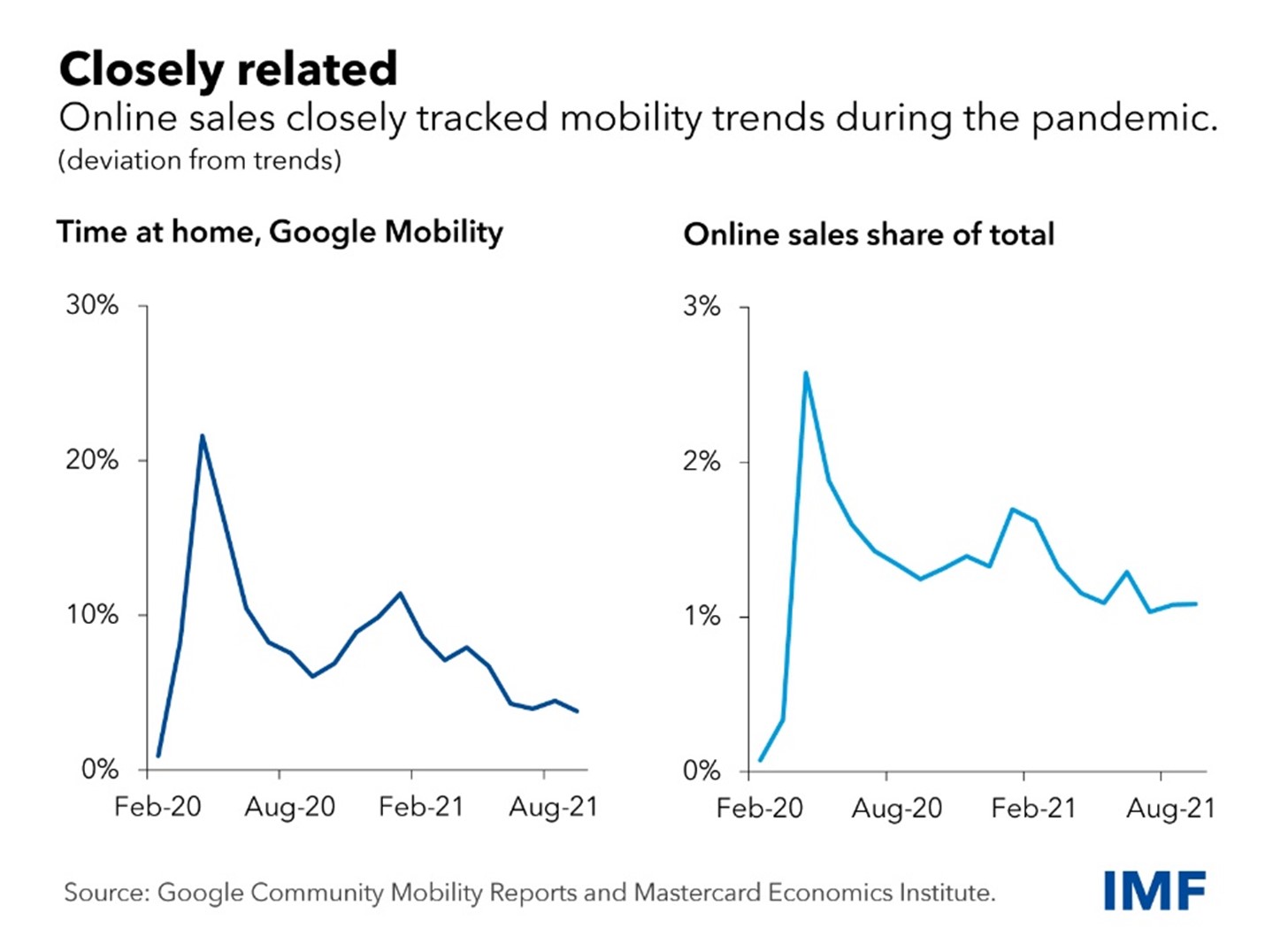
- Economies with stricter mobility limits saw much higher online spending, especially in Q2 2020 when lockdowns severely curtailed movement.
- Over time, the correlation between restrictions and online spending weakened as the impact of lockdowns and other restrictions on economic activity declined.
- Fiscal support during the pandemic helped boost e-commerce penetration, likely by increasing consumption that, in the presence of restrictions, could mostly be done online.
- Wealthier, more digitally mature economies returned faster to pre-pandemic pace of online spending once the crisis receded.
Industry-level heterogeneity and persistence
- Sectors showing more persistent increases in e-commerce:
- Restaurants (more specifically food delivery)
- Health care (which includes telemedicine)
- Some retail categories including department stores, electronics, and clothing
- Dynamics by industry:
- Industries already familiar with online technologies were able to shift online to a larger degree during the initial surge.
- Industries with lower pre-pandemic digital maturity—such as retail, restaurants, and health care—have greater potential for e-commerce, particularly in less developed markets.
- Possible explanations for cross-industry differences:
- Mobility and in-person nature of some sectors (e.g., dining) have not fully recovered.
- Digitalization was previously low in some sectors, and COVID-19 propelled larger shifts in those areas.
Key implications
- The pandemic produced a quick uptake in e-commerce, but the persistence of that learning is not broad-based across countries or industries.
- Early adopters and digitally mature economies and sectors experienced larger and more sustained shifts toward online spending.
- There remains substantial room for expansion of e-commerce in less digitally mature economies and in sectors such as retail, restaurants, and health care.
IMF Blog — Joel Alcedo, Alberto Cavallo, Bricklin Dwyer, Prachi Mishra, Antonio Spilimbergo; March 17, 2022