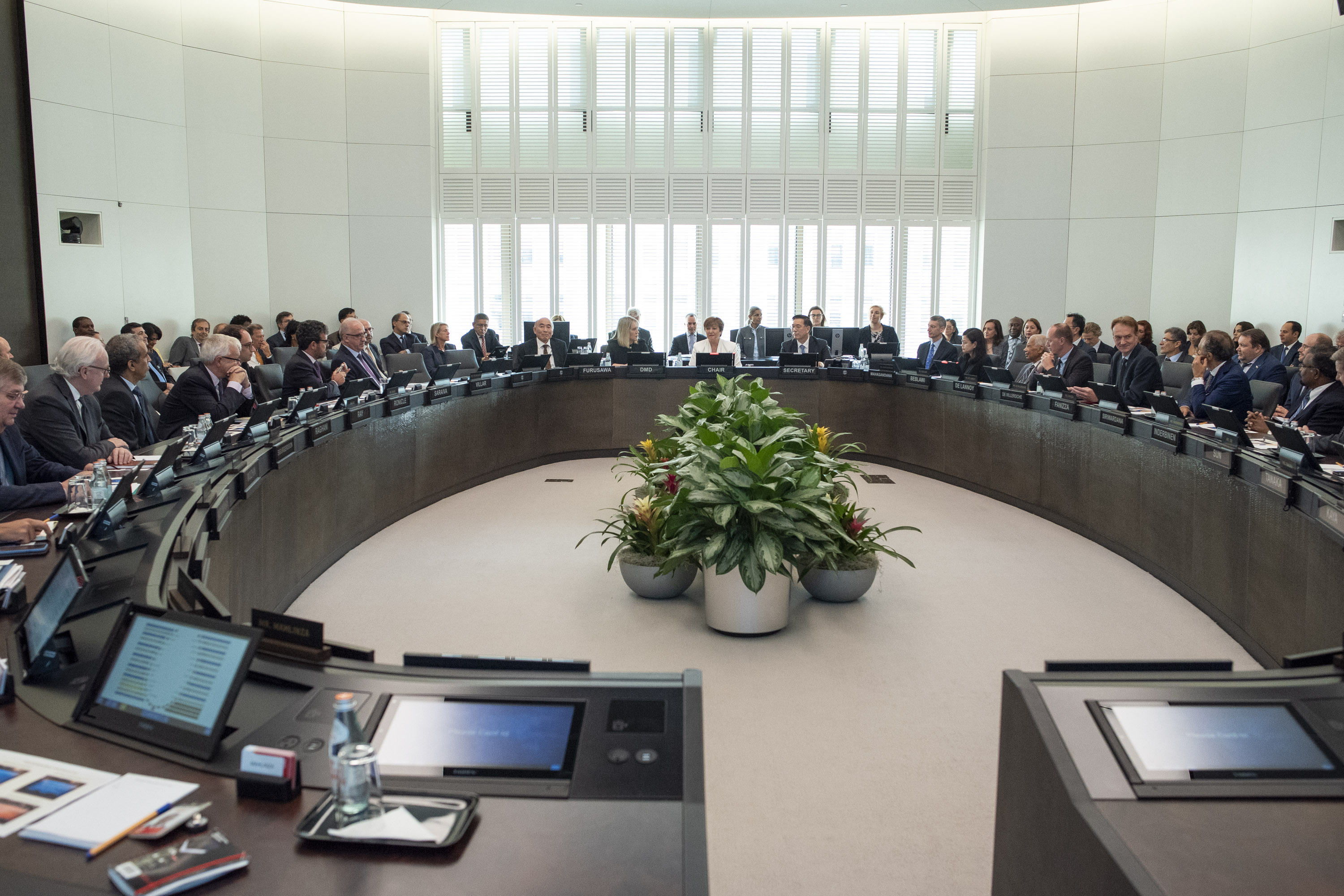
IMF Executive Board Concludes 2018 Article IV Consultation with Bolivia
IMF News, December 6, 2018
Source details
- Canonical URL
- IMF Executive Board Concludes 2018 Article IV Consultation with Bolivia
Other formats
Bibliographic details
- Published: December 6, 2018
Background and recent performance
- On November 9, 2018, the Executive Board of the International Monetary Fund (IMF) concluded the Article IV consultation with Bolivia.
- Bolivia registered annual real GDP growth of 4.8 percent on average between 2004–17.
- The share of the population living in extreme poverty fell by half to 17 percent.
- Since the commodity price drop in 2014, authorities conducted accommodative fiscal and credit policies that maintained robust growth but resulted in:
- large fiscal and external current account deficits,
- reserve losses,
- a sharp increase in public debt.
- External competitiveness was negatively affected by the appreciating US dollar and high wage growth in the context of a stabilized exchange rate.
Growth outlook and projections
- Real GDP growth is projected at 4.5 percent in 2018.
- Growth is forecast to moderate to 3.7 percent in the medium-term.
- Drivers and assumptions:
- Continued accommodative policies, a second economy-wide wage bonus, and strong agriculture output support near-term growth.
- Limited impulse from macro policies and lower total factor productivity in the post-commodity boom period underpin the medium-term moderation.
- Government decision to limit the growth of public investment expected to help reduce the fiscal deficit over time and slow growth in public debt.
- External current account deficit expected to narrow slowly owing to moderation in imports of capital goods.
- Capital inflows and remittances expected to be weaker, with international reserves forecast to decline slowly, falling below the Fund’s reserve adequacy metric by 2020.
Fiscal and external sector assessments
- Executive Directors welcomed containment of public investment as helpful to reduce the fiscal deficit over the medium term but noted:
- The current large fiscal deficit and loss of foreign reserves warrant further policy tightening to restore external balance and limit vulnerabilities.
- Fiscal adjustment should come more from the spending side.
- Recommendation to implement a medium‑term fiscal framework anchored by a debt target to guide fiscal policy.
- Directors recommended ensuring social schemes are directed to the most vulnerable groups.
- External sector notes:
- Main risks include political uncertainty surrounding the 2019 elections, failure to lower public investment as envisaged, and commodity-related shocks, including failure to discover new natural gas fields.
Monetary policy and financial sector
- Directors agreed monetary policy should focus primarily on price stability and preserving the nominal exchange rate anchor.
- Observations and recommendations:
- Strong credit growth and central bank lending to state‑owned enterprises contributed to pressure on international reserves.
- Advice to normalize monetary conditions as inflation pressures resume.
- Encouraged strengthening the independence of the central bank.
- Called for steps to cease direct lending by the central bank to state‑owned enterprises.
- Banking sector remains broadly stable.
- Encouraged removal of credit quotas and interest rate caps to limit build‑up of vulnerabilities and ensure lending decisions better reflect intrinsic risks.
Structural reforms and governance
- Directors emphasized accelerating structural reforms to strengthen productivity, competitiveness, and support diverse and broad‑based growth.
- Policy recommendations include:
- Unleash private investment to support export diversification.
- Reform trade policies and product and labor markets to improve cost competitiveness.
- Discontinue practices of centralized wage setting and indexing national bonuses to the GDP growth rate.
- Reduce bureaucracy in business processes and combat corruption.
- Move to digital processes for tax and business‑related payments.
- Reform the legislative framework governing state‑owned enterprises and include activities of all subsidiaries in the fiscal accounts of the non‑financial public sector.
- Adopt standards under the Extractive Industries Transparency Initiative and further strengthen the AML/CFT framework.
- Address weaknesses in data provision.
Executive Board assessment and next steps
- Executive Directors commended Bolivia’s impressive economic growth and social improvements but noted challenges from continued accommodative policies, lower commodity prices, and political uncertainty.
- It is expected that the next Article IV consultation with Bolivia will be held on the standard 12‑month cycle.
Selected economic and financial indicators
I. Social and Demographic Indicators
- GDP per capita (U.S. dollars, 2017): 3,382
- Poverty headcount ratio (percent of population, 2016): 39.5
- Population (millions, 2017): 11.2
- Gini index (2016): 44.6
- Life expectancy at birth (years, 2015): 69
- Adult literacy rate (percent, 2015): 92.5
- Mortality rate, under-5 (per thousand, 2016): 36.9
- Gross enrollment ratio, primary, both sexes (2015): 97.1
II. Economic Indicators — Baseline projections (annual percentage changes unless otherwise indicated)
- Real GDP:
- 2015: 4.9
- 2016: 4.3
- 2017: 4.2
- 2018: 4.5
- 2019: 3.9
- 2020: (not listed)
- Nominal GDP:
- 2015: 0.2
- 2016: 3.6
- 2017: 11.1
- 2018: 9.8
- 2019: 7.8
- CPI inflation (period average):
- 2015: 4.1
- 2016: 2.8
- 2017: 4.0
- 2018: (not listed)
- Investment and savings (In percent of GDP, unless otherwise indicated):
- Total investment:
- 2015: 20.7
- 2016: 21.8
- 2017: 24.2
- 2018: 24.3
- 2019: 22.9
- Of which : Public sector:
- 2015: 13.7
- 2016: 13.0
- 2017: 13.3
- 2018: 12.4
- 2019: 11.6
- Gross national savings:
- 2015: 15.1
- 2016: 16.0
- 2017: 16.3
- 2018: 15.0
- 2019: 13.8
- Combined public sector:
- Revenues and grants:
- 2015: 38.1
- 2016: 32.8
- 2017: 30.7
- 2018: 31.3
- 2019: 31.9
- 2020: 31.6
- Expenditure:
- 2015: 45.0
- 2016: 40.0
- 2017: 38.5
- 2018: 38.8
- 2019: 38.2
- 2020: 37.2
- Net lending/borrowing (overall balance):
- 2015: -7.0
- 2016: -7.3
- 2017: -7.8
- 2018: -7.4
- 2019: -6.3
- 2020: -5.7
- Of which : Non-hydrocarbon balance:
- 2015: -14.2
- 2016: -10.9
- 2017: -11.7
- 2018: -12.6
- 2019: -10.5
- Total gross NFPS debt 2/:
- 2015: 41.3
- 2016: 46.6
- 2017: 51.1
- 2018: 53.5
- 2019: 54.6
- External sector:
- Current account 1/:
- 2015: -5.9
- 2016: -5.3
- 2017: -4.8
- 2018: -4.6
- 2019: -4.5
- Exports of goods and services:
- 2015: 30.2
- 2016: 25.1
- 2017: 25.2
- 2018: 24.7
- 2019: 24.6
- Imports of goods and services:
- 2015: 36.2
- 2016: 30.8
- 2017: 30.6
- 2018: 30.4
- 2019: 30.1
- Financial account:
- 2015: -8.6
- 2016: -6.6
- 2017: -6.5
- 2018: -6.2
- Terms of trade index (percent change):
- 2015: -23.1
- 2016: -15.5
- 2017: 9.5
- 2018: 10.0
- 2019: -2.9
- 2020: -1.5
- Net Central Bank foreign reserves 3/ 4/:
- In percent of GDP:
- 2015: 39.7
- 2016: 29.6
- 2017: 27.1
- 2018: 21.1
- 2019: 18.6
- 2020: 16.4
- In months of imports of goods and services:
- 2015: 14.5
- 2016: 10.4
- 2017: 9.7
- 2018: 7.7
- 2019: 6.9
- 2020: 6.1
- Money and credit (Annual percentage changes, unless otherwise indicated):
- Credit to the private sector:
- 2015: 17.6
- 2016: 14.8
- 2017: 12.8
- 2018: 11.7
- 2019: 10.9
- 2020: 10.1
- Credit to the private sector (percent of GDP):
- 2015: 52.0
- 2016: 57.6
- 2017: 58.5
- 2018: 59.5
- 2019: 61.2
- 2020: 62.5
- Broad money:
- 2015: 82.5
- 2016: 81.7
- 2017: 80.9
- 2018: 81.3
- 2019: 83.2
- Memorandum items:
- Nominal GDP (in billions of U.S. dollars):
- 2015: 32.9
- 2016: 34.1
- 2017: 37.9
- 2018: 41.6
- 2019: 44.8
- 2020: 48.3
- Exchange rates 5/:
- Bolivianos/U.S. dollar (end-of-period): …
- REER, period average 6/ (percent change):
- 2015: 16.1
- 2016: 6.0
- 2017: -1.4
IMF Executive Board Concludes 2018 Article IV Consultation with Bolivia (Press Release No. 18/453), December 6, 2018.