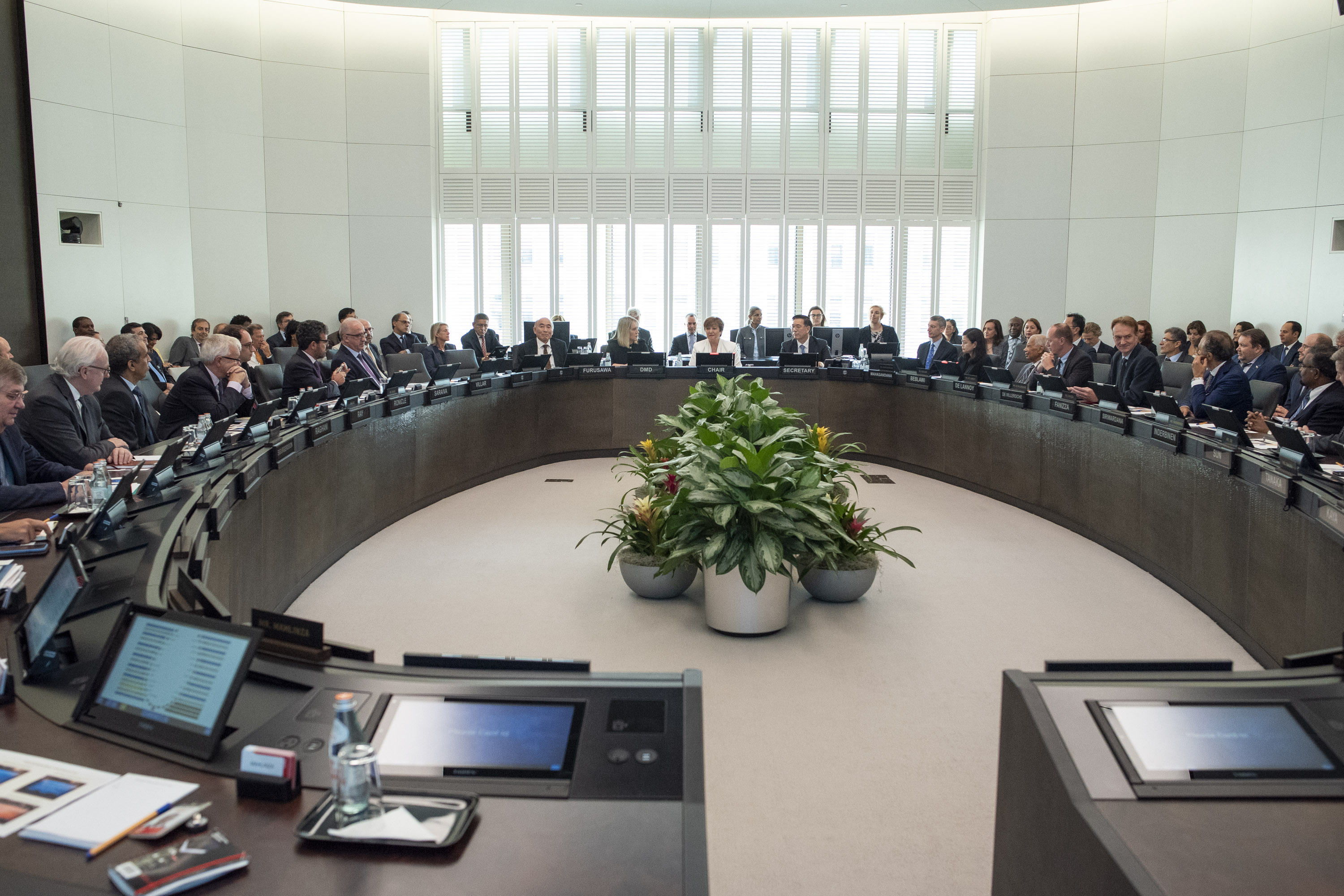
IMF Executive Board Concludes 2018 Article IV Consultation with Albania
IMF News, January 28, 2019
Source details
- Canonical URL
- IMF Executive Board Concludes 2018 Article IV Consultation with Albania
Other formats
Bibliographic details
- Published: January 28, 2019
Overview and recent developments
- Executive Board concluded the 2018 Article IV Consultation with Albania on January 23, 2018.
- Growth is estimated at 4.2 percent in 2018 and is projected to stay close to this level over the medium term.
- Exchange rate appreciated sharply since March 2018, putting downward pressure on inflation.
- Inflation is expected to rise gradually to reach its 3 percent target by 2021.
- In October, the authorities issued a €500 million Eurobond with a seven-year maturity at a rate of 3.50 percent.
- Current account deficit expected to narrow to around 6 percent of GDP over the medium term as large energy projects taper off.
- Non-performing loan (NPL) ratio lowered to about 13 percent, but pockets of vulnerability remain.
Growth, inflation, and external sector
- Real GDP growth: 4.2 percent in 2018; projected 3.7 percent in 2019 and 3.9 percent in 2020.
- Domestic demand contribution to 2018 growth: 4.4 (percentage points).
- Consumption growth: 2.3 in 2018; projected 2.7 in 2019 and 2.9 in 2020.
- Investment (incl. inventories and stat. disc) contribution to growth: 0.3 in 2018; 0.0 in 2019.
- External demand contribution: negative in 2018 (implied from totals).
- Consumer Price Index (avg.) series: 1.6 (2014), 1.9 (2015), 1.3 (2016), 2.0 (2017).
- Consumer Price Index (eop) reported for 2018 (value not provided in text excerpt beyond header).
- GDP deflator: 0.6 (2014), -0.4 (2015), 1.4 (2016), 2.1 (2017).
- Trade balance (goods and services) as percent of GDP: -13.1 in 2018; projected -12.5 in 2019; -12.0 in 2020.
- Current account balance as percent of GDP: -6.3 in 2018; projected -6.0 in 2019; -5.8 in 2020.
- Gross international reserves: reported in months of imports and in billions of Euros (series: 7.0, 6.5, 6.7 for recent years).
Fiscal policy, revenues, and public debt
- Fiscal stance broadly neutral in 2018; without additional measures fiscal deficit expected to hover around 2 percent of GDP in the medium term.
- Total Revenues and grants: 27.2 in 2018.
- Tax revenue: 25.4 in 2018; 25.2 projected 2019; 25.1 projected 2020.
- Total Expenditure: 29.0 in 2018; projected 29.3 in 2019; 29.1 in 2020.
- Overall balance: -1.9 in 2018.
- Primary balance and interest series reported in table headings (specific year values: Primary 28.3, 26.8, 27.1, 27.0 for earlier years; Interest and Primary balance entries partially tabulated).
- Financing composition: financing and of which domestic/foreign entries shown in table (values include 5.9, 4.6, 1.7 for financing across years; domestic -1.3, -0.8, 1.0; foreign 3.1).
- General Government Debt (percent of GDP): 68.6 in 2018; 65.1 projected 2019; 63.3 projected 2020.
- Domestic debt: 33.7 in 2018; 32.1 projected 2019.
- External debt: 31.2 in 2018 (series shows 34.3, 32.9, 31.9, 31.4, 31.2 for earlier years).
Financial sector and monetary policy
- Banking system is well-capitalized and liquid; credit provision to support business investments has remained weak.
- Non-performing loan (NPL) ratio reduced to about 13 percent.
- Broad money growth: 4.0 (2014), 4.9 (2015) (series continues for later years).
- Private credit growth: -2.8 (2014), 0.4 (2015), 3.6 (2016) (series continues).
- Directors agreed accommodative monetary policy stance remains appropriate; normalization should be data dependent, aimed at reaching the inflation target over the medium term.
- Authorities committed to maintain exchange rate flexibility; interventions should be temporary and limited to preventing disorderly market conditions and a destabilization of inflation.
- Directors urged measures to address credit growth bottlenecks, expedite de-euroization measures, and tackle structural weaknesses in credit provision, including continued high NPLs.
- Strengthening property rights and insolvency regimes recommended to support credit recovery.
- Directors emphasized strengthening financial supervision and enhancing the AML/CFT framework.
Risks and vulnerabilities
- Medium-term risks tilted to the downside.
- External risks: Albania strongly exposed to slowing growth in Europe (main trading partners); downturn could reduce exports, remittances, and foreign direct investment.
- Financial risk: expected tightening in global financial conditions would raise Albania’s cost of financing.
- Domestic risks: high public debt; low domestic savings; absence of large institutional investors increases dependence on foreign financing.
- Increasing reliance on PPPs for infrastructure projects has resulted in rising contingent liabilities.
- Drought impact on electricity generation creates fiscal risks.
- Directors highlighted need to halt persistent build-up of government arrears which hurt private activity and trust in public sector.
Executive Board assessment and policy recommendations
- Directors welcomed Albania’s continued economic growth and urged using the favorable environment to:
- Further advance policies and structural reforms to entrench macroeconomic stability, build buffers, and foster sustainable and inclusive growth.
- Implement additional fiscal consolidation to build stronger buffers; lower the fiscal deficit further and accelerate public debt reduction, including through stronger revenue measures.
- Achieve a simple, predictable tax system; focus on broadening the tax base and avoid ad‑hoc tax measures that create distortions.
- Contain fiscal risks from PPPs; consolidate and strengthen public investment decision‑making; ensure value for money for PPPs through competitive bidding.
- Halt the build‑up of government arrears through determined measures.
- Continue accommodative, data‑dependent monetary policy toward the inflation target; maintain exchange rate flexibility.
- Address bottlenecks to credit growth and improve monetary transmission.
- Expedite de‑euroization measures and address high NPLs.
- Strengthen property rights and insolvency regimes.
- Strengthen financial supervision and enhance AML/CFT framework.
- Undertake resolute structural reforms to improve the business climate, with emphasis on strengthening the rule of law, completing judicial reform, and strengthening anti‑corruption efforts.
- Reduce informality by maintaining a simple and fair tax system, sustaining improvements in tax collection, and increasing the quality of public services.
Selected economic indicators (highlights from table)
- Real GDP growth: 1.8 (2014); 2.2 (2015); 3.3 (2016); 3.8 (2017); 4.2 (2018); 3.7 (2019 proj.); 3.9 (2020 proj.).
- Foreign savings (percent of GDP): 10.8 (2014); 8.6 (2015); 7.6 (2016); 7.5 (2017); 6.3 (2018); 6.0 (2019); 5.8 (2020).
- National savings (percent of GDP): 15.9 (2014); 15.8 (2015); 17.0 (2016); 17.4 (2017); 17.9 (2018); 18.1 (2019).
- Investment (incl. inventories and stat. disc.) (percent of GDP): 26.7 (2014); 24.4 (2015); 24.5 (2016); 24.9 (2017); 24.2 (2018); 23.9 (2019).
- Trade balance (goods and services) (percent of GDP): -19.0 (2014); -17.3 (2015); -16.8 (2016); -15.1 (2017); -13.1 (2018).
- Current account balance (percent of GDP): -10.8 (2014); -8.6 (2015); -7.6 (2016); -7.5 (2017); -6.3 (2018).
- General Government Debt (percent of GDP): 72.0 (2014); 73.9 (2015); 73.3 (2016); 71.9 (2017); 68.6 (2018).
- Nominal GDP (in billions of lek): 1395 (2014); 1431 (2015); 1473 (2016); 1551 (2017); 1649 (2018); 1748 (2019); 1860 (2020).
- Output Gap (percent): -1.5 (2014); -1.8 (2015); -1.4 (2016); -0.7 (2017); -0.2 (2018).
IMF Communications Department. Press Release No. 19/19. January 28, 2019.