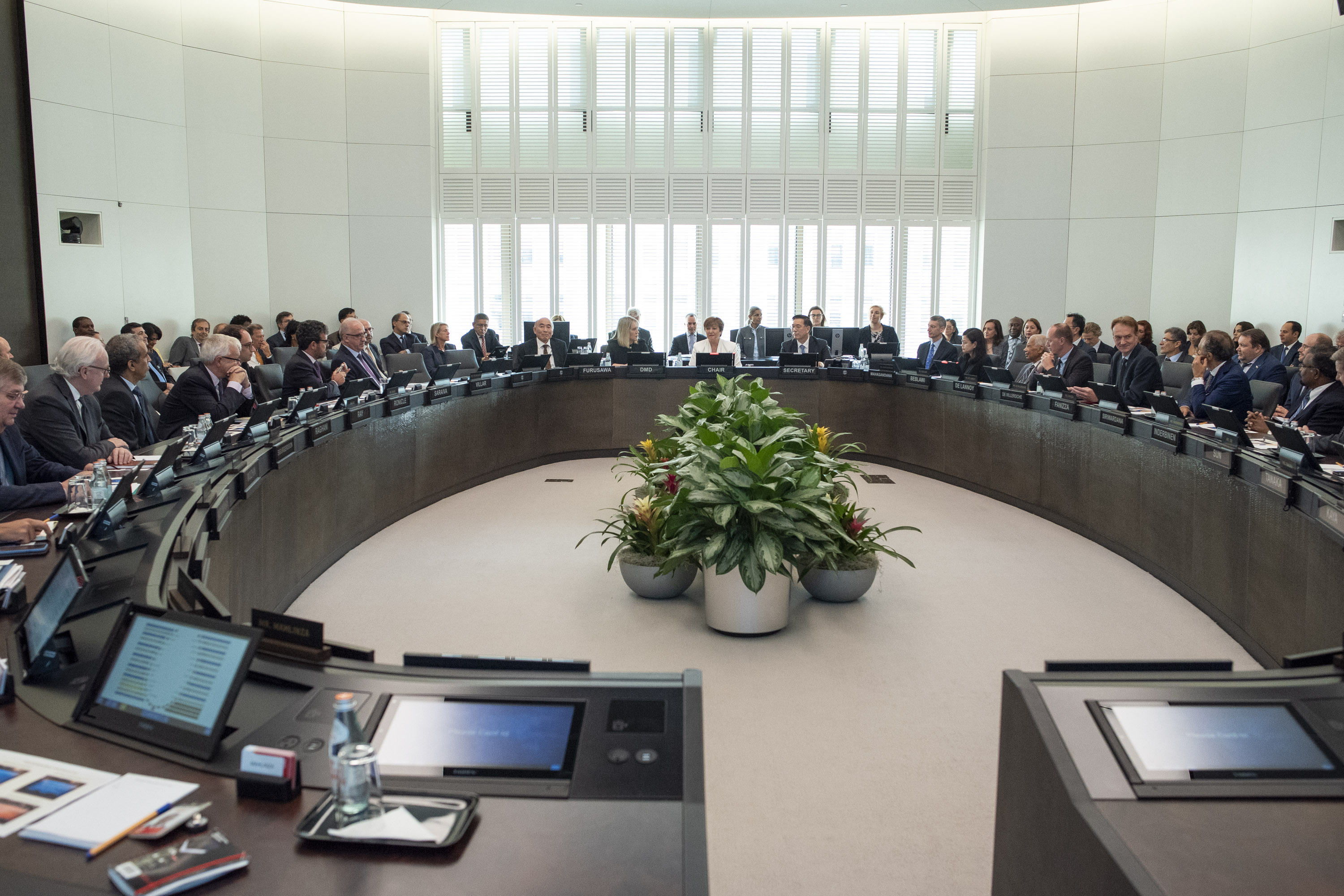
IMF Executive Board Concludes 2019 Article IV Consultation with the Russian Federation
IMF News, July 16, 2019
Source details
- Canonical URL
- IMF Executive Board Concludes 2019 Article IV Consultation with the Russian Federation
Other formats
Bibliographic details
- Published: July 16, 2019
Executive Board assessment and main messages
- Executive Directors agreed with the thrust of the staff appraisal.
- Commended the authorities for their sound macroeconomic policy framework that helped reduce policy uncertainty and mitigate effects of external shocks.
- Noted that despite the ongoing recovery, the medium-term outlook remains modest and called for continued strong policy efforts and comprehensive structural reforms to:
- accelerate potential growth,
- address institutional weaknesses and governance issues,
- strengthen the financial sector,
- lift productivity and investment.
Recent economic performance and outlook
- Output grew by 2.3 percent in 2018, driven by exports and consumption, which was supported by growth in real wages and higher labor demand.
- Investment registered a moderate increase compared to the previous year.
- Inflation picked up in the second half of 2018 after reaching historical lows earlier in 2018; one-off factors (ruble depreciation, food and fuel price increases) were the major drivers rather than demand pressures.
- Growth projections:
- Growth is projected at 1.2 percent in 2019, reflecting a weak first quarter estimate, lower oil prices and the impact of the higher VAT rate on private consumption.
- GDP growth should be supported by an increase in public sector spending under the national projects announced in 2018.
- Inflation has begun to fall and is expected to return to the 4 percent target by early 2020.
- Medium-term growth outlook: absent deeper structural reforms, long-run growth is projected to settle around 1.8 percent.
- Public infrastructure spending under national projects and increased labor supply due to pension reform could have a positive effect on the growth rate of potential output.
Fiscal policy and public finances
- Directors agreed that a neutral fiscal policy stance is currently appropriate.
- Additional fiscal consolidation would be needed in the long-term to ensure inter-generational equity.
- Fiscal rule:
- Anchors fiscal policy and helps shield the economy from fluctuations in oil prices, facilitating economic diversification.
- Further changes to the rule, especially after the slight relaxation last year, should be avoided to firmly establish credibility.
- National Welfare Fund (NWF):
- Authorities were encouraged to refrain from quasi-fiscal activities through the NWF and to continue to invest NWF funds into high-quality foreign assets.
- Spending and revenue recommendations:
- Welcome implementation of the pension reform and plans to boost spending on health, education, and infrastructure; spending plans should be well-targeted and efficiently implemented.
- Fiscal revenue framework could benefit from tax base broadening and growth-friendly shifts in taxation to incentivize labor supply, reduce labor informality, and attract new investment.
- Recommended simplification of oil sector taxation and phasing out subsidies on domestic fuel consumption.
- Expenditure on social assistance needs better targeting to have a stronger impact on reducing poverty.
Monetary policy and financial sector
- Directors supported continued easing of monetary policy given recent inflation outturns.
- Welcomed the Central Bank of Russia’s plans to maintain a careful and data-driven approach; noted inflation expectations are not yet firmly anchored.
- Encouraged the CBR to further refine its monetary policy communications strategy.
- Banking sector recommendations:
- Continue to enhance bank supervision and regulation, including strengthening asset quality reviews and reducing related-party loans.
- Continue efforts to complete consolidation of the banking sector.
- Welcomed macroprudential measure to curb unsecured consumer lending; additional measures may be needed if lending growth does not moderate.
- Emphasized importance of a credible strategy for returning rehabilitated banks to the private sector consistent with increasing competition among banks.
Structural reforms and governance
- Ambitious structural reforms are important to raise growth.
- Priority areas:
- Create a more vibrant private sector and reduce the footprint of the state.
- Enhance competition by facilitating entry and exit for firms and strengthening the institutional architecture in which firms compete.
- Governance and transparency:
- Welcomed advances in the fiscal transparency agenda; further progress needed to:
- report the government’s obligations under Public Private Partnerships,
- reduce the share of classified expenditure in the budget,
- strengthen State Owned Enterprise governance.
Selected macroeconomic indicators and projections (highlights from Table 1)
- Real GDP (annual percent change): 2016: 0.3; 2017: 1.6; 2018: 2.3; 2019 (Projection): 1.2; 2020 (Projection): 1.9.
- Real domestic demand (annual percent change): 2016: -1.1; 2017: 3.8; 2018: 1.5; 2019: 1.1.
- Consumption (annual percent change): 2016: -1.0; 2017: 3.1; 2018: 1.8; 2019: 1.7.
- Investment (annual percent change): 2016: -1.2; 2017: 6.0; 2018: 0.8; 2019: 1.0; 2020: 2.2.
- Consumer prices, period average: 2016: 7.1; 2017: 3.7; 2018: 2.9; 2019 (Projection): 4.9; 2020 (Projection): 3.9.
- Consumer prices, end of period: 2016: 5.4; 2017: 2.5; 2018: 4.3.
- Core CPI: 2016: 7.5; 2017: 3.5; 2018: 2.1; 2019: 4.1.
- Unemployment rate: 2016: 5.5; 2017: 5.2; 2018: 4.8.
- General government revenue (percent of GDP): 2016: 32.8; 2017: 33.3; 2018: 35.5; 2019 (Projection): 34.7; 2020 (Projection): 34.3.
- General government expenditures (percent of GDP): 2016: 36.4; 2017: 32.6; 2018: 33.0.
- General government net lending/borrowing (overall balance, percent of GDP): 2016: -3.7; 2017: -1.5; 2018: 1.3.
- Nonoil balance (percent of GDP): 2016: -9.8; 2017: -8.7; 2018: -7.0; 2019 (Projection): -6.9; 2020 (Projection): -6.7.
- Nonoil primary structural balance (percent of GDP): 2016: -8.9; 2017: -7.7; 2018: -6.6; 2019 (Projection): -6.4; 2020 (Projection): -6.1.
- Ruble broad money (annual percent change): 2016: 9.2; 2017: 10.5; 2018: 11.0; 2019 (Projection): 8.8; 2020 (Projection): 7.4.
- Credit to the economy (annual percent change): 2016: -1.6; 2017: 10.6; 2018: 9.8.
- Total merchandise exports, f.o.b (billions of U.S. dollars): 2016: 281.7; 2017: 353.5; 2018: 443.1; 2019 (Projection): 447.7; 2020 (Projection): 451.0.
- Total merchandise imports, f.o.b (billions of U.S. dollars): 2016: -191.5; 2017: -238.1; 2018: -248.6; 2019 (Projection): -255.7; 2020 (Projection): -264.5.
- External current account (billions of U.S. dollars): 2016: 24.5; 2017: 33.2; 2018: 113.8; 2019 (Projection): 106.5; 2020 (Projection): 97.5.
- External current account (percent of GDP): 2016: 6.9; 2017: 6.3; 2018: 5.6.
- Gross international reserves (Billions of U.S. dollars): 2016: 377.7; 2017: 432.7; 2018: 468.5; 2019 (Projection): 517.5; 2020 (Projection): 551.5.
- Months of imports (reserves): 2016: 17.0; 2017: 15.9; 2018: 16.4; 2019 (Projection): 17.6; 2020 (Projection): 18.1.
- Percent of short-term debt covered by reserves: 2016: 422.7; 2017: 376.0; 2018: 480.0; 2019 (Projection): 519.1; 2020 (Projection): 571.9.
- Nominal GDP (billions of rubles): 2016: 86,014; 2017: 92,101; 2018: 103,876; 2019 (Projection): 109,663; 2020 (Projection): 116,072.
- Nominal GDP (billions of U.S. dollars): 2016: 1,283; 2017: 1,579; 2018: 1,658; 2019 (Projection): 1,678; 2020 (Projection): 1,733.
- Real per capita GDP (2014=100): 2016: 97.7; 2017: 99.2; 2018: 101.5; 2019 (Projection): 102.8; 2020 (Projection): 104.8.
- Output gap (percent of potential GDP): 2016: -0.8; 2017: 0.2; 2018: -0.1.
- Exchange rate (rubles per U.S. dollar, period average): 2016: 67.1; 2017: 58.3; 2018: 62.7.
- Oil exports (billions of U.S. dollars): 2016: 119.9; 2017: 151.6; 2018: 207.2; 2019 (Projection): 197.2; 2020 (Projection): 196.2.
- Brent oil price (U.S. dollars per barrel): 2016: 44.0; 2017: 54.4; 2018: 71.1; 2019 (Projection): 68.4; 2020 (Projection): 66.9.
- Urals crude oil spot price (U.S. dollars per barrel): 2016: 41.9; 2017: 53.0; 2018: 69.6; 2019 (Projection): 65.4.
Source: IMF press release "IMF Executive Board Concludes 2019 Article IV Consultation with the Russian Federation," July 16, 2019.