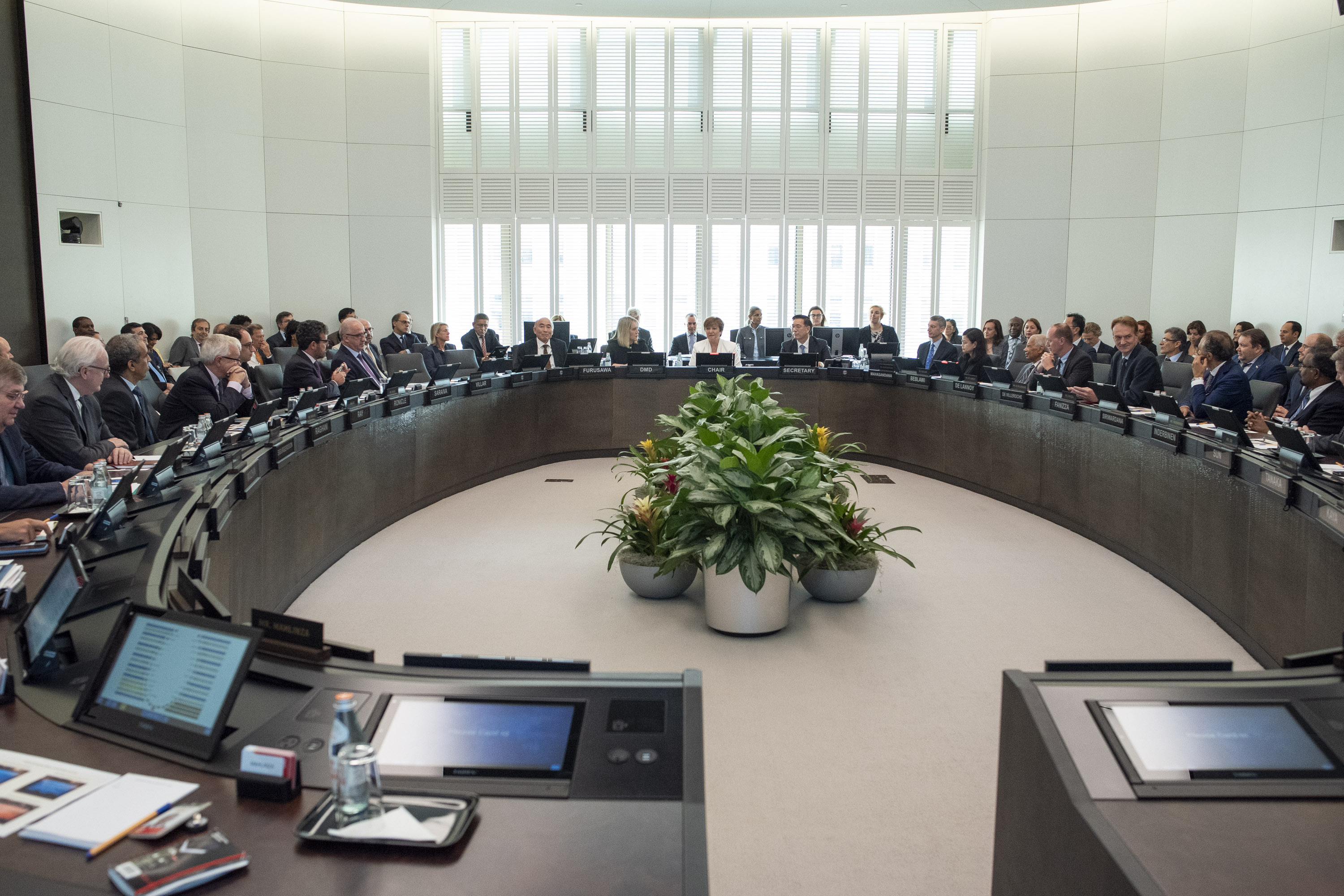
IMF Executive Board Discusses the Rise of Public and Private Digital Money—A Strategy to Continue Delivering on the IMF's Mandate
IMF News, July 29, 2021
Source details
- Canonical URL
- IMF Executive Board Discusses the Rise of Public and Private Digital Money—A Strategy to Continue Delivering on the IMF's Mandate
Other formats
Bibliographic details
- Published: July 29, 2021
Overview of the staff paper and strategic intent
- Press Release No. 21230; published July 29, 2021.
- The Executive Board discussed a staff paper titled “The Rise of Public and Private Digital Money—A Strategy to Continue Delivering on the IMF's Mandate.”
- A companion paper, “The Rise of Digital Money—A Strategic Plan to Continue Delivering on the IMF’s Mandate,” was discussed by the Executive Board in an informal meeting on April 2, 2021, and is also being published the same day as the staff paper.
- The paper sets out an operational strategy for the IMF to continue delivering on its mandate in light of rapidly changing developments from the rise of public and private digital money.
- Contact information provided: PRESS OFFICER: Nadya Saber; Phone: +1 202 623-7100; Email: MEDIA@IMF.org; @IMFSpokesperson.
Forces of change and new policy questions
- The paper summarizes forces driving adoption of digital forms of money and identifies new policy questions that emerge from those forces.
- Key thematic concerns enumerated in the paper:
- Trustworthiness: New forms of money must remain trustworthy, protect consumers, be safe, be anchored in sound legal frameworks, and support financial integrity.
- Domestic stability: Protect domestic economic and financial stability through carefully designed public-private partnerships, a smooth transition in the role of banks, and fair competition.
- Climate and fiscal support: Digital money should be designed to support climate sustainability and efficient fiscal policy.
- International monetary system (IMS) stability: Digital money must be designed, regulated, and provided so that countries maintain control over monetary policy, financial conditions, capital account openness, and foreign exchange regimes.
- Payments integration and inclusivity: Payment systems must grow increasingly integrated, not fragmented, and must work for all countries to avoid a digital divide.
- Reserve configurations and backstops: Reserve currency configurations and backstops must evolve smoothly.
How the IMF can help — core competencies and operational approach
- The paper outlines how the IMF can monitor and advise members on the transition using its four core competencies:
- Near universal membership.
- Focus on macro-financial policies and spillovers.
- Diversity of expertise.
- Unique ties to member countries—central banks and ministries of finance—through surveillance and capacity development.
- Operational elements described:
- Evolution of IMF core activities and outputs to address digital money issues.
- Partnerships with other organizations.
- Growth and structuring of internal resources to fulfill the vision.
- Monitoring and advisory role across surveillance and capacity development when requested by members.
Executive Board assessment — views and priorities
- Executive Directors welcomed the discussion of the strategy and recognized both opportunities and challenges from increased adoption of digital money.
- Broadly positive reception to staff proposals for:
- Closer engagement with other organizations and country authorities.
- Tailored support to member countries.
- Broader efforts in capacity development.
- Divergent views on implementation speed and resourcing:
- Many Directors found the strategy appropriately ambitious given fast-moving developments and the need for the Fund to act swiftly.
- Many other Directors called for further prioritization and a more phased implementation given complexity and an evolving regulatory environment.
- Consensus on central imperatives:
- Digital money has implications at the core of the Fund’s mandate—international monetary system, spillover and cross-border effects, and domestic economic structure and stability.
- Digital money must be designed, regulated, and provided so that countries maintain control over monetary policy, financial conditions, capital account openness, and foreign exchange regimes.
- Domestic economic and financial stability must be protected via public-private partnerships, a smooth transition for banks, fair competition, and ensuring financial integration and inclusion.
- Role endorsed for the Fund:
- Serve as a thought leader in analytical work and policy development, particularly on IMS issues, in close collaboration with other organizations.
- Provide timely advice in surveillance and capacity development to members when requested.
- Serve as a bridge between membership experience and international policy-making.
- Emphasize tailored advice for different stages of development and capacities—especially for low-income countries and EMDCs with less developed digital capabilities.
Resource allocation, capacity development, and implementation considerations
- Directors noted the staff proposal on resource allocation and broadly agreed it needs holistic consideration as part of the broader budget augmentation request.
- Views on resources:
- Many Directors were supportive of, or open to considering, the resource request.
- Many other Directors suggested a more modest, phased increase in resources calibrated to actual developments and finer details on work priorities.
- Several Directors stressed prioritizing and ensuring adequate resources to assist members—particularly LICs—with low capacity for mitigating risks from digital money and spillovers.
- Emphasis on efficient staffing and knowledge sharing:
- Partner and collaborate with other international financial institutions, country authorities, standard setters, and the private sector to maximize synergies and minimize duplication.
- Effective delineation of responsibilities will be important.
- Avoid excessive reliance on external experts; emphasize internal training of fungible economists to mainstream this workstream.
- Staff exchanges with other organizations and country authorities and promotion of knowledge sharing between country teams and functional departments.
Next steps and governance
- Directors called for regular engagement with the Board to reevaluate the appropriateness of the strategy and any agreed resource allocation.
- The Managing Director, as Chairman of the Board, summarizes Executive Directors’ views at the conclusion of the discussion and transmits the summary to the country's authorities; an explanation of qualifiers used in summings up is available at the IMF link noted in the original text.
Summary based solely on the IMF press release titled “IMF Executive Board Discusses the Rise of Public and Private Digital Money—A Strategy to Continue Delivering on the IMF's Mandate.”