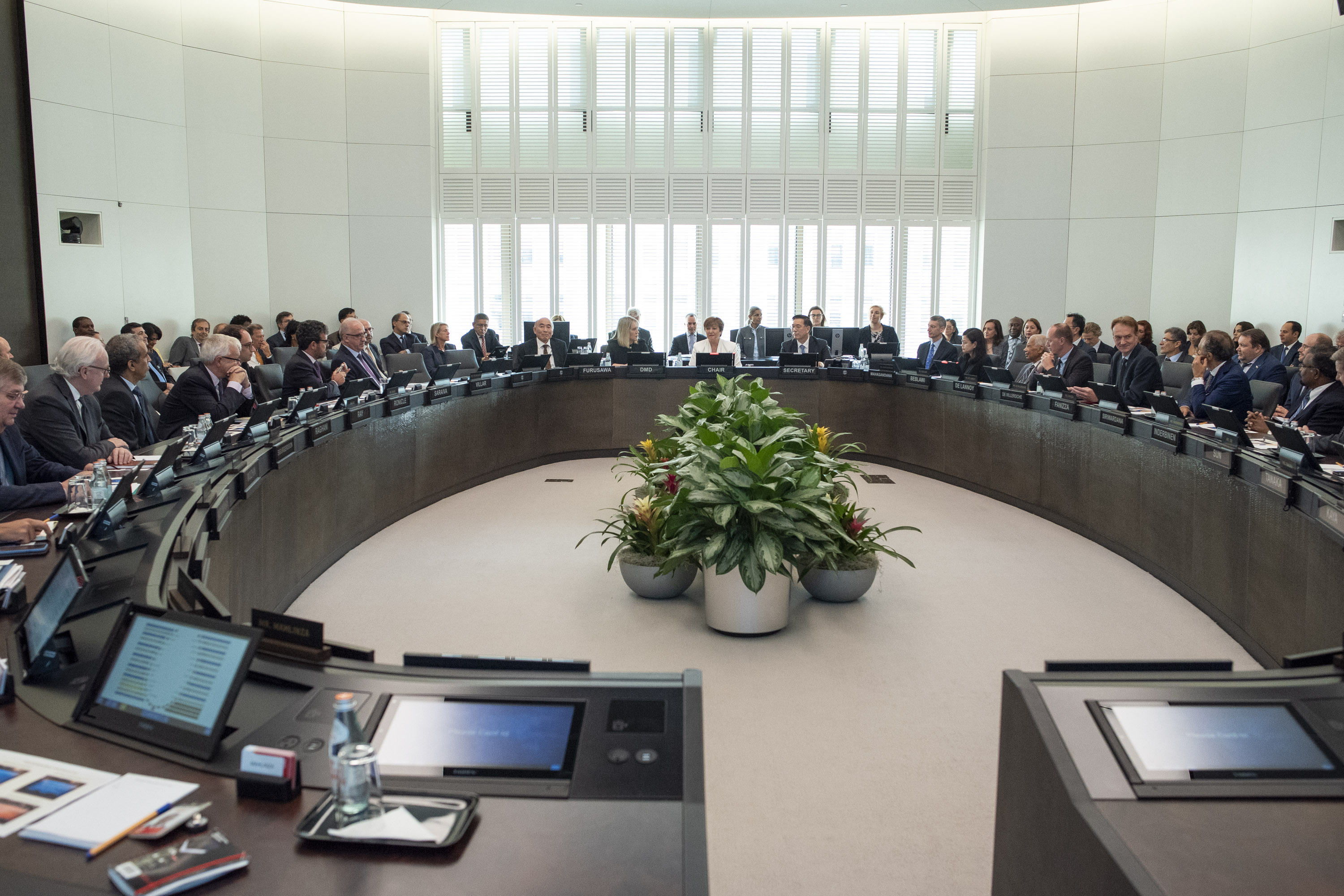
IMF Executive Board Concludes 2025 Article IV Consultation, Third Review under the Resilience and Sustainability Facility with Morocco
IMF News, April 8, 2025
Source details
- Canonical URL
- IMF Executive Board Concludes 2025 Article IV Consultation, Third Review under the Resilience and Sustainability Facility with Morocco
Other formats
Bibliographic details
- Published: April 8, 2025
Executive summary and financing
- The Executive Board concluded the 2025 Article IV consultation and completed the Third Review under the Resilience and Sustainability Facility (RSF) arrangement (approved in September 2023).
- Completion of the Third Review allows the authorities to draw SDR 375 million (about US$ 496 million).
- Total disbursement under the RSF arrangement now stands at SDR 937.5 million (about US$ 1.24 billion).
- Press Release No. 25/094; conclusion date of Executive Board discussion: March 17.
Growth, inflation, and external sector
- 2024 real GDP growth: 3.2 percent (estimated), down from 3.4 percent in 2023.
- Growth outlook: GDP growth expected to accelerate to about 3.7 percent over the next few years.
- 2024 drivers: Robust domestic demand helped offset weak agricultural output amid drought.
- Unemployment: about 13 percent in 2024; elevated mainly due to job losses in the agricultural sector.
- Inflation:
- Inflation (period average) in 2024: 0.9
- Inflation (end of period) in 2024: 2.1
- Bank Al-Maghrib lowered the policy rate twice in June and December 2024.
- Current account: widened somewhat in 2024.
- Exchange rate: the dirham continued to move within the fluctuation band of ±5 percent.
Fiscal developments and public debt
- 2024 central government overall deficit: 4.1 percent of GDP, about 0.2 percent of GDP less than projected in the 2024 Budget.
- Revenue (central government, percent of GDP):
- 2020: 27.0
- 2021: 25.1
- 2022: 28.4
- 2023: 27.9
- 2024: 30.1
- 2025 (proj.): 30.4
- 2026 (proj.): 29.4
- 2027 (proj.): 28.1
- Expenditure (central government, percent of GDP):
- 2020: 34.1
- 2021: 31.0
- 2022: 33.8
- 2023: 32.3
- 2024: 34.2
- 2025 (proj.): 34.3
- 2026 (proj.): 32.8
- 2027 (proj.): 31.4
- Fiscal balance (central government, percent of GDP):
- 2020: -7.1
- 2021: -5.9
- 2022: -5.4
- 2023: -4.5
- 2024: -4.1
- 2025 (proj.): -3.9
- 2026 (proj.): -3.4
- 2027 (proj.): -3.3
- Public debt (percent of GDP):
- 2020: 72.2
- 2021: 69.4
- 2022: 71.5
- 2023: 69.5
- 2024: 70.0
- 2025 (proj.): 68.9
- 2026 (proj.): 67.7
- 2027 (proj.): 66.8
- 2028 (proj.): 66.2
- 2029 (proj.): 65.6
- 2030 (proj.): 65.1
- Authorities are reforming the Organic Budget Law to introduce a new fiscal rule based on a medium-term debt anchor.
- Directors encouraged saving at least part of the revenue windfall and implementing additional structural measures to increase revenue and rationalize spending.
Monetary policy and financial sector
- Bank Al-Maghrib (BAM) lowered the policy rate twice in June and December 2024.
- Directors supported BAM’s monetary policy stance and advised a cautious data-dependent approach.
- Transition: Directors broadly concurred that the central bank should resume its planned transition to an inflation targeting framework and carefully remove the peg as conditions allow.
- Financial sector risks noted: rising risks from NPLs and bank concentration.
- Recommendations: introduction of a secondary market for NPLs; welcomed authorities’ request for an FSAP update.
- Progress: Morocco progressing to align financial supervisory and regulatory framework with international standards.
Structural reforms and RSF-related measures
- Structural agenda implementation continued: restructuring of SOEs, operationalization of the Mohammed VI Investment Fund, and implementation of the new Charter of Investment.
- RSF third and final review measures implemented 6 of the 7 scheduled measures.
- RSF measures aim to:
- Better protect underground water resources.
- Prepare the ground for a change in tariffication of water.
- Improve the regulatory setting of the electricity market to encourage private sector production of renewable energy.
- Reinforce fiscal and financial systems’ resilience to climate change-related risks.
- Carbon tax: gradual introduction was not implemented; authorities need further analysis and deeper consultations.
Executive Board assessment and policy recommendations
- Directors agreed with the thrust of the staff appraisal and welcomed Morocco’s resilience supported by strong policies and frameworks.
- Policy guidance and priorities highlighted by Directors:
- Continue prudent macroeconomic policies and implement structural reforms to support activity amid uncertainty.
- Save part of revenue windfalls and rationalize spending to rebuild fiscal buffers.
- Report budgetary implications and risks from Investment Charter and public private partnerships in the Medium-Term Fiscal Framework.
- Introduce the planned medium-term debt anchored fiscal rule.
- Further improve the business environment and market competition, including reforming state owned enterprises and reducing their presence outside strategic sectors.
- Continue the fight against corruption.
- Advance the regulatory framework for renewable energy production and improve grid capacity to secure private sector participation.
- It is expected the next Article IV consultation will be held on the standard 12-month cycle.
Selected economic indicators and memoranda (highlights)
- Population: 36.8 million; 2024
- Per capita GDP: $3,817; 2023
- Quota: SDR 894.4 million
- Poverty rate: 4.8 percent; 2013
- Main exports: automobiles, phosphate and derivatives; 2023
- Key export markets: France and Spain (42% of total trade); 2023
- Selected time-series datapoints:
- Real GDP growth:
- 2020: -7.2
- 2021: 8.2
- 2022: 1.5
- 2023: 3.4
- 2024: 3.2
- 2025 (proj.): 3.9
- 2026 (proj.): 3.7
- 2027 (proj.): 3.6
- Unemployment:
- 2020: 11.9
- 2021: 12.3
- 2022: 11.8
- 2023: 13.0
- 2024: 13.3
- 2025 (proj.): 13.2
- 2026 (proj.): 12.9
- 2027 (proj.): 12.4
- 2028 (proj.): 12.1
- Current account (percent of GDP):
- 2020: -1.2
- 2021: -2.3
- 2022: -3.5
- 2023: -0.6
- 2024: -1.5
- 2025 (proj.): -2.0
- 2026 (proj.): -2.2
- 2027 (proj.): -2.6
- 2028 (proj.): -2.9
- Gross reserves (months of imports):
- 2020: 7.2
- 2021: 5.8
- 2022: 5.4
- 2023: 5.2
- 2024: 5.2
- External debt (percent of GDP) selected years:
- 2020: 54.2
- 2021: 45.5
- 2022: 46.9
- 2023: 50.2
- 2024: 47.8
- 2025 (proj.): 49.2
- 2026 (proj.): 50.0
- 2027 (proj.): 50.9
- 2028 (proj.): 54.0
- 2029 (proj.): 57.3
- Nominal GDP (in billions of U.S. dollars):
- 2020: 121
- 2021: 142
- 2022: 131
- 2023: 144
- 2024: 155
- 2025 (proj.): 166
- 2026 (proj.): 177
- 2027 (proj.): 188
- 2028 (proj.): 199
- 2029 (proj.): 212
- 2030 (proj.): 225
- Net imports of energy products (in billions of U.S. dollars):
- 2020: -5.3
- 2021: -8.4
- 2022: -15.1
- 2023: -11.5
- 2024: -12.1
- 2025 (proj.): -12.3
- 2026 (proj.): -13.2
- 2027 (proj.): -13.7
- 2028 (proj.): -14.1
Source: IMF Communications Department — "IMF Executive Board Concludes 2025 Article IV Consultation, Third Review under the Resilience and Sustainability Facility with Morocco", April 8, 2025.
References
- https://www.imf.org/-/media/images/imf/bios/imfboard.jpg
- The Executive Board
- IMF Policy Advice -- A Factsheet
- IMF-World Bank Debt Sustainability Framework for Low-Income Countries -- A Factsheet
- Special Drawing Rights (SDRs) -- A Factsheet
- Press Releases
- PRESS CENTER
- PR 23/327).
- http://www.IMF.org/external/np/sec/misc/qualifiers.htm
- https://www.imf.org/en/home