Does Cheap Foreign Money Bring Risks for Latin America?
IMF Blog, May 4, 2010
Source details
- Canonical URL
- Does Cheap Foreign Money Bring Risks for Latin America?
Other formats
Bibliographic details
- Authors: Nicols Eyzaguirre
- Published: May 4, 2010
Context and framing
- Author and date: Nicolás Eyzaguirre, May 4, 2010.
- Central question: abundant and cheap foreign financing creates opportunities (debt management, saving on interest, investment) but also potential risks that must be managed.
- Comparative scope: analysis focuses on Latin America and compares responses with a group of advanced commodity-exporting economies—Canada, Australia and New Zealand, and Norway—as well as with other regions.
Definition of “easy external financial conditions”
- Measured using two summary indicators:
- Interest rates in reserve currency countries: U.S. short-term interest rates, minus expected U.S. core inflation.
- Global risk aversion: the VIX (financial market indicator closely related to emerging market bond spreads).
- Episodes labeled “easy” when both indicators are on the low side (examples: a number of years in the 1990s, and 2004-07).
- Current (as of publication) observations: the U.S. real interest rate is unusually low and likely to remain low given the weak U.S. economy; the VIX is well below its historical average, though this is uncertain and subject to jumps tied to investor concerns (noted spikes earlier in the year and briefly in late April).
Empirical findings on macro responses
- Domestic demand and credit:
- Low foreign interest rates and low VIX levels stimulate domestic demand and credit.
- These stimulative effects have been much larger in Latin America than in the comparator group of advanced economies.
- The demand response in Latin America comes mainly from the private sector, with governments also tending to increase expenditure—unlike the advanced economy group.
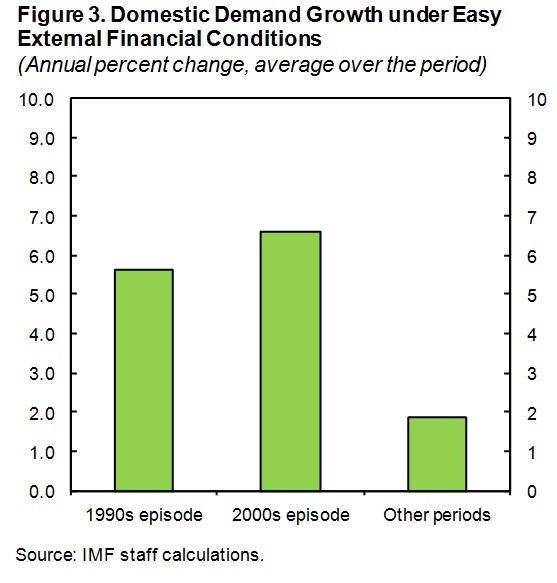
- Result: in Latin America, domestic demand tended to grow much in excess of trend output during episodes of easy conditions (see Figure 3).
- Exchange rate policies and outcomes:
- Advanced economies featured highly flexible exchange rates; currency appreciation helped choke off foreign-financed domestic demand growth.
- Latin American countries have increased exchange rate flexibility over time, but in 2006-07 many joined other emerging markets in trying to limit or smooth appreciation of their currencies.
- Some Eastern European economies that maintained fixed exchange rates during the same years experienced the fastest domestic demand growth, large current account deficits, and soaring credit—until the boom ended.
- Capital inflows dynamics:
- Capital inflows accelerate during easy external financial conditions.
- Volume of inflows is influenced not only by foreign investors but also by domestic private and public sector responses to easy global conditions.
- Strong private spending can widen current account deficits and increase demand for foreign financing.
- Central bank foreign exchange intervention that holds the exchange rate at a too-weak level, or excessively limits appreciation and volatility, can create incentives for additional capital inflows rather than dissipating them.
Key risks identified
- Booms in domestic demand and credit.
- Large current account deficits and capital inflows.
- Accumulation of risks that can lead to boom-bust outcomes, though such outcomes are not inevitable and depend on policy responses.
Policy recommendations and tools to contain risks
- Allow significant flexibility of the exchange rate to help absorb external shocks and limit excessive foreign-financed demand growth.
- Maintain fiscal discipline and use fiscal policy to lean against possible excessive demand growth.
- Apply macroprudential financial policies to dampen unwanted credit booms.
- If the above measures are insufficient, consider carefully designed taxes on capital inflows on a temporary basis.
Notes for further analysis
- The May 2010 Regional Economic Outlook for the Western Hemisphere contains extended analysis, including a discussion of the risks of currency appreciation for economic growth (Chapter 3) and chapters on the current economic environment and revised outlook for the Latin American and Caribbean region, the United States, and Canada.
Does Cheap Foreign Money Bring Risks for Latin America? — Nicolás Eyzaguirre, May 4, 2010 (IMF blog page overview).