Is There a Silver Lining to Sluggish Credit Growth in the Gulf Countries?
IMF Blog, December 7, 2010
Source details
- Canonical URL
- Is There a Silver Lining to Sluggish Credit Growth in the Gulf Countries?
Other formats
Bibliographic details
- Authors: Masood Ahmed
- Published: December 7, 2010
Overview
- Bank credit has been very slow to pickup in the six nations of the Gulf Cooperation Council (GCC).
- Sluggish credit growth in the post-crisis period was observed broadly in the Middle East and Central Asia region and elsewhere; however, credit to the private sector remained barely growing in the GCC despite policy efforts to revive it.
- The negative impact of weak credit growth on short-term economic activity may be limited, partly because of how the current situation arose.
Causes of the credit slowdown
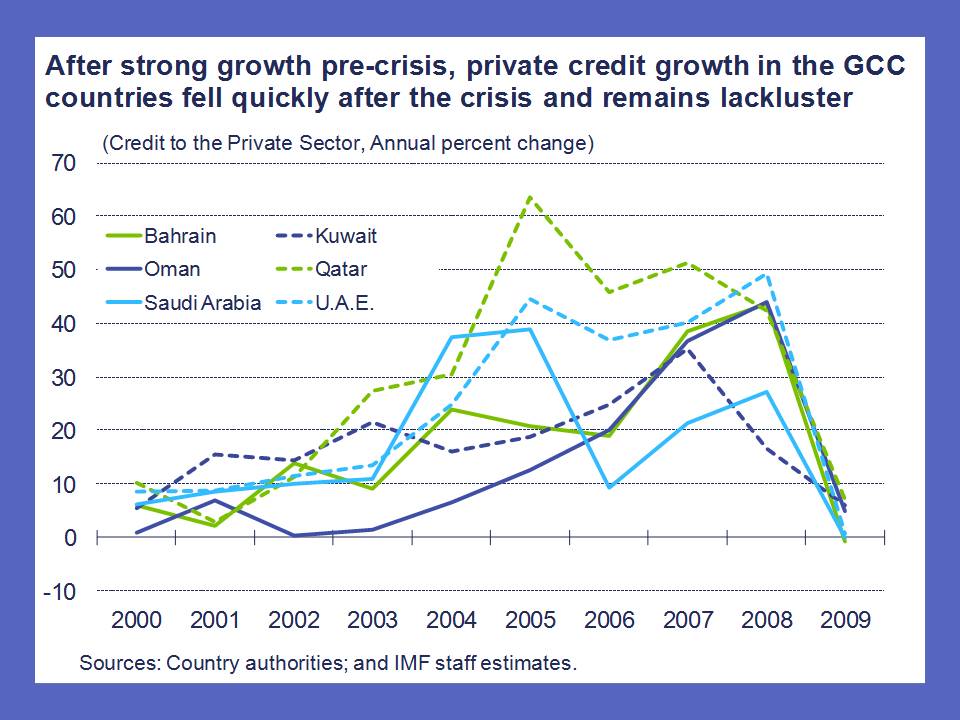
- Pre-crisis (five years before the crisis) the GCC countries—Bahrain, Kuwait, Oman, Qatar, Saudi Arabia, and the U.A.E.—experienced significant increases in credit, spurred by favorable macroeconomic conditions.
- At its peak, credit growth exceeded 30 percent year-on-year.
- The crisis reversed the situation; credit growth quickly fell and remained anemic during 2010.
- Supply-side factors:
- Funding strains have been overcome, but higher risk aversion and stricter lending policies by banks have stifled credit growth.
- Banks in all GCC countries reconsidered lending practices that had sometimes relied on the reputation of the borrower (“name lending”) rather than credit analysis.
- Demand-side factors:
- Demand for credit appears to have dropped with the decline in real estate prices, the slowdown in construction activities and non-oil growth, and corresponding weakness in investor and consumer confidence.
Reasons not to be overly concerned (the “silver lining”)
- The adjustment in credit growth reflects a much needed correction from very high—perhaps unsustainable—rates of credit growth witnessed during the boom years.
- There are signs of a modest rebound in credit growth in Bahrain, Oman and Saudi Arabia.
- Banking system health is generally satisfactory:
- Capital adequacy ratios remain strong.
- IMF staff stress tests indicate banks are generally resilient to severe shocks.
- Significant progress in financial and corporate restructuring during 2010 helped shore up market confidence.
- Underlying sectoral shifts:
- Overall banking sector credit growth masks trends: credit is moving away from volatile sectors (like real estate and household equity purchases) toward more stable sectors such as industry, trade, and services.
- Credit growth to industry, trade, and services has been healthy in a number of countries.
- Alternative financing channels supplement bank credit:
- Some governments are guaranteeing foreign debt issued by government-related entities (Qatar and Abu Dhabi).
- Some governments are increasing their advance payments to contractors (Qatar and Saudi Arabia), lowering the need to seek bank credit for working capital.
- Specialized credit institutions, especially in Saudi Arabia, have significantly increased credit to domestic sectors.
- Corporates in the GCC generally appear to have adequate cash balances and can finance operations from these cushions in the short term.
Policy implications and recommendations
- Fiscal and monetary policies have been geared to support recovery, but these supports are not open-ended; private sector activity and private sector credit growth will need to resume a more active role.
- Demand-side policy:
- It is appropriate for country authorities to maintain fiscal stimulus—if there is fiscal space—and quantitative easing in 2010, and possibly into 2011.
- These policies should be revisited at signs of a pickup in inflation, which remains relatively muted.
- Supply-side policy to improve credit supply:
- Strengthen corporate governance, financial disclosure, and transparency.
- Build banks’ capacity to assess credit risk.
- Develop alternative domestic sources of corporate funding, primarily domestic or regional debt markets, to diversify financing channels and improve standards for financial disclosure.
Source: Masood Ahmed, December 7, 2010
Content in this bundle
- 120710a