The Long and the Short of It—Government Debt Plans in 2011 and Beyond
IMF Blog, February 1, 2011
Source details
- Canonical URL
- The Long and the Short of It—Government Debt Plans in 2011 and Beyond
Other formats
Bibliographic details
- Authors: Carlo Cottarelli
- Published: February 1, 2011
Overview and context
- Author: Carlo Cottarelli
- Date: February 1, 2011
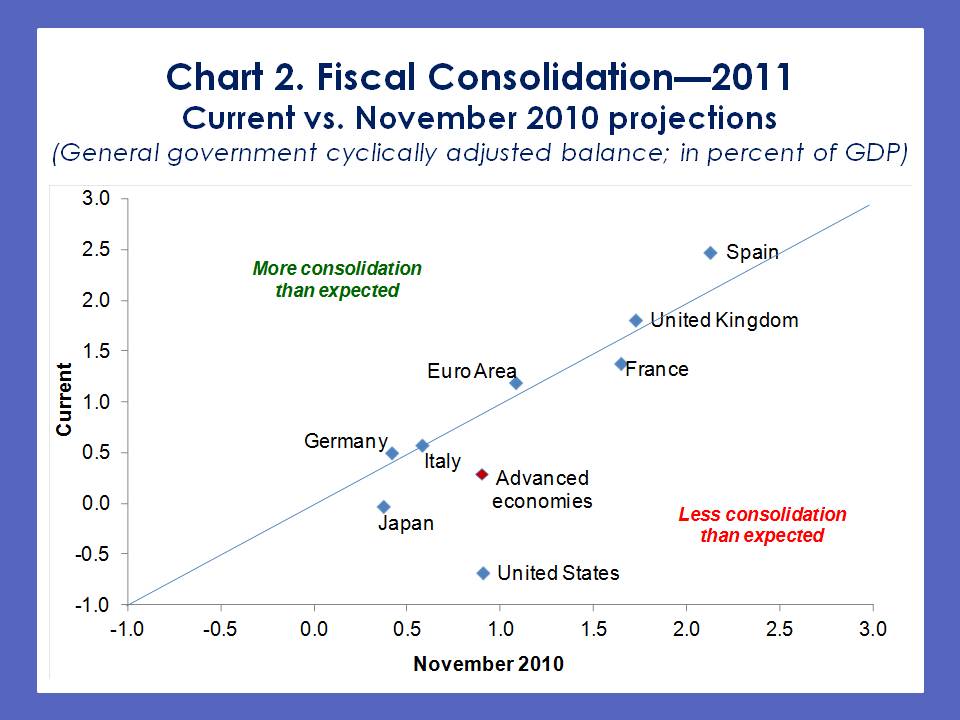
- Main point: Fiscal policy in some leading advanced economies in 2011 diverged from expectations in November 2010, with the United States and Japan delaying earlier plans to reduce public deficits and providing further support to their economies.
- Emphasis: Countries need to detail medium-term measures to lower deficits and debt; sovereign risks remain elevated and in some cases have increased since November 2010.
2010 fiscal outcomes
- Advanced economies: fiscal developments in 2010 were slightly better on average—by about 0.3 percent of GDP—than estimated in the November 2010 Fiscal Monitor, with larger differences for some individual countries.
- Emerging economies: the average 2010 fiscal deficit was broadly unchanged from November estimates, though notable country differences exist.
- Revenue developments in emerging economies:
- Revenue growth has been solid, reflecting higher commodity prices and asset prices and, to some extent, strong capital inflows.
- Concern: in several countries (for example, in Latin America) these revenue gains have financed higher spending; some of the revenue increase may be transitory but the spending it financed may not be.
Changes in 2011 fiscal stance and causes
- The United States and Japan postponed earlier deficit-reduction plans and introduced additional stimulus measures in the last two months (relative to the November 2010 plan), contributing to a changed fiscal stance.
- Part of the shift versus earlier projections is due to somewhat better-than-projected fiscal results in 2010; most of it is due to additional stimulus measures.
Assessment of medium-term plans and institutions
- United States:
- The fiscal commission produced comprehensive and sound medium-term deficit-reduction proposals.
- Despite failing to achieve the supermajority to submit the proposal to Congress, the recommendations are welcomed.
- The IMF welcomes President Obama’s emphasis (in the State of the Union) on broad-based fiscal reforms, including discretionary spending restraint, revenue measures, and entitlement reforms (most critically, health care spending).
- The IMF looks forward to reviewing the U.S. Administration’s specific proposals in the forthcoming budget.
- Europe:
- Main change: decision by the European Council to create a permanent crisis management and resolution arrangement (institutional change).
- At the country level: some weakening of fiscal institutions noted (example: Hungary, where a non-partisan fiscal watchdog was effectively closed).
Policy implication and recommendation
- No single year of deficit reduction in 2011 is sufficient to restore fiscal accounts to robust good health; restoring government accounts requires a multi-year effort.
- Countries—especially those that delayed consolidation—need to strengthen fiscal adjustment credibility by detailing the measures they will adopt to lower deficits and debt over the medium term.
- The elevated sovereign risks and, in some cases, increased risks since November 2010 underscore the need for more robust and specific medium-term consolidation plans.
Source: The Long and the Short of It—Government Debt Plans in 2011 and Beyond, Carlo Cottarelli, February 1, 2011