Does Foreign Exchange Intervention Slow the Pace of Currency Appreciation?
IMF Blog, May 4, 2011
Source details
- Canonical URL
- Does Foreign Exchange Intervention Slow the Pace of Currency Appreciation?
Other formats
Bibliographic details
- Authors: Gustavo Adler, Camilo E Tovar
- Published: May 4, 2011
Overview
- Abundant global liquidity and high exposure to capital movements have put foreign exchange intervention at center stage of the policy debate in Latin America.
- The analysis covers intervention practices and effectiveness for a group of economies in Latin America and other regions during 2004-10.
- Key questions examined:
- How do Latin American countries intervene and in what respects do they differ from other economies?
- What are the rationales for these policies?
- How effective have they been in affecting the exchange rate?
- Most central banks in Latin America were actively involved in foreign exchange markets and, on average, about one third intervened on any given day.
- Intervention in the region came in waves—frequently corresponding with shifts in global financial conditions—and there are cross-country differences:
- Chile, Colombia, Guatemala, and Mexico were moderate interveners.
- Peru and Uruguay (dollarized economies) and Brazil intervened more heavily.
- Intervention has often been accompanied by exchange rate appreciation, complicating causal assessment because:
- Intervention affects the exchange rate.
- The decision to intervene depends on the exchange rate.
- The counterfactual (what would have happened absent intervention) is unknown.
How countries intervene
- Information gaps exist on central bank intervention practices; a qualitative database was developed using central bank publications, statements, and press releases to fill some gaps.
- Most common stated rationales:
- To build international reserve buffers.
- To contain exchange rate volatility.
- Other stated reasons tend to be vague.
- Rule-based versus discretionary approaches:
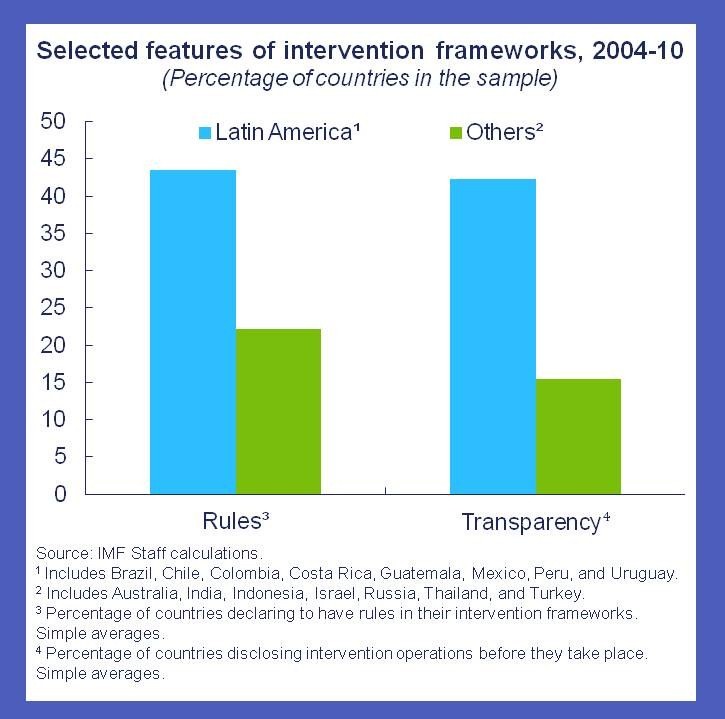
- Central banks in one third of the countries looked at have used some form of rule-based approach to intervention.
- Rule-based approaches are more common in Latin America, with country variation:
- Chile and Mexico always used rules when intervening.
- Colombia and Guatemala relied on rules while giving themselves room for discretionary purchases.
- Brazil, Peru, and Uruguay did not use rules.
- Market instruments used:
- The spot market is the most commonly used market, possibly reflecting higher liquidity.
- As derivative markets expanded, some central banks increased use of such instruments:
- Central Bank of Brazil uses forward and swap markets.
- Central Banks of Colombia and Mexico have used options.
- Transparency:
- Latin America is among the most transparent regions in terms of its operations, publishing better and more timely information.
How effective is intervention?
- No immediate impact of interventions on the rate of appreciation was detected.
- Statistically significant effects were found on the pace of appreciation:
- Increasing interventions by 0.1 percent of GDP will produce—in one week and in comparison to a country that does not intervene—a 0.3 percent slowdown in the pace of appreciation.
- Effectiveness by institutional/design features:
- Effectiveness is not dependent on the use of rules or discretionary frameworks, or on the degree of transparency.
- Greater financial integration may significantly reduce the effectiveness of interventions.
- Intervention is more effective in Asia than in Latin America, consistent with regional differences in financial integration.
- Timing and misalignment:
- Interventions are most effective when there are signs of the currency being overvalued compared to its recent history.
- This highlights the importance of intervening “when the time is right,” and never “too early”.
Conclusions and policy implications
- Foreign exchange market interventions may help to mitigate appreciation temporarily.
- The impact of intervention depends on country-specific circumstances and characteristics.
- Key factors influencing effectiveness:
- Degree of capital account openness.
- Exchange rate misalignment.
- Policymakers should weigh benefits against costs:
- Foreign exchange intervention carries major quasi-fiscal costs and other nonfinancial costs.
Source: Does Foreign Exchange Intervention Slow the Pace of Currency Appreciation? (Gustavo Adler, Camilo E. Tovar, May 4, 2011)