Tailwinds or Headwinds? Adjusting the Economic Sails in Latin America
IMF Blog, October 5, 2011
Source details
- Canonical URL
- Tailwinds or Headwinds? Adjusting the Economic Sails in Latin America
Other formats
Bibliographic details
- Authors: Nicols Eyzaguirre
- Published: October 5, 2011
Context and timing
- Author: Nicolás Eyzaguirre
- Date: October 5, 2011
- Focus: Latin America (analysis drawn from the Regional Economic Outlook for Western Hemisphere)
- Outlook horizon referenced: the next six to eighteen months
Current global environment and implications
- Global uncertainty described as "virtually unprecedented."
- Possible global scenarios affecting Latin America:
- Headwinds: greater stress in the global economy and markets resulting from unresolved problems in advanced economies.
- Tailwinds: renewed confidence and stronger global demand if advanced countries' problems are tackled.
- Volatile gusts: weak growth and continued uncertainty producing unstable outcomes similar to current conditions.
Strengths in Latin America noted
- Inflation is generally under control in most countries.
- Government budgets are in reasonably good shape.
- Financial systems are stronger than in past decades.
- Exposure to the vagaries of international finance is lower.
- Exchange rates are allowed to move more to absorb shocks.
Historical performance and risk of overheating
- In 2008–09 global crisis, Latin America was hit but subsequently bounced back strongly.
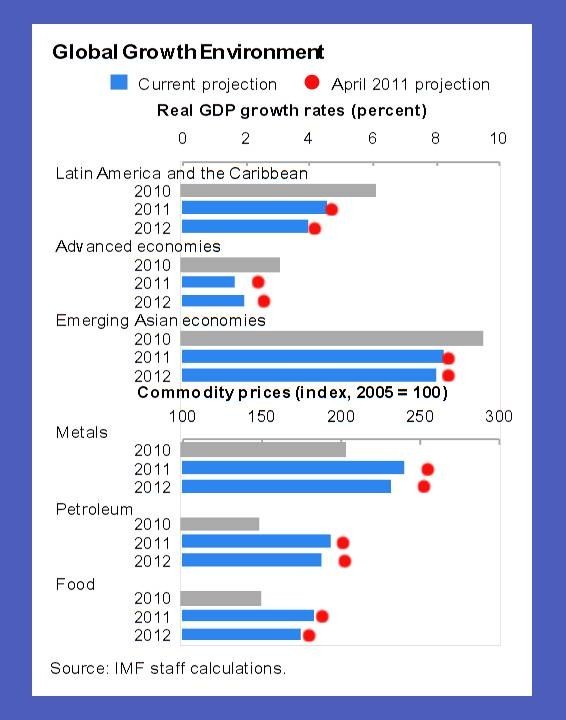
- The post-crisis recovery benefited from the dual tailwinds of buoyant commodity prices and easy external finance.
- Prior to the fading of tailwinds, some countries experienced overheating symptoms: growing inflation, widening current account deficits, and strong credit growth.
Recent shifts in external conditions
- Tailwinds are fading: commodity prices remain high but have come down and could fall further if world demand falters.
- International financial markets remain volatile with unusually fluid day-to-day sentiment.
- If global uncertainties are resolved, tailwinds could return strongly; if not, headwinds could intensify.
Headwinds scenario — transmission channels and risks
- Collapse in confidence could trigger intense volatility in global financial markets.
- Another recession in advanced countries would:
- Slow growth in Asian emerging markets.
- Reduce demand supporting commodity prices.
- Deliver a heavy blow to Latin America, particularly commodity exporters.
- Potential consequences for the region:
- Capital flows could dry up, squeezing domestic credit markets.
- Growth could slow abruptly as foreign demand and commodity prices fall.
- Currencies and financial conditions could come under pressure.
- Investors, if spooked by troubles elsewhere, would scrutinize fundamentals and potentially pull out.
Tailwinds scenario — implications if global outlook improves
- Early resolution to global uncertainties could:
- Stoke confidence and renew capital inflows to the region.
- Be accompanied by easy monetary policies in advanced economies, further propelling capital flows.
- Cause commodity prices to soar as global demand revives, particularly in emerging Asia.
- Risk: renewed dual tailwinds could lead to overheating pressures again.
Policy recommendations — navigating shifting winds
- Fiscal policy:
- Stay the course of gradual fiscal consolidation until global prospects are clearer.
- Resist the temptation to ramp up government spending now to preserve fiscal buffers for a potential global downturn and to maintain fiscal credibility.
- Monetary policy:
- Be nimble; use monetary easing first to counter a downturn when it appears.
- Central banks with strong inflation control records and well-anchored inflation expectations can pause now and even cut rates if risks materialize.
- If uncertainties settle and tailwinds return, central banks may need to resume tightening.
- Financial sector vigilance and prudential policy:
- Monitor stress in financial institutions and corporations, particularly liquidity strains.
- Keep watch for liquidity strains that can spread virulently to emerging markets, as in 2008–09.
- If external finance remains cheap and domestic credit is frothy, implement tighter prudential policies to protect financial sectors.
Overall guidance
- Countries should stand ready to deal with both headwinds and stronger tailwinds.
- With the right policies, Latin America can influence its future regardless of which external winds prevail.
Source: Tailwinds or Headwinds? Adjusting the Economic Sails in Latin America, Nicolás Eyzaguirre, October 5, 2011.
Content in this bundle
- Wreo1011c2
- Wreo1011c3