India: Linked or De-linked from the Global Economy?
IMF Blog, October 25, 2011
Source details
- Canonical URL
- India: Linked or De-linked from the Global Economy?
Other formats
Bibliographic details
- Authors: Anoop Singh
- Published: October 25, 2011
Overview / Context
- Author: Anoop Singh
- Date: October 25, 2011
- Key framing:
- Global outlook described as “fairly uneven and uncertain.”
- Risks building up especially in Europe, including “an extreme scenario with financial disruption.”
- India historically less prone to external forces than many others, but still exposed and in need of a “new wave of reforms.”
De-linked — why India can remain relatively insulated
- Growth projection:
- “In our latest Regional Economic Outlook for Asia, we expect India to grow by about 7½ percent in 2011 and 2012, only marginally below its estimated potential.”
- Structural features supporting partial insulation:
- India is less open to international trade than most other economies in the region.
- Rural consumption is “fairly insulated from the world economy.”
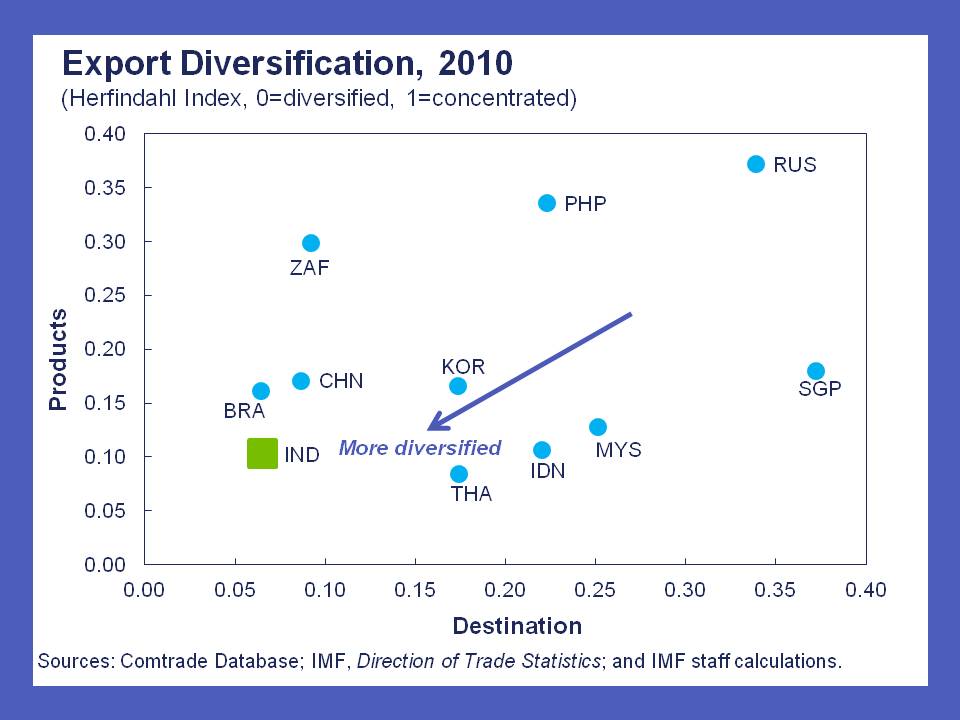
- India’s exports are “less dependent on advanced economies,” and are “more diversified—both geographically and in terms of the products it sells—than its neighbors and competitors.”
- Implication:
- A protracted slowdown in advanced economies would lower India’s growth somewhat, but growth is expected to “still remain robust.”
- In that scenario, the primary domestic challenge highlighted is elevated inflation.
Linked — channels of vulnerability if global financial stress intensifies
- Historical evidence of financial integration and vulnerability:
- India’s financial markets came under considerable pressure in 2008; investment “dipped substantially” as a transmission channel.
- India’s stock market is described as “one of the most correlated in the region with the VIX,” linking it to global risk aversion.
- The 2008 Lehman episode is invoked as an example of global financial contagion.
- Present-day vulnerabilities (as of the article):
- India has a current account deficit.
- Some major Indian corporates are global players relying more extensively on external debt issuance.
- Foreign investors have more extensive holdings in the Indian stock market.
- Implication:
- In an extreme scenario with contagion and further financial shocks, India would likely be hit materially.
Time for reform — policy recommendations and priorities
- Policy space and constraints:
- India “has the tools and the experience to deal with a repeat of 2008,” but “likely have less policy space now,” much of which was used during the initial crisis response.
- Inflation remains above the Reserve Bank of India’s comfort zone, constraining monetary policy flexibility.
- Fiscal policy and buffers:
- Rebuilding buffers to recreate policy space is emphasized; “fiscal consolidation remains pivotal.”
- Recommended shift in budgetary expenditure composition: away from untargeted subsidies (examples given: fuel and fertilizer) and toward infrastructure, health, and education.
- Structural reforms to boost investment and domestic demand:
- Proposed reforms include:
- Introducing the GST.
- Improving the business environment.
- Liberalizing the labor market.
- Furthering trade and financial reforms.
- Rationale: Strengthening domestic demand and boosting investment will help India compensate for external headwinds and sustain growth momentum.
- Historical precedent:
- Reference to 1991 reforms prompted by a balance of payments and fiscal crisis, which “have continued paying off to this day.”
- Conclusion:
- “Today’s risks can be translated into tomorrow’s reforms and growth momentum.”
IMF blog post: India: Linked or De-linked from the Global Economy? — Anoop Singh, October 25, 2011