Latin America’s Commodity Dependence: What if the Boom Turns to Bust?
IMF Blog, November 1, 2011
Source details
- Canonical URL
- Latin America’s Commodity Dependence: What if the Boom Turns to Bust?
Other formats
Bibliographic details
- Authors: Gustavo Adler, Sebastian Sosa
- Published: November 1, 2011
Regional exposure and historical patterns
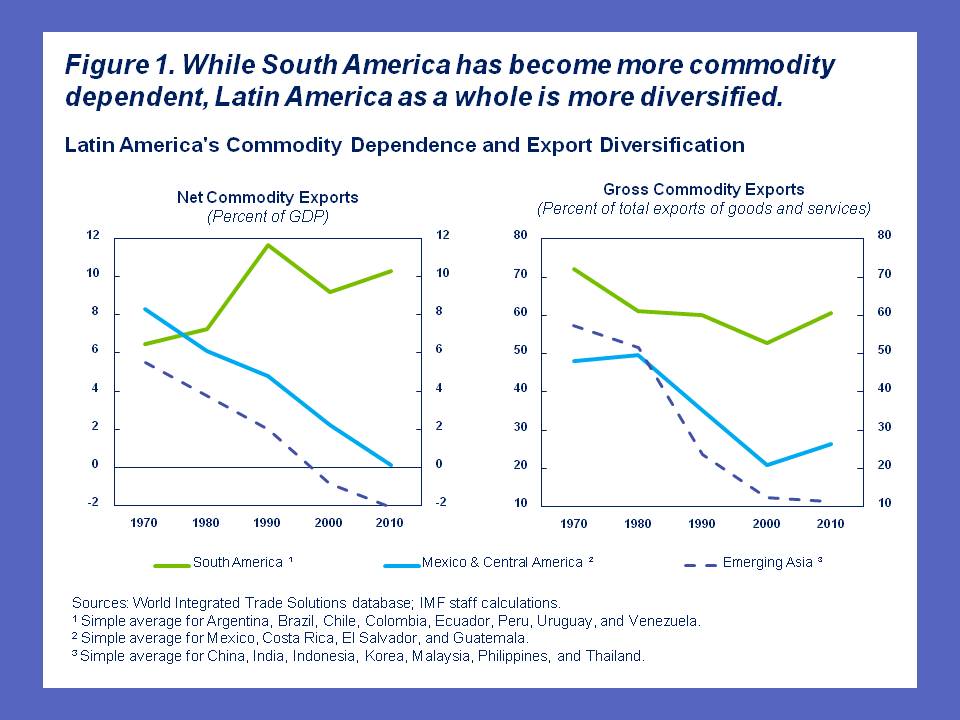
- South America is as commodity dependent (or more) as four decades ago, with exports of basic goods reaching about 10 percent of GDP in 2010 (see Figure 1, left panel).
- Mexico and Central America have seen commodity dependence fall sharply, reaching balanced trade in 2010.
- Emerging Asia moved from being a net commodity exporter in 1970 to a net importer in 2010.
- Latin America as a whole is more diversified than four decades ago because noncommodity exports have grown even more rapidly than commodity exports over the past 40 years (see Figure 1, right panel).
- Exceptions to diversification: heavy energy exporters (Colombia, Ecuador, and Venezuela) and metal exporters (Chile and Peru) have experienced both increasing dependence on and little (or no) diversification away from commodities, making them especially vulnerable to a commodity price slump.
Commodity price behavior and sensitivity
- Energy and metal prices have tripled since 2003, and current prices are not far from the historic peaks of the 1970s.
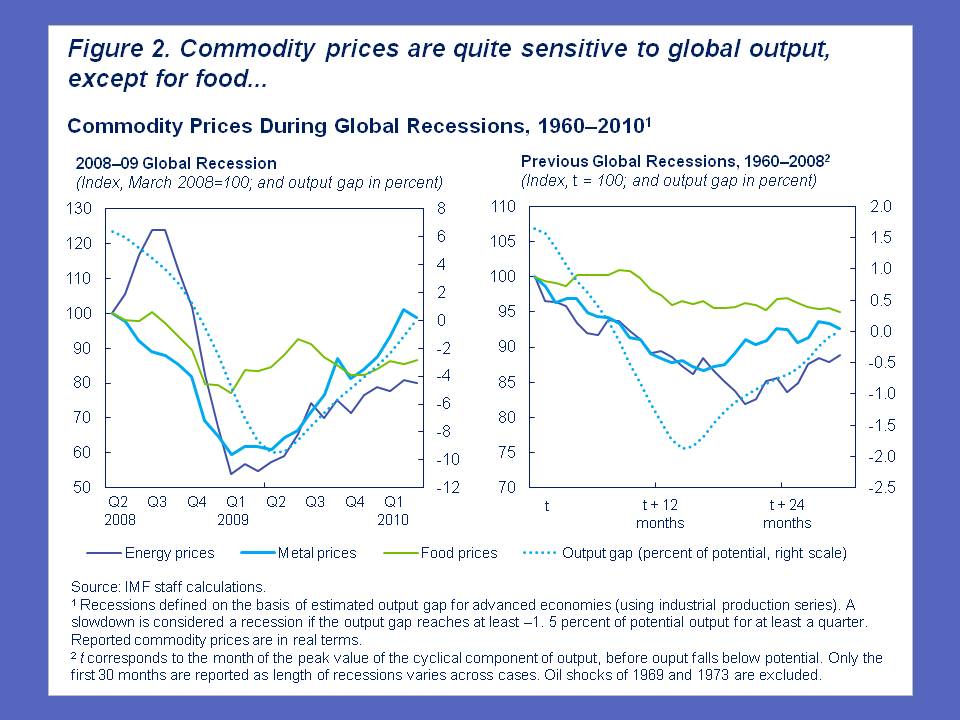
- Energy and metal prices are highly sensitive to global output, as evidenced during the 2008–09 crisis and all previous recessions (the only exception being the oil shocks of the 1970s).
- Food prices are up about 50 percent since 2003, have only partly reversed a pronounced downward trend seen over several decades, and are much less sensitive to world growth.
- Prices of many commodities have moved closely during the last cycle, but the magnitude of booms and sensitivity to global output have varied across categories (see Figure 2).
Economic impact of price busts
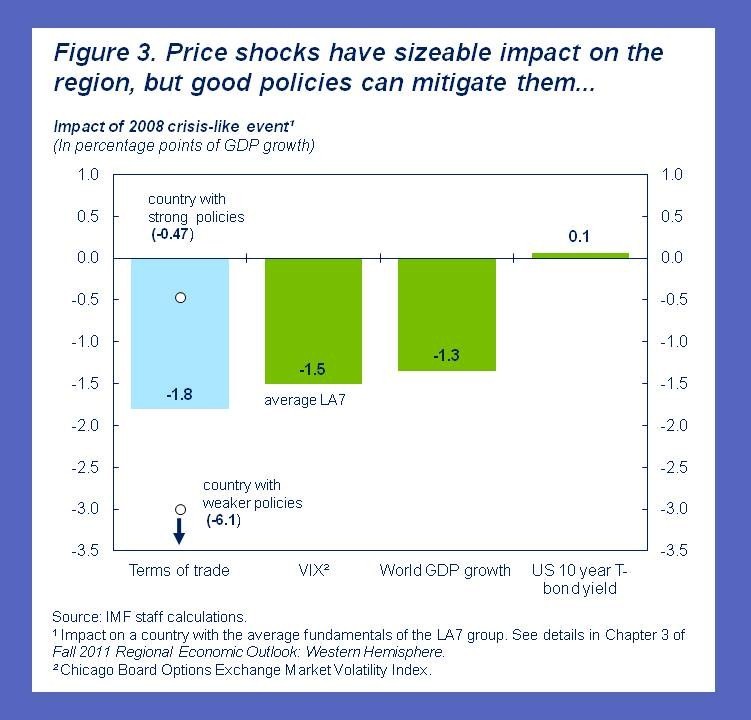
- The history of sharp terms-of-trade drops during the past 40 years shows these price shocks can have a sizeable impact on the region and can be even more important than other external shocks (see Figure 3).
- The magnitude of price shocks alone cannot fully explain cross-country differences in performance during busts; policy choices during boom years matter critically.
Policy findings and recommendations
- Countries that behave more prudently during the boom phase of commodity price cycles—preventing a deterioration of their underlying fiscal and external positions—perform better during the bust.
- Exchange rate flexibility is a powerful shock absorber, although its effectiveness is reduced in highly dollarized economies.
- In countries with strong fundamentals, the extent of financial integration with the rest of the world can help buffer shocks by helping to keep external funding available.
- Preserving gains from the commodity boom requires undertaking the right set of policies to be prepared for a possible bust while favorable conditions last—this is especially important for metal and energy exporters, which are particularly vulnerable to a global slowdown.
Source: IMF blog post “Latin America’s Commodity Dependence: What if the Boom Turns to Bust?” by Gustavo Adler and Sebastián Sosa, November 1, 2011.