Spring Is in the Air in Parts of Latin America
IMF Blog, April 25, 2012
Source details
- Canonical URL
- Spring Is in the Air in Parts of Latin America
Other formats
Bibliographic details
- Authors: Nicols Eyzaguirre
- Published: April 25, 2012
Regional overview and growth outlook
- Most of Latin America stands out for good performance in a subpar environment.
- Growth is generally solid, despite a slowdown late last year owing to policy tightening and global volatility.
- Under the baseline scenario, regional growth is expected to moderate to near 3¾ percent in 2012, down from 4½ percent last year (but modestly up from our January projections).
- Short-term risks, while receding, still tilt downwards: renewed European tensions or a large oil price shock could hit financial markets and global growth, triggering safe haven flows out of emerging markets, including Latin America.
Focus on inflation-targeting commodity exporters
- Countries highlighted: Brazil, Chile, Colombia, Peru, and Uruguay.
- These countries represent close to 60 percent of the region’s total GDP.
- They have generally fared well thanks to:
- Good economic policy management.
- Favorable external conditions (the “twin tailwinds” of high commodity prices and easy international financing).
- The twin tailwinds may persist for a while, unless large shocks appear; even modest-sized shocks would probably not disrupt capital flows into the region for too long.
Policy challenges and recommendations
- Capacity and policy stance:
- The group of economies is mostly near or above full capacity; policies need to continue moving to neutral.
- The stimulus deployed to combat the 2008–09 financial crisis has been only partially unwound.
- Overheating remains a risk—credit and import growth have slowed but are still strong.
- Fiscal policy:
- Continued fiscal normalization is essential to avoid driving an overheating cycle.
- Fiscal normalization helps reduce the burden on monetary policy, preserve credibility, and make space for a response if downside risks materialize again.
- Authorities should manage the abundance well, recognizing favorable conditions will not last forever.
- Monetary and liquidity policy:
- Monetary policy should remain nimble and continue to serve as a first line of defense in case of adverse global shocks.
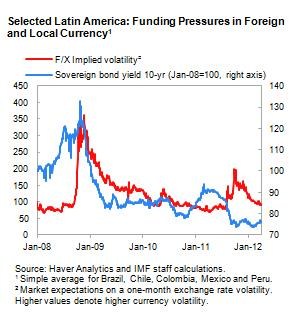
- The Lehman and European crises share the global propagation of liquidity shocks; effects included tightening in local markets and shortages of dollars.
- Policymakers need to be alert for droughts punctuating the rainfall and stand ready to support liquidity in their markets in the short term, as needed.
- Strategic stance:
- Policymakers should carry both an umbrella and sunscreen: rebuild resilience and flexibility rather than resting easy or fighting risks that haven’t materialized yet.
Analytical notes featured in this edition of the Regional Economic Outlook
- (i) How global financial shocks affect output in Latin America.
- (ii) The real spillovers from the region’s largest economies.
- (iii) Developments in the housing and mortgage market in the region.
- These notes will be discussed in forthcoming blogs.
Spring Is in the Air in Parts of Latin America — Nicolás Eyzaguirre, April 25, 2012