Latin America: Vulnerabilities Under Construction?
IMF Blog, May 10, 2012
Source details
- Canonical URL
- Latin America: Vulnerabilities Under Construction?
Other formats
Bibliographic details
- Authors: Luis Cubeddu, Camilo E Tovar, Evridiki Tsounta
- Published: May 10, 2012
Overview and context
- Easy external financing conditions and high commodity prices contributed to improvements in living standards and credit deepening in many countries of the region over the past decade.
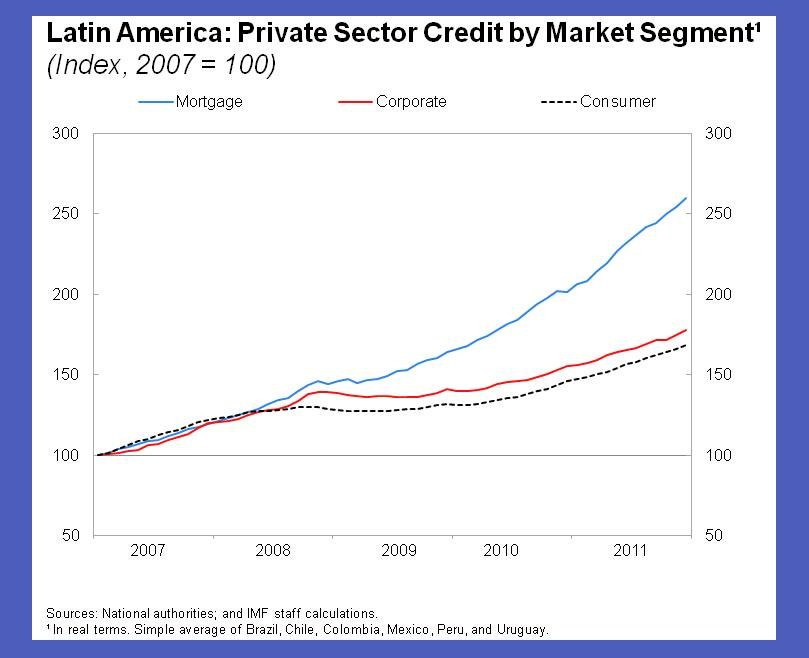
- Mortgage credit in Latin American countries is relatively low by international standards—at just 7 percent of GDP versus over 20 percent in emerging Asia and over 65 percent in the United States—but has grown at an impressive annual average real rate of 14 percent since 2003, with Brazil leading the pack.
- Home prices have risen sharply over this period, particularly in countries where mortgage credit has expanded the fastest.
Evidence on housing vulnerabilities
- Mortgage credit may be growing well above rates explained by economic fundamentals over the past three years in a few economies in the region.
- In Brazil, mortgage credit has surged; this surge may also be explained by the introduction of a government housing credit program (“Minha Casa, Minha Vida”) aimed at low-income households.
- Other indicators suggest housing vulnerabilities are currently contained:
- Nonperforming mortgage loans are still relatively low.
- Mortgages are a small share of banks’ funding structure.
- The few existing household indebtedness indicators are at manageable levels, although they are rising, especially for low-income households.
Data and information gaps
- House price data are available only for some countries: Brazil, Chile, Colombia, Mexico, Peru, and Uruguay.
- Available time series are usually short, with coverage often limited to large metropolitan areas or segments within them.
- Information on the stock and flows of housing and on construction activity is patchy.
- Complete information on housing-specific financial soundness indicators and household balance-sheet data is readily available and complete for just a few countries.
- Experience shows that even small mortgage markets can have systemic effects, particularly in new markets with significant data gaps (for example, lessons from the U.S. subprime sector).
Policy recommendations and priority actions
- Close information gaps and strengthen oversight of the housing sector.
- Disseminate current information on housing-specific financial soundness indicators and household balance sheet data.
- Implement deeper reforms to ensure sustainable housing market growth:
- Improve credit registries.
- Provide programs to increase consumer financial literacy.
- Use loan-to-value and debt-to-income limits.
Luis Cubeddu, Camilo E. Tovar, Evridiki Tsounta; May 10, 2012