Latin America: Riding the Global Financial Waves
IMF Blog, June 17, 2012
Source details
- Canonical URL
- Latin America: Riding the Global Financial Waves
Other formats
Bibliographic details
- Authors: Gustavo Adler, Camilo E Tovar
- Published: June 17, 2012
Overview and context
- Authors: Gustavo Adler, Camilo E. Tovar
- Date: June 17, 2012
- Focus: Impact of global financial shocks on Latin America, isolating the effect of financial shocks from commodity prices and global demand shocks.
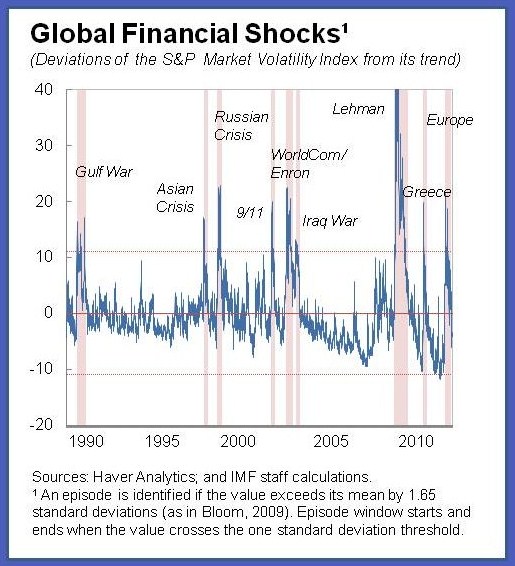
- Background: Global financial markets have seen frequent bouts of severe stress since 2008. Global financial shocks have occurred on average every 2½ years since 1990, with significant effects on Latin America.
Opposing forces shaping vulnerability
- Two key factors determine the impact of external financial shocks on domestic output:
- Degree of financial linkages (financial integration) with the rest of the world.
- Strength of the country’s economic fundamentals.
- Dynamics:
- Higher financial integration can increase sensitivity to external financial shocks.
- Stronger fundamentals mitigate shock impacts by: maintaining confidence in macroeconomic management, discouraging capital outflows, and easing economic adjustment after shocks.
- Regional trend:
- Over the past two decades, financial integration has deepened in Latin America.
- Key economic fundamentals have improved markedly, particularly those related to external and fiscal sustainability.
- Given these opposing forces, net vulnerability is not obvious a priori.
Empirical assessment (sample and approach)
- Sample: 40 emerging and 9 small advanced economies.
- Episodes: Seven episodes of global financial stress since 1990.
- Analytical aim: Assess importance of different economic fundamentals in amplifying or mitigating the impact of global financial shocks, holding commodity-price and global-demand effects constant.
Main findings
- Exchange rate flexibility is a key shock absorber, especially for financially integrated economies.
- A country’s external position (for example, its current account balance and external debt) influences performance during external crises.
- Higher financial integration does not always increase vulnerability:
- Financial integration amplifies financial shocks in economies with fixed exchange rate regimes.
- Financial integration mitigates financial shocks in economies with more flexible exchange rate regimes.
- Net implication: Financially integrated economies with strong fundamentals (especially exchange rate flexibility) are better equipped to cope with global financial shocks than economies with weak fundamentals and limited financial linkages.
Regional conclusion and policy implication
- Simulations show that despite increasing financial integration, output costs associated with global financial shocks in Latin America have declined in the past 15 years.
- The progress on economic fundamentals appears to have reduced vulnerability and helped the region “ride more safely” through recent global financial waves.
- Policy recommendation: The region should still take precautions in case of a bigger global downturn, even though recent policy improvements have paid off.
Source: Latin America: Riding the Global Financial Waves — IMF blog post by Gustavo Adler and Camilo E. Tovar, June 17, 2012.
References
- https://www.imf.org/wp-content/uploads/2012/06/slide2-22.jpg
- Latin America
- Regional Economic Outlook: Western Hemisphere
- effects of terms-of-trade shocks
- more
- https://www.imf.org/wp-content/uploads/2012/06/slide1.jpg
- Latin America
- https://www.imf.org/wp-content/uploads/2012/06/slide3-2.jpg
- pointed out