Can Policymakers Stem Rising Income Inequality?
IMF Blog, June 28, 2012
Source details
- Canonical URL
- Can Policymakers Stem Rising Income Inequality?
Other formats
Bibliographic details
- Authors: David Coady, Sanjeev Gupta
- Published: June 28, 2012
Overview
- The issue of rising income inequality is central to public debate, with concern over economic and social consequences of increases in the share of income captured by higher income groups.
- Much discussion focuses on drivers—globalization, labor market reforms, technological changes favoring higher-skilled workers—but the study emphasizes what policymakers can do.
- Public spending and taxation policies have had, and are likely to continue to have, a crucial impact on income inequality in both advanced and developing economies.
Income inequality in recent decades
- Database covers inequality trends in 150 advanced and developing countries.
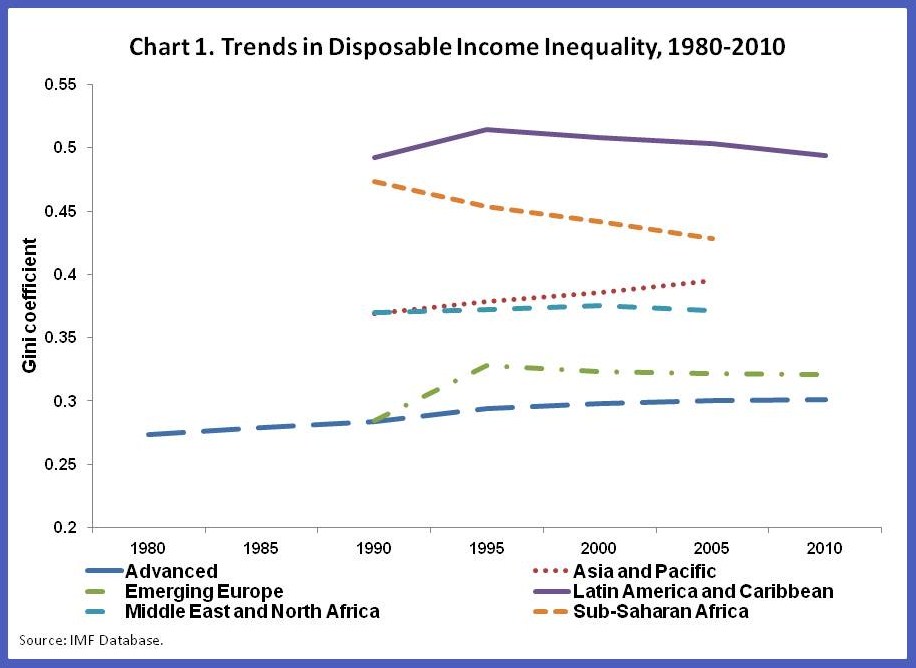
- Disposable income inequality (after taxes and transfers) has increased in most advanced and many developing economies over recent decades.
- Inequality is measured by the Gini coefficient (which ranges from 0, when everyone has exactly the same income, to 1 when a single individual receives all the income of a society).
- Large variation in average income inequality across regions.
- Sharp increase in the share of income captured by the highest income groups since the early 1980s.
- United States example: the share of market (before taxes and transfers) income captured by the richest 10 percent surged from around 30 percent in 1980 to 48 percent by 2008.
- Some experts argue that such increases contributed to the recent financial crisis.
Fiscal policy in advanced economies
- Taxes and public transfers have played a significant role in offsetting the increase in inequality.
- Over the past two decades, fiscal policy decreased inequality by about one-third in OECD countries.
- Two-thirds of this decrease achieved through transfers such as child benefit and public pensions.
- The redistributive impact is even higher when in-kind transfers such as education and health are included.
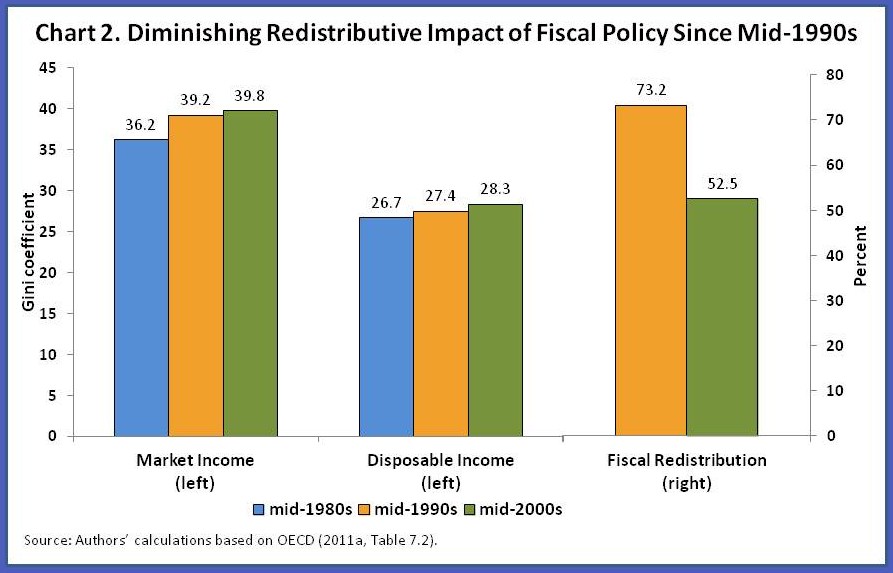
- The distributive impact of fiscal policy has diminished since the mid-1990s.
- Fiscal policy offset 73 percent of the 3 percentage point increase in market-income inequality up to the mid-1990s.
- Fiscal policy offset 53 percent of the increase up to the mid-2000s.
- Over the whole period, market-income inequality grew by twice as much as redistribution!
- Some countries have seen income distribution worsen since 2007 (for example, Ireland and Spain).
Factors behind the decreasing impact of fiscal policy
- Reduction in the generosity of social benefits, particularly unemployment and social assistance benefits.
- Lower income tax rates, especially at higher income levels.
- These developments are worrisome given the need for substantial fiscal consolidation in advanced economies in the coming years.
Policy options to mitigate adverse impacts in advanced economies
- Allow automatic stabilizers (such as unemployment benefits) to work during consolidation.
- Protect the most progressive social benefits.
- Remove opportunities for tax avoidance and evasion.
- Increase reliance on wealth and property taxes.
Role of fiscal policy in developing countries
- Inequality in developing countries is substantially higher than in advanced economies.
- Much of the higher inequality can be explained by lower levels of taxation and public spending, as well as greater reliance on less progressive tax and spending instruments.
- Policy levers:
- Tax side: focus on broadening tax bases rather than increasing tax rates, through reduced tax exemptions, closing loopholes and improving compliance.
- Spending side: improve the progressivity of public spending by eliminating general price subsidies and better targeting of poverty programs to the most vulnerable.
- Continued tight revenue constraints and large demands to finance development objectives imply greater emphasis on spending progressivity.
Source: Can Policymakers Stem Rising Income Inequality? — David Coady, Sanjeev Gupta, June 28, 2012
Content in this bundle
- Staff Discussion Note