The Ties That Bond Us: What Demand For Government Debt Can Tell Us About the Risks Ahead
IMF Blog, January 17, 2013
Source details
- Canonical URL
- The Ties That Bond Us: What Demand For Government Debt Can Tell Us About the Risks Ahead
Other formats
Bibliographic details
- Authors: Serkan Arslanalp, Takahiro Tsuda
- Published: January 17, 2013
Overview
- Authors: Serkan Arslanalp, Takahiro Tsuda.
- Publication date: January 17, 2013.
- Core thesis: Advanced-economy exposure to refinancing risk and changes in government borrowing costs depend mainly on who is holding the bonds — the demand side for government debt. Tracking ownership (who owns what, when, and for how long) sheds light on potential sovereign debt market risks.
Investor base risk index
- Constructed a publicly available database of government debt holdings by six different classes of investors.
- Proposed a new risk metric: the investor base risk index.
- The index runs from zero to 100, based on the composition of the investor base and risk scores assigned to investor types according to how they tend to change holdings.
- Low index scores: countries with a high share of domestic investors (domestic banks and central banks) and foreign central banks.
- High index scores: countries with a high share of foreign private investors, who are identified as the most skittish in times of trouble.
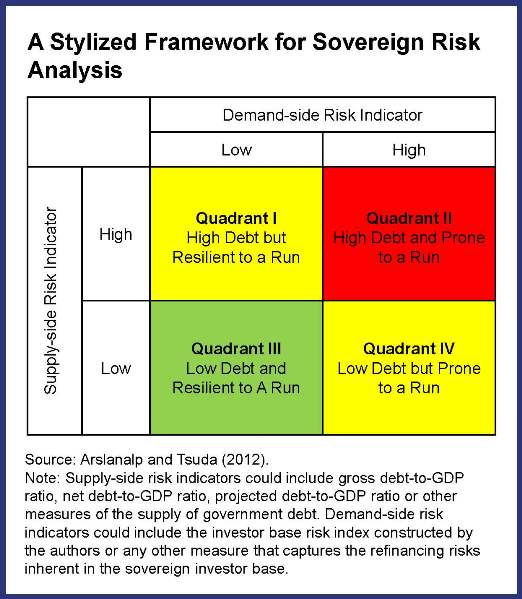
- The index is designed to be used in combination with a supply-side risk indicator (e.g., debt-to-GDP) to assess overall sovereign risk.
Empirical findings and classification
- Framework: two-by-two table (Figure 1) combining supply-side and investor-base risk:
- Quadrant III: low debt and low investor base risk — identified as the best scenario.
- Quadrant II: high debt and high investor base risk — identified as the worst scenario.
- Backtest: assessed countries' investor base risk at end-2009 to examine vulnerability before sovereign risk issues emerged in 2010.
- The risk index indicated several euro area countries were prone to a sudden stop as early as end-2009 (Figure 2, Quadrant II).
- Countries with high debt and low investor base risk (examples): Germany, Japan, and the United States — these did not face similar market pressures despite high projected levels of debt.
- Countries with low debt and low investor base risk (examples): Australia, Canada, and Sweden — became “new safe haven” countries in the period studied.
- Observation: this classification closely matched how markets differentiated sovereign risk after 2009.
Explaining the high-debt, low-yield puzzle
- Both supply and demand dynamics drive sovereign bond yields; supply factors alone do not fully explain recent low yields in some highly indebted countries.
- Example: Japan — despite continued worries about the fiscal outlook, demand for Japanese government bonds, particularly from domestic banks, has been strong and yields stable; captured by the investor base risk index.
- Implication: where investor base risk is low, high debt-to-GDP levels may matter less because the likelihood of a run by sovereign investors is lower.
- Comparative note: Germany, the United Kingdom, and the United States may resemble Japan in index terms, but primarily because of a high share of foreign central banks and domestic central banks in their investor bases.
Policy implications and risks
- Demand-side factors should be monitored alongside traditional supply-side metrics (such as debt-to-GDP).
- Potential downside of heavy reliance on domestic financial institutions as major holders of government debt:
- May result in inflationary pressures.
- May create stronger sovereign-bank interdependence (sovereign-bank nexus).
- Could curb credit channels to the private sector and thus hurt growth.
- Overall conclusion: investor composition matters for sovereign refinancing risk and borrowing costs; demand-side indicators like the investor base risk index are valuable complements to supply-side analyses.
Source: The Ties That Bond Us: What Demand For Government Debt Can Tell Us About the Risks Ahead — Serkan Arslanalp and Takahiro Tsuda, January 17, 2013.
Content in this bundle
- PDP-Working Paper