Europe: Toward A More Perfect Union
IMF Blog, February 15, 2013
Source details
- Canonical URL
- Europe: Toward A More Perfect Union
Other formats
Bibliographic details
- Authors: Nemat Shafik
- Published: February 15, 2013
Integration and convergence
- Financial integration accelerated after the euro’s introduction, fostering a belief that capital would flow to where it would be best used and promote real convergence.
- In practice, lasting convergence in productivity did not materialize across the European Union; a competitiveness divide emerged.
- For the 17 euro area members:
- A common currency implied a common monetary policy and, initially, convergence of risk premia that encouraged capital shifts from the richer north to the poorer south (the periphery).
- Differences in sovereign yields across the euro area narrowed quickly during this period.
- Recipient countries largely used capital to finance current consumption and real estate investment rather than productive capital, resulting in little absolute real convergence.
- Newly accessant countries from emerging Europe performed better, with per capita incomes converging faster to northern Europe levels; these economies benefited from global growth, FDI, and stronger integration in worldwide supply chains, notably via links with Germany.
Crisis dynamics and financial fragmentation
- The crisis in the euro zone largely reflected the unwinding of financial integration in the absence of accompanying productivity improvements.
- As growth prospect gaps became evident, markets discriminated among countries that had formerly faced similar borrowing costs, triggering a reversal of capital flows and fragmentation of the financial system in the euro zone.
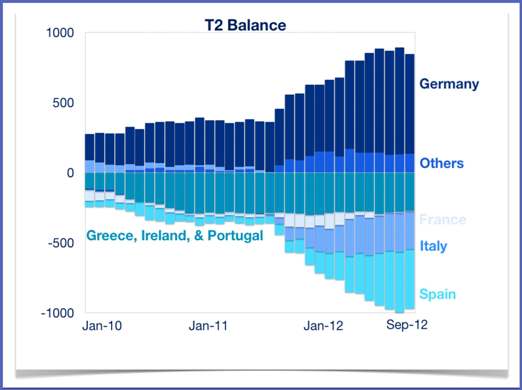
- The fragmentation impaired monetary policy transmission. The Target2 system serves as an indicator of financial fragmentation along national borders.
- In late 2011, Target2 balances increased particularly due to fragmentation affecting markets in Italy and Spain, with surplus countries—particularly Germany—providing the counterbalance.
- The Target2 system acted as an important shock absorber and balances have since stabilized.
Reforms, growth prospects, and IMF findings
- Hard-hit countries on the southern periphery implemented tough reforms in the three years following the crisis; these reforms are beginning to yield results, but substantial work remains.
- IMF research cited:
- If euro area member states managed to close half the gap with OECD best practice in labor market and pension policies, they could boost GDP by almost 1½ percent on average after five years.
- An additional boost of 2¼ percent could follow if more competition is introduced into markets for products and services.
- As reforms improve growth prospects, private capital needs to return to the periphery and be channeled into investment that converts prospects into realized growth.
Fixing structural flaws: banking union and fiscal integration
- National reforms are necessary but insufficient; managing the crisis requires “more Europe” to reverse financial fragmentation and prevent sudden stops in intra-union capital flows.
- Recent euro area policy actions include measures aimed at strengthening the monetary union’s functioning (actions categorized as helping growth, helping integration, or both).
- Two elements identified as necessary for a more viable union:
- A banking union to make the financial sector more robust to future shocks.
- More fiscal integration to address gaps that amplify country-level shocks into zone-wide events.
- From the IMF perspective, a banking union additionally requires:
- A common fiscal backstop for resolution of troubled banks.
- A common approach to deposit insurance.
- No consensus yet exists on the form of closer fiscal integration. Proposals range from:
- A common euro area treasury with a centralized budget.
- Powers to direct national budgets and common borrowing.
- These proposals carry direct monetary implications and substantial consequences for national sovereignty; empirical evidence from various federations suggests multiple models can work.
Policy priorities and recommendations
- Immediate focus should be on growth to address very weak economic outlooks and intolerable unemployment in much of the EU.
- Priority national reforms include:
- Encouraging labor mobility.
- Implementing product market reforms.
- Investing in infrastructure and education to foster competitiveness.
- Eurozone-level actions needed include:
- Central support for market access.
- Mechanisms to support troubled banks.
- The path forward requires sustained, difficult work:
- 2012 was characterized as balancing on edges of cliffs and precipices for Europe.
- 2013 should be a year of climbing mountains—restoring competitiveness across economies to restore growth and steadily completing the monetary union’s architecture.
Italic: Europe: Toward A More Perfect Union — Nemat Shafik, February 15, 2013
Content in this bundle
- Staff Discussion Note
References
- https://www.imf.org/wp-content/uploads/2012/05/shafik4_1024.jpg
- https://www.imf.org/wp-content/uploads/2013/02/shafik-eur-blog-figures-1-2.jpg
- https://www.imf.org/wp-content/uploads/2013/02/shafik-eur-blog-figure-3.jpg
- https://www.imf.org/wp-content/uploads/2013/02/shafik-eur-blog-figure-4.jpg
- https://www.imf.org/wp-content/uploads/2013/02/shafik-eur-blog-figure-5.jpg