On A Roll: Sustaining Strong Growth in Latin America
IMF Blog, May 29, 2013
Source details
- Canonical URL
- On A Roll: Sustaining Strong Growth in Latin America
Other formats
Bibliographic details
- Authors: Sebastian Sosa, Evridiki Tsounta, Hye Sun Kim
- Published: May 29, 2013
Overview and headline figures
- Latin America has enjoyed strong growth during the last decade, with annual growth averaging 4½ percent compared with 2¾ in the 1980s and 1990s.
- The study analyzes supply-side drivers of growth for a large group of Latin American countries to identify sources of the recent strong output performance and assess sustainability.
Supply-side drivers of growth (2003–12)
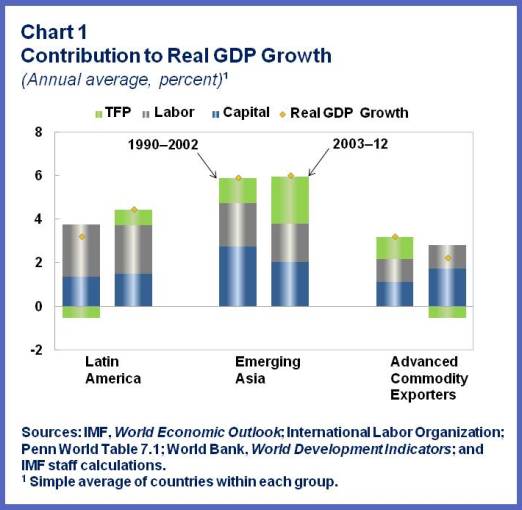
- Increases in employment and the accumulation of capital (buildings and machinery) remain the main drivers of growth.
- Employment growth and investment in physical capital together explain 3¾ percentage points of annual GDP growth in 2003–12.
- Improvements in the efficiency of inputs of production (total factor productivity) explain ¾ percentage points of annual GDP growth in 2003–12.
- Employment has grown vigorously in the last decade and many countries are enjoying historically low unemployment rates.
- Investment in physical capital has risen steadily amid favorable external financial conditions and high commodity prices.
Total factor productivity (TFP) dynamics
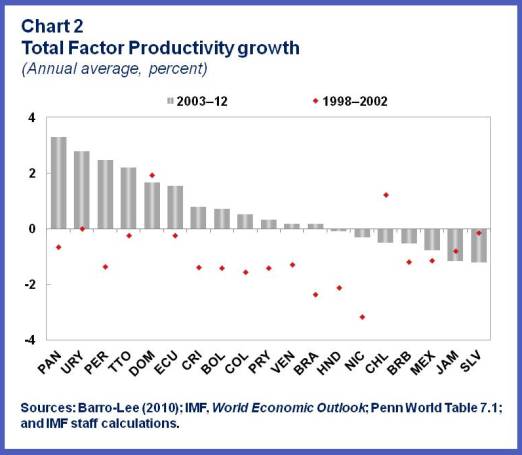
- The recent pickup in growth is mainly explained by higher total factor productivity.
- After declines in previous decades, total factor productivity is on the rise in the region.
- Changes in productivity are highly correlated with changes in output; some improvements reflect structural shifts such as movement away from the informal sector, where productivity tends to be lower.
Outlook and potential growth (2013–17)
- Sustaining the recent high growth rates is assessed as unlikely without significant changes.
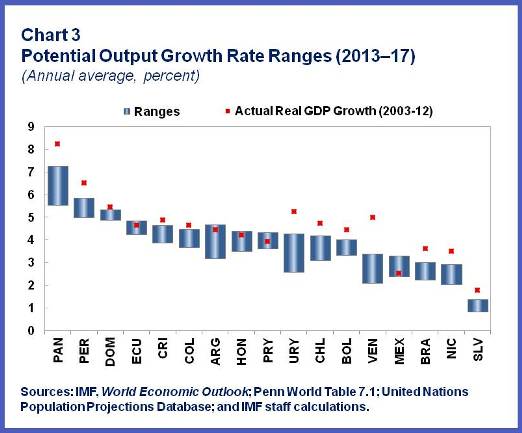
- While the region grew on average 4½ percent during 2003–12, estimates suggest the average potential GDP growth rate in 2013–17 is closer to 3¼ percent.
- Strong growth rates observed in recent years exceed the potential GDP growth ranges in most countries.
- Potential output ranges vary significantly across countries, reflecting differences in population aging trends, labor force participation rates, savings and investment in physical and human capital, natural resource endowments, productivity performance, and other country characteristics.
- Expected moderating factors:
- Growth of physical capital is expected to moderate as low global interest rates start to rise and commodity prices stabilize.
- Contribution of labor will likely be limited by natural constraints: population aging, limited scope for further increases in labor force participation rates (including for women), and currently record low unemployment rates that would hinder strong employment growth.
Role of productivity and explanation for growth differential
- Sustaining strong momentum requires one or more of:
- A surge in capital accumulation (for example, supported by rising savings, which are still very low in the region).
- Significant increases in human capital (the quality of education has ample room for improvement).
- Significant improvement in total factor productivity performance.
- Total factor productivity performance, despite recent improvement, remains weak compared with emerging Asia and explains most of the growth differential vis-à-vis that region.
Policy recommendations to boost productivity and sustain growth
- Aim to reduce distortions in the allocation of resources through country-specific measures.
- Policies to consider include:
- Improving the business climate and enhancing competition.
- Strengthening entry and exit regulation to facilitate reallocation of resources to new and high-productivity sectors.
- Improving infrastructure.
- Promoting deeper and more efficient financial markets.
- Enhancing research, development and innovation.
- Strengthening institutions to secure property rights and stamp out corruption.
Sebastián Sosa, Evridiki Tsounta, Hye Sun Kim — May 29, 2013
Content in this bundle
- Regional Economic Outlook -- Western Hemisphere: Time to Rebuild Policy Space; May 2013
- wp13109 — Institutional Factors and TFP Growth