Taming government debt—it can be done, but it ain’t easy
IMF Blog, September 25, 2013
Source details
- Canonical URL
- Taming government debt—it can be done, but it ain’t easy
Other formats
Bibliographic details
- Authors: Helge Berger, Justin Tyson
- Published: September 25, 2013
Overview
- Authors: Helge Berger, Justin Tyson
- Date: September 25, 2013
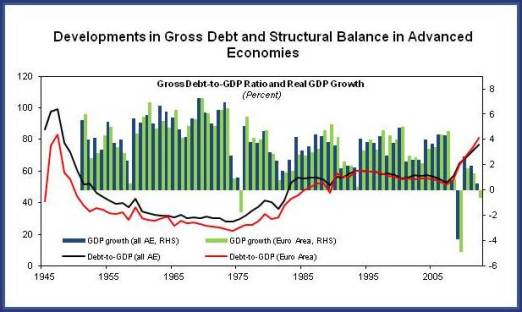
- Central message: Government debt in advanced economies, elevated after the global economic and euro area crises, will need to be reduced. There is no single “magic” safe debt ratio; reduction comes with trade-offs because cutting spending or raising taxes risks lowering growth and employment in the short term.
The ins and outs of debt reduction
- Key mechanisms that reduce debt:
- Higher economic growth increases government revenues, reduces unemployment benefits, and lowers the debt-to-GDP ratio.
- Fiscal consolidation (reducing government deficits) is the alternative when rapid growth is not available.
- Constraints and complications:
- Current environment features cautious household spending, stretched bank balance sheets, low inflation, and limited prospects for quickly conjuring high growth.
- Attempts to raise inflation to reduce real debt could backfire if inflation expectations are not well anchored.
- Fiscal consolidation in a weak-growth, high-debt context can initially increase the debt-to-GDP ratio because lower demand reduces revenues and the GDP denominator.
- Lower borrowing costs from credible consolidation rarely offset the short-run demand loss.
- If a country is losing market access, fiscal effort may need to be front-loaded.
- Empirical findings:
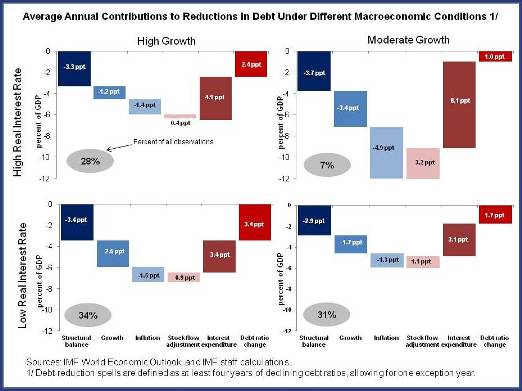
- Fiscal balances are a key driver of changes in debt-to-GDP ratios, but growth matters strongly.
- Debt reductions tend to be larger when growth rates are high and interest rates are low.
- Debt reversals are fewer and smaller when both growth is low and interest rates are high.
- Only 26 percent of fiscal consolidation efforts (defined as a large adjustment in fiscal balances ignoring interest rate payments) were successful when growth is below a country’s historical average.
- When growth is above average, the success rate of consolidation increases to 41 percent.
Past experience — reducing debt when growth is low is possible
- Sample: 26 episodes of debt reductions in advanced economies since 1980.
- Findings from these episodes:
- Growth and fiscal effort were the main drivers of successful debt reductions.
- Some episodes achieved large debt reductions despite starting conditions of anemic growth and very high debt burdens.
- Common factors in successful episodes:
- Early start to consolidation and persistence through initial weak growth.
- Continued consolidation as growth recovered, allowing debt to fall.
- Fortuitous improvements such as falling short-term interest rates, currency depreciation, and solid export growth—channels less available in the current near-zero interest rate, slow global trade environment.
Policy implications and recommendations
- Pace and design:
- Consolidation should generally be gradual where possible, supported by credible medium-term plans to spread adjustment over time.
- If a country is close to losing market access, stronger, front-loaded consolidation may be unavoidable.
- Complementary measures:
- Enact measures now that increase medium-term growth, including structural reforms.
- Consider privatization of government assets in some economies to reduce the need for fiscal consolidation.
- Expectations:
- For most countries, bringing down the public debt-ratio will require a sustained fiscal effort for a number of years.
- Perseverance with credible plans and strong budget institutions improves the chances that consolidation will pay off over time.
Source: Taming government debt—it can be done, but it ain’t easy — Helge Berger, Justin Tyson; September 25, 2013.
Content in this bundle
- Staff Discussion Note
References
- https://www.imf.org/wp-content/uploads/2013/09/figure-1-dev-in-gross-debt-and-structural-balance-in-adv-economies.jpg
- https://www.imf.org/wp-content/uploads/2013/09/figure-2-avg-annual-contributions-to-reductions-in-debt-under-diff-macro-conditions.jpg
- https://www.imf.org/wp-content/uploads/2013/09/figure-3-components-of-major-debt-reductions-in-adv-economies.jpg
- https://www.imf.org/wp-content/uploads/2013/09/figure-4-evolution-of-key-variables-through-deficit-reduction.jpg