How Emerging Markets Can Get Their Groove Back
IMF Blog, October 7, 2013
Source details
- Canonical URL
- How Emerging Markets Can Get Their Groove Back
Other formats
Bibliographic details
- Authors: Kalpana Kochhar, Roberto Perrelli
- Published: October 7, 2013
Current situation and magnitude of slowdown
- After a decade of high growth and a swift rebound after the collapse of U.S. investment bank Lehman Brothers, emerging markets are seeing slowing growth.
- Their average growth is now 1½ percentage points lower than in 2010 and 2011.
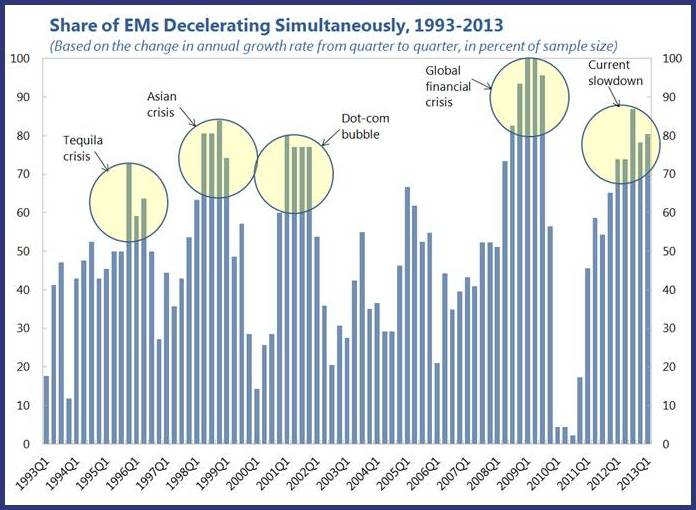
- Growth has been slowing in roughly three out of four emerging markets.
- Such synchronized and persistent slowdowns typically have only occurred during acute crises in the past.
Drivers of the slowdown
- Cyclical forces:
- Softer external demand.
- Recently tightening financing conditions (after a period of easy financing).
- Structural bottlenecks:
- Infrastructure constraints.
- Labor market frictions.
- Power sector weaknesses.
- Offsetting factors that had been supportive:
- Supportive domestic macroeconomic policies.
- (Still) favorable terms of trade.
- Unexplained component:
- A non-trivial portion of the slowdown remains unexplained, suggesting other common factors affecting emerging markets.
Outlook and revisions to growth potential
- Growth potential is unobservable and may have been overstated after a decade of cheap financing and rising commodity prices that boosted investment and growth.
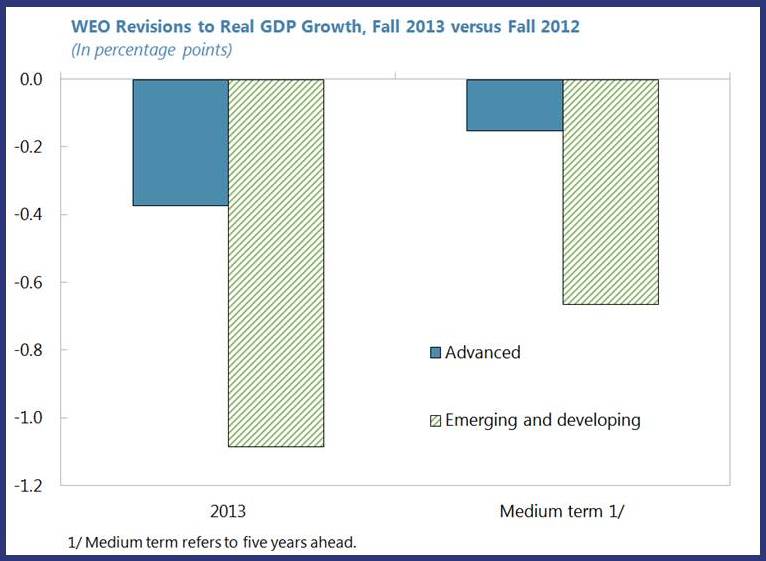
- IMF forecasts for growth five years ahead are down by 0.7 percentage points compared to October 2012.
- Market analysts have made similar downward revisions.
- Implication: Policymakers need to recognize that emerging markets will likely grow at lower rates than in the past to avoid over-stimulation and the generation of imbalances.
Policy implications and recommended priorities
- Short-term monetary/fiscal countercyclical demand management will not be sufficient on its own.
- Priority areas to generate higher sustainable growth:
- Identify reform priorities to remove supply bottlenecks.
- Boost productivity.
- Move economies up the value chain.
- Push ahead with infrastructure investment.
- Improve the business climate.
- Timing and urgency:
- Structural measures take time to implement and the economy responds with natural lags.
- The need for decisive policy action is now to avoid the risk of a lost decade.
Risks from global financial conditions and investor differentiation
- Imminent tightening of global interest rates (e.g., U.S. Fed tapering announcement) has led to:
- Large and disruptive capital outflows in some emerging markets.
- Sharper exchange rate depreciation and bond-yield increases in more vulnerable emerging markets (those with high and growing current account deficits and high inflation).
- Investors will increasingly differentiate between emerging market countries according to:
- Their policy frameworks.
- The health of their balance sheets.
Event
- High-level seminar at the IMF:
- Emerging Markets: Restoring the Momentum seminar.
- Tuesday, October 8, 3:00 p.m. – 4:30 p.m. EST.
- Join the conversation on Twitter using hashtag #EmergingMkt.
Kalpana Kochhar, Roberto Perrelli — October 7, 2013