Are Jobs and Growth Still Linked?
IMF Blog, February 7, 2014
Source details
- Canonical URL
- Are Jobs and Growth Still Linked?
Other formats
Bibliographic details
- Authors: Prakash Loungani
- Published: February 7, 2014
Main findings on the jobs–growth relationship
- Over 200 million people are unemployed around the globe today, over a fifth of them in advanced economies.
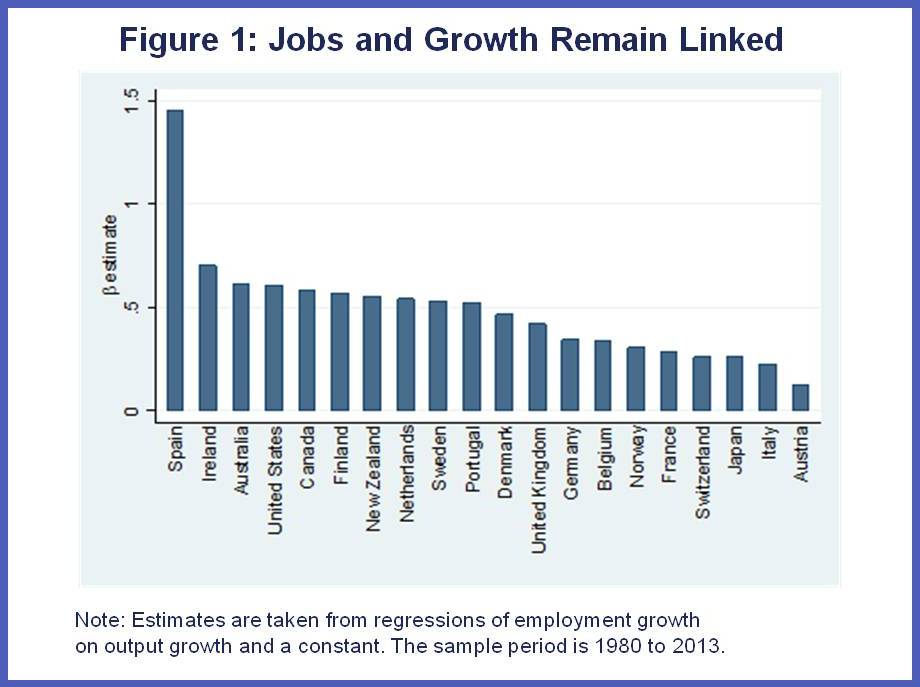
- Across the 20 advanced economies studied, a 1 percentage point increase in output growth leads to a ½ percentage point increase in employment growth.
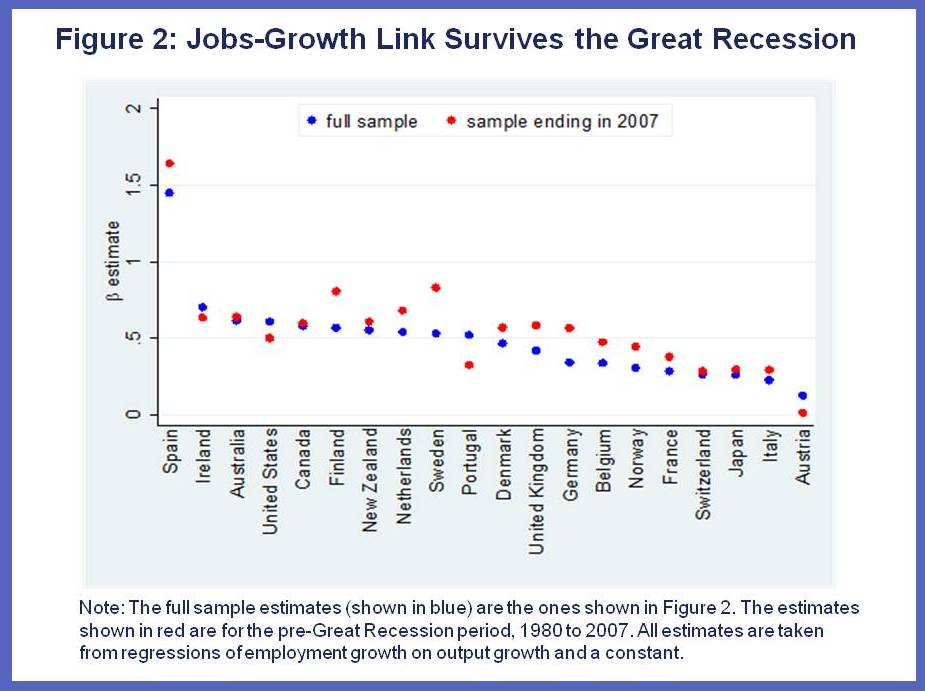
- There is no evidence that the link between output growth and employment growth (Okun’s Law) broke down during 2008 to 2013, including in high unemployment countries like Ireland and Spain.
- The Okun coefficient for the full period 1980 to 2013 is essentially the same as before the Great Recession, indicating little appreciable change over the course of the crisis.
Cross-country variation in Okun coefficients
- Spain: 1.5
- Ireland: 0.7
- Italy: 0.3
- Austria: 0.2
- Interpretation given: Spain’s high Okun coefficient reflects greater use of temporary contracts, producing larger job gains in expansions and larger job losses in recessions.
Country trajectories and recent dynamics
- United States:
- Okun’s Law fits very well; the relationship between output and employment growth is strong.
- During the Great Recession there was a year when U.S. employment fell more than expected, but the historical relationship was restored by 2013.
- A similar relationship for unemployment would indicate that U.S. unemployment today is about a percentage point lower than its historical relationship with output growth, consistent with the view that labor force dropouts may account for some of the decline in measured unemployment.
- Spain:
- The jobs–growth link is very tight with little evidence it broke down over the Great Recession; the trajectory since 2007 remains close to the historical relationship.
Policy implications and interpretation
- The finding that Okun’s Law holds matters for interpreting employment movements and for policy design.
- The alleged breakdown of Okun’s Law is often used to argue that problems are structural and will not be solved by cyclical policy responses; the authors’ results do not support that inference.
- IMF Managing Director Lagarde is quoted: “the most effective way of boosting jobs is to get growth going again … an additional percentage point of growth in the world’s advanced economies would lower unemployment there by about half of a percentage point, pulling over 4 million people back into jobs. So, in order to create jobs, we must lift economic growth. How can this be done? In the near term, there is no doubt that it will take smart monetary and fiscal policy to protect the recovery.”
- Authors note that demonstrating Okun’s Law holds does not fully determine policy: one must also examine relationships such as the Beveridge Curve and other indicators of mismatch in the labor market.
- While there may be good reasons to recommend structural reforms to boost employment, proposing them on the grounds that Okun’s Law has broken down should not be one of those reasons.
Prakash Loungani — Are Jobs and Growth Still Linked? — February 7, 2014
Content in this bundle
- Cyclical Unemployment, Structural Unemployment
References
- https://www.imf.org/wp-content/uploads/2014/02/are-jobs-and-growth-still-linked-charts-1.jpg
- https://www.imf.org/wp-content/uploads/2014/02/are-jobs-and-growth-still-linked-charts-2.jpg
- https://www.imf.org/wp-content/uploads/2014/02/are-jobs-and-growth-still-linked-charts-3.jpg
- https://www.imf.org/wp-content/uploads/2014/02/are-jobs-and-growth-still-linked-charts-4.jpg
- IMF Managing Director Lagarde noted recently