Abenomics—Time for a Push from Higher Wages
IMF Blog, March 20, 2014
Source details
- Canonical URL
- Abenomics—Time for a Push from Higher Wages
Other formats
Bibliographic details
- Authors: Dennis Botman, Zoltan Jakab
- Published: March 20, 2014
Overview
- Publication: Abenomics—Time for a Push from Higher Wages
- Authors: Dennis Botman, Zoltan Jakab
- Date: March 20, 2014
- Main point: Japan’s strong recent macroeconomic performance largely reflects fiscal and monetary stimulus (the first two arrows of “Abenomics”). To transition to sustainable, private-sector led growth, a hike in wages could provide the necessary push.
Argument for higher wages
- Recent progress: strong growth, and inflation, investment, and credit growth “all heading in the right direction.”
- Problem: past nominal and real basic wages have declined despite tight labor-market conditions and solid productivity growth.
- Key mechanisms and benefits:
- Higher nominal wages passed through to consumers would allow the Bank of Japan to meet its inflation target more rapidly without overburdening monetary policy.
- Higher real wages would support aggregate demand and encourage firms to raise investment.
- Wage increases would reduce reliance on household savings to finance consumption growth.
- Contextual constraints:
- The savings rate as a percent of disposable income has declined “from around 5 percent a decade ago to close to zero today.”
- Real wages face additional downward pressure from “higher underlying inflation and successive increases in the consumption-tax rate.”
Factors that prevent wages from rising
- Structural and coordination impediments identified:
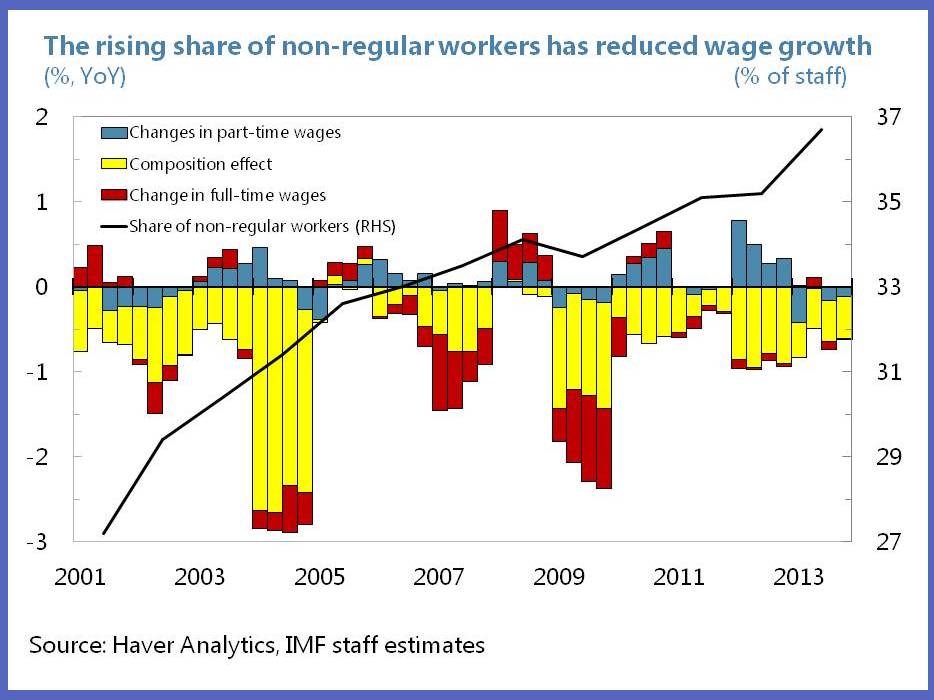
- Rise of non-regular workers combined with generally low horizontal mobility reduces incentives to invest in firm-specific human capital and depresses aggregate basic wage growth.
- Competitiveness pressures from past exchange rate appreciation, increased foreign competition, and technology catch-up have limited domestic wage increases and encouraged overseas production and outsourcing.
- Weak SME sector, which “accounts for close to 70 percent of employment,” may not have benefited from Abenomics due to higher energy and other intermediate imported goods costs caused by the weaker yen.
- Coordination problem: fragmented labor markets, lack of wage indexation, declining importance of the annual wage-bargaining round (“Shunto”), and prominence of bonuses and overtime in compensation create incentives for firms to free-ride on others’ wage increases.
Measures to raise wages (policy options and recent measures)
- Structural reforms (Third Arrow): ambitious growth reforms to reduce labor-market duality and move toward a “flexicurity” model that combines labor market flexibility and security to boost aggregate compensation growth.
- Government coordination and social concertation:
- Prime Minister Abe’s use of “moral suasion” asking profit-making companies to increase wages.
- Establishment of the Tripartite Commission to involve the government more directly in discussions with employers and trade unions.
- Decision not to extend the “7.8 percent cut in wages of national public servants” introduced in 2012 and set to expire on April 1, 2014—likely to push up salaries of local government workers.
- Tax incentives:
- Introduction of a tax credit “equal to 10% of incremental labor expenses provided the firm’s wage bill rises by 2%—gradually rising to 5% by 2017.”
- Options to enhance effectiveness: make the credit permanent, target increases in base wages only, or raise the credit—while recognizing potential deadweight losses.
- Minimum wage considerations:
- Japan’s minimum wage is “among the lowest in OECD countries.”
- Tentative prefectural evidence suggests a positive relation between minimum and basic wages.
- Higher-than-usual minimum wage increases might spur basic wage growth but may cause job losses among non-regular workers and in the SME sector.
Key statistics and exact figures cited
- Labor’s share of national income: “from around 66 percent at the turn of the millennium to around 60 percent today.”
- Savings rate as a percent of disposable income: “from around 5 percent a decade ago to close to zero today.”
- Bank of Japan inflation target: “2-percent inflation target.”
- Public servant wage cut: “7.8 percent” cut set to expire on “April 1, 2014.”
- SME employment share: “close to 70 percent of employment.”
- Tax credit details: “10% of incremental labor expenses” if wage bill rises by “2%—gradually rising to 5% by 2017.”
Source: Abenomics—Time for a Push from Higher Wages, March 20, 2014.
Content in this bundle
- アベノミクス―賃上げでひと押しの時か?デニス・ボトマン、ゾルタン・マティヤス・ヤコブ; iMFdirect ブログ 2014年3月20日掲載