For Africa, Good Policies Bring Good Prospects
IMF Blog, April 24, 2014
Source details
- Canonical URL
- For Africa, Good Policies Bring Good Prospects
Other formats
Bibliographic details
- Authors: Antoinette M Sayeh
- Published: April 24, 2014
Growth outlook and drivers
- Growth in the region is set to pick up to 5½ percent in 2014 compared to 4.9 percent last year.
- Growth momentum over the medium term can continue if countries rise to new challenges and manage their economies as dexterously as they have over the past decade.
- Key drivers:
- Good macroeconomic policies in the region.
- Investment in infrastructure and mining.
- Strong agricultural output.
- Favorable global tailwinds—high demand for commodities and low interest rates.
- External support highlights:
- China has been a major source of foreign direct investment and infrastructure financing for Africa.
Downside risks to the outlook
- Export demand risk:
- If growth in emerging markets slows considerably, export demand will decline, especially for base metals such as copper and iron ore.
- Countries particularly exposed: Democratic Republic of Congo, Liberia, and Zambia.
- Tighter financial conditions in China could reduce the appetite for Chinese companies investing abroad.
- Global financial conditions:
- As advanced economies unwind highly accommodative monetary policies, global financial conditions will tighten.
- Sub-Saharan Africa could experience a hike in interest rates and a slowdown, or even a reversal, of private capital flows.
- Security-related risks:
- Conflicts in the Central African Republic and South Sudan are exacting a heavy human and economic toll and creating negative spillovers for neighboring countries through lower trade flows and higher security outlays.
- Fiscal risks:
- High fiscal deficits in some countries threaten sustainability and could amplify vulnerability to shocks.
Warning signs: fiscal imbalances and history
- Policy context:
- In 2009 many countries mitigated the global crisis using countercyclical fiscal policy or avoiding fiscal procyclicality, maintaining spending when revenue fell.
- Recent fiscal patterns:
- In the years preceding the crisis (2004–08), the region saw a fiscal surplus that averaged about 2 percent of GDP.
- Between 2010 and 2013, the average fiscal deficit amounts to some 3 percent of GDP, a deterioration of 5 percentage points compared with pre-crisis levels.
- Debt levels:
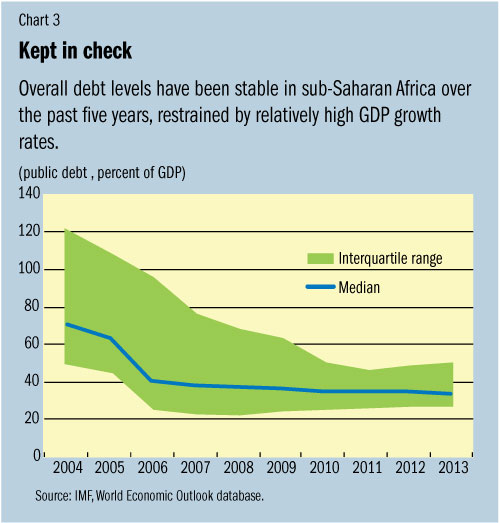
- Overall public debt-to-GDP ratios declined from a regional average of 37 percent in 2004–08 to some 33 percent in 2010–13.
- Debt burdens have been kept in check by relatively high GDP growth rates.
- Concerns:
- Continued weakening fiscal positions and rapidly rising debt in some countries, especially those reliant on portfolio flows, increase vulnerability to shocks.
Higher-quality spending and fiscal trade-offs
- Much of the increased spending reflects boosts to public investment and pro-poor spending in health, education, and infrastructure.
- Rationale:
- The Heavily Indebted Poor Countries Initiative was designed to give fiscal space for socially useful spending and rebuilding infrastructure.
- Over the long run, higher investment in human capital and infrastructure should raise potential growth sufficiently to pay off debt, assuming spending quality is high.
- Fiscal judgment:
- Deficits of the order of 2–3 percent of GDP are probably not a bad thing and will not lead to rising debt burdens given higher GDP growth rates.
- Targeted concern:
- Countries depending heavily on portfolio flows to finance deficits are particularly vulnerable and need to put their fiscal house in order.
Preparing for future shocks — policy recommendations
- Strengthen resilience to shocks by:
- Boosting the revenue base.
- Avoiding excessive spending growth.
- Intensifying efforts to bring public finances on a more sustainable path in countries with large fiscal deficits and high or rapidly rising debt levels.
- Fast-growing countries should take advantage of growth momentum to strengthen fiscal balances.
- Improve the quality and efficiency of public spending across all countries.
- Leverage existing strengths:
- Make use of current favorable conditions (“make hay while the sun shines”) to rebuild fiscal buffers and reduce vulnerability.
Source: Antoinette M. Sayeh, April 24, 2014.
Content in this bundle
- Regional Economic Outlook: Sub-Saharan Africa -Fostering Durable and Inclusive Growth, April 2014