Are Banks Too Large? Maybe, Maybe Not
IMF Blog, May 14, 2014
Source details
- Canonical URL
- Are Banks Too Large? Maybe, Maybe Not
Other formats
Bibliographic details
- Authors: Luc Laeven, Lev Ratnovski, Hui Tong
- Published: May 14, 2014
Large banks and systemic versus individual risk
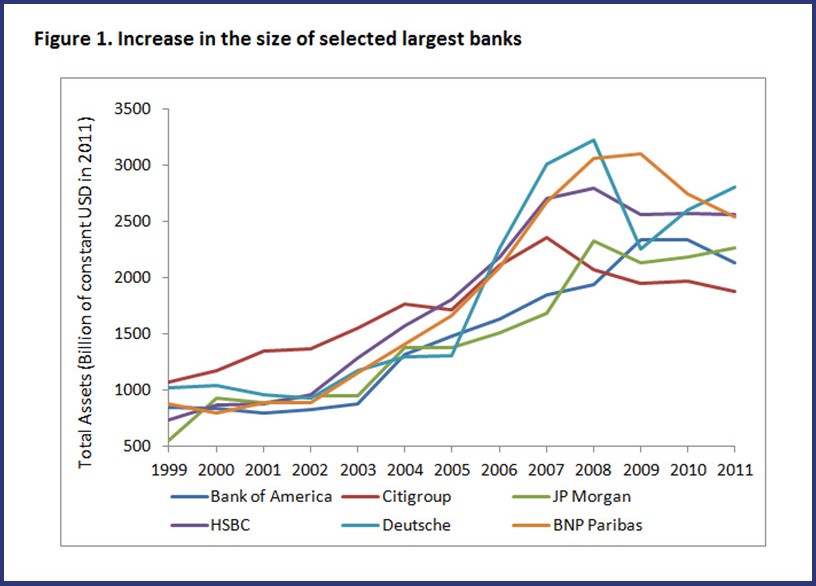
- Large banks were at the center of the recent financial crisis and have significantly grown in size and become more involved in market-based activities since the late 1990s.
- Large banks increase systemic, not individual bank risk:
- Large banks create most of systemic risk in today’s financial system. Systemic risk is measured as expected bank capital shortfall in a financial crisis, i.e., the bank’s contribution to how deep a crisis would be.
- Large banks create especially high systemic risk when they have insufficient capital or unstable funding.
- Large banks create high systemic risk, but are not individually riskier, when they engage more in market-based activities or are organizationally complex.
- Large banks tend to simultaneously have lower capital, less stable funding, more market-based activities, and be more organizationally complex than smaller banks.
Drivers of large bank size and business models
- Implicit too-big-to-fail subsidies:
- The perception that creditors of large banks will be bailed out during bank distress (moral hazard) lowers the cost of debt for large banks, predisposing them to use leverage and unstable funding, and to engage in risky market-based activities.
- Possible empire building:
- A relatively high disagreement among analyst earnings forecasts for large banks suggests complexity and non-transparency, making them difficult to understand and control, which can entrench managers and enable empire building strategies that lead to larger banks.
- Economies of scale:
- Economies of scale are a plausible explanation for large bank size but recent studies suggest they are modest.
- The value of the economies derived from the presence of large banks is $16-45 billion per year (for U.S. banking system).
- That is 0.2 percent of the $20 trillion U.S. banking system size.
- The estimated cost of the recent financial crisis is US$6-12 trillion, making the economies-of-scale gains small in comparison.
Social welfare and optimal bank size
- Evidence that large banks respond to too-big-to-fail and empire building incentives and create systemic risk suggests banks might become “too large” from a social welfare perspective.
- Important caveat: too little is known about the value that large banks bring to their customers (e.g., large global corporations).
- The potential for economies of scale in large banks cannot be dismissed.
- Conclusion: it is difficult to determine a socially optimal bank size; outright restrictions on bank size or activities may be imprecise and hence costly.
Policy implications and recommendations
- Traditional micro-prudential bank regulation may be insufficient for large banks because:
- It may not fully reflect the systemic ramifications of large banks’ risk-taking (the same capital or funding deficiencies create more systemic risk when they occur in large banks).
- It may neglect distortions associated with large banks’ involvement in market-based activities and organizational complexity, which increase systemic but not individual bank risk.
- Need for systemic risk–based regulation of large banks:
- Such regulation may take the form of capital surcharges on large banks, in line with Basel III.
- Quantified example from the study:
- For a large bank with about $1 trillion in assets, an increase in the capital ratio by 2.5 percentage points (similar to the systemic surcharge in Basel III) reduces its systemic risk by a quarter.
- If that increase in capital is combined with measures to bring the bank’s involvement in market-based activities, funding structure, and organizational complexity in line with those of medium-sized banks (should this be possible), the systemic risk is reduced by another quarter.
- Need for better bank resolution and governance:
- Better resolution would reduce “too-big-to-fail” distortions.
- Corporate governance policies should target organizational complexity, deal with high-powered incentives that encourage risk-taking in large banks, and include measures to strengthen risk controls.
Luc Laeven, Lev Ratnovski, Hui Tong — May 14, 2014
Content in this bundle
- CHAPTER 3 How BIg Is tHe IMplIcIt suBsIdy For Banks consIdered too IMportant to FaIl?
- Staff Discussion Note
References
- restrictions on bank size
- https://www.imf.org/wp-content/uploads/2014/05/figure-11.jpg
- https://www.imf.org/wp-content/uploads/2014/05/figure-2.jpg
- https://www.imf.org/wp-content/uploads/2014/05/figure-3.jpg
- https://www.imf.org/wp-content/uploads/2014/05/figure-4.jpg
- https://www.imf.org/wp-content/uploads/2014/05/figure-5.jpg
- https://www.imf.org/wp-content/uploads/2014/05/figure-6.jpg