U.S. Interest Rates: The Potential Shock Heard Around the World
IMF Blog, May 21, 2014
Source details
- Canonical URL
- U.S. Interest Rates: The Potential Shock Heard Around the World
Other formats
Bibliographic details
- Authors: Serkan Arslanalp, Yingyuan Chen
- Published: May 21, 2014
Key takeaway
- A bumpy U.S. exit from unconventional monetary policy could cause a faster rise in U.S. long-term Treasury rates that transmits to other bond markets, affecting not only emerging markets but also other advanced economies.
Context and motivation
- The timing and management of the U.S. Fed exit from unconventional monetary policy is critical, as demonstrated by the financial market turbulence of May 2013.
- The analysis summarized is drawn from the latest Global Financial Stability Report and examines a tail-risk scenario (a bumpy exit), not the baseline prediction.
Some facts (historical evidence)
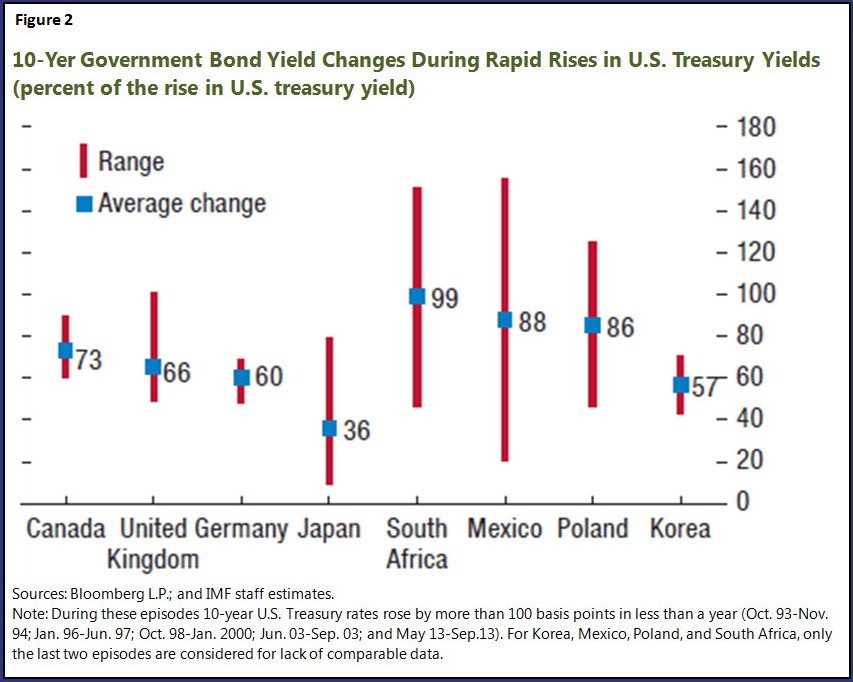
- During the last five episodes when 10-year U.S. Treasury rates rose rapidly, bond yields rose, on average:
- 73 basis point in Canada for every 100 basis point rise in the U.S. Treasury rate.
- 66 basis points in the United Kingdom for every 100 basis point rise in the U.S. Treasury rate.
- 60 basis points in Germany for every 100 basis point rise in the U.S. Treasury rate.
- 36 basis points in Japan for every 100 basis point rise in the U.S. Treasury rate.
- A similar effect was observed for emerging market local-currency bond yields, especially during the selloff in 2013.
Transmission mechanism: the term premium as a key channel
- Bond yields were decomposed into:
- expected short rates (determined by expectations of central bank policy rates), and
- the term premium (compensation sought by investors for potential losses due to interest rate or inflation risk).
- Findings:
- The term premium plays a key role in the transmission of U.S. shocks to other countries.
- Even if expected short rates differ across countries, term premia across countries were found to be highly correlated.
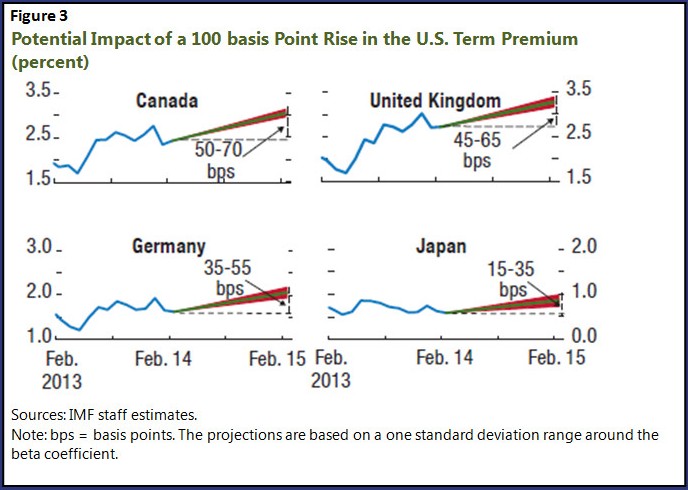
- The transmission of U.S. term premium shocks to other countries was highest for Canada, followed by the United Kingdom, Germany, and Japan.
Why term premia are correlated across countries
- Two possible explanations:
- Financial linkages:
- A “global price of risk” may lead investors to price term premium across advanced economy bond markets similarly through arbitrage.
- Bond markets of major advanced economies have become increasingly integrated over time.
- Economic linkages:
- The term premium charged by investors tends to fluctuate with the country’s business cycle: when the economy is doing well, the premium drops, and vice versa.
- When the U.S. economy does well, other countries with close economic ties to the U.S. also tend to do well, synchronizing business cycles and term premia.
- These factors help explain stronger term premium correlations between countries with closer financial and economic ties (for example, Canada and the United States).
Implications and policy-relevant points
- A bumpy U.S. exit could impact other countries through bond markets if investors demand higher term premia in the United States.
- Even if central banks outside the United States can fully control expected short-term rates through forward guidance, a rise in the U.S. term premium could still put upward pressure on long-term bond yields in other economies, including major advanced economies.
- For countries with highly leveraged balance sheets, a rise in long-term yields could:
- Put further pressure on the capacity to service debt.
- Create headwinds for growth.
- These points underscore the importance of achieving a smooth exit from unconventional monetary policy in the United States.
Source: U.S. Interest Rates: The Potential Shock Heard Around the World — Serkan Arslanalp, Yingyuan Chen, May 21, 2014 (IMF blog).
Content in this bundle
- doi:10.1016/j.jfineco.2005.02.004
- Cp