Slowdown in Emerging Markets: Not Just a Hiccup
IMF Blog, June 26, 2014
Source details
- Canonical URL
- Slowdown in Emerging Markets: Not Just a Hiccup
Other formats
Bibliographic details
- Authors: Evridiki Tsounta, Kalpana Kochhar
- Published: June 26, 2014
Overview
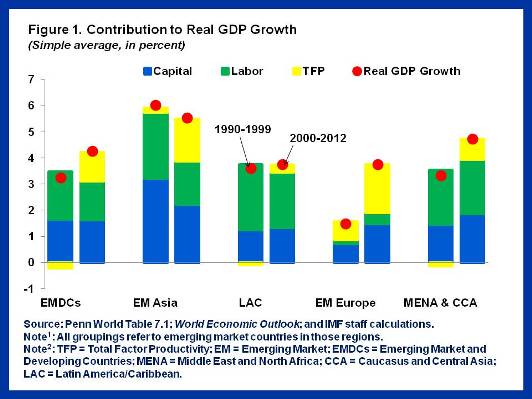
- Emerging market economies experienced strong growth in 2000-12, averaging 4¾ percent per year.
- In the last two to three years (prior to June 26, 2014), growth in most emerging markets has been cooling off, in some cases quite rapidly.
- The key question: is the recent slowdown transitory (a hiccup) or a sign of a more chronic condition?
Main drivers of past growth
- Employment increases and accumulation of capital (buildings and machinery) remain the main drivers of growth.
- Together they explain 3 percentage points of annual GDP growth in 2000–12.
- Improvements in total factor productivity explain 1 ¾ percentage points of annual GDP growth in 2000–12.
- The pickup in economic activity in the 2000s compared to the 1990s is solely explained by higher total factor productivity.
- Total factor productivity, after previous declines in Latin America and the Middle East and North Africa, is now on the rise across emerging market regions.
- Productivity improvements reflect both cyclical upsides during good times and structural (permanent) factors such as:
- Reallocation of inputs to more productive sectors.
- Gains from past reforms (deregulation, trade liberalization, financial liberalization).
Assessment of the slowdown: cyclical vs. structural
- External factors account for a considerable part of the recent slowdown; domestic factors also play a role.
- On average, cyclical and structural factors are equally important in explaining the growth slowdown in emerging markets over the last few years.
- Implication:
- The cyclical component implies some slowdown may reverse once advanced-economy growth picks up.
- The structural component implies a more permanent reduction in potential growth for some countries.
Lower potential growth and near-term outlook
- Estimates of potential growth rates in emerging markets for the next 3-4 years are 3½ percent.
- This implies growth would be on average 1¼ percentage points lower than in the 2000s.
- Factors explaining the anticipated slowdown in potential growth:
- Expected moderation in investment (growth of the physical capital stock) as global interest rates rise and commodity prices stabilize.
- Natural constraints such as population aging limiting the contribution of labor.
- The need to slow growth in countries that allowed external and financial imbalances to build, in order to address balance-sheet risks.
Policy implications and recommendations
- Policymakers in emerging markets should place renewed emphasis on structural reforms to raise productivity, which despite recent improvements remains relatively low compared to advanced economies.
- Structural reforms can include measures tailored to country circumstances (referenced IMF work discusses tailored structural reforms).
- Two possible country-level responses:
- In some countries, transitioning to a slower potential growth rate may be desirable if it yields more sustainable and balanced growth.
- In other countries, the slowdown can be an opportunity to reevaluate policies and undertake structural reforms to restore stronger growth, income convergence, and rising living standards.
Source: Slowdown in Emerging Markets: Not Just a Hiccup — Evridiki Tsounta, Kalpana Kochhar, June 26, 2014.
Content in this bundle
- Staff Discussion Note
References
- https://www.imf.org/wp-content/uploads/2014/06/slowdown-in-ems-figure-1-rev.jpg
- previous blog
- structural
- previous blog
- https://www.imf.org/wp-content/uploads/2014/06/slowdown-in-ems-figure-2.jpg
- our results
- https://www.imf.org/wp-content/uploads/2014/06/slowdown-in-ems-figure-3-rev.jpg
- recent IMF paper