Europe’s Russian Connections
IMF Blog, August 1, 2014
Source details
- Canonical URL
- Europe’s Russian Connections
Other formats
Bibliographic details
- Authors: Aasim M Husain, Anna Ilyina, Li Zeng
- Published: August 1, 2014
Overview
- Authors: Aasim M. Husain, Anna Ilyina, Li Zeng
- Date: August 1, 2014
- Context: The conflict in Ukraine and the related imposition of sanctions against Russia signal an escalation of geopolitical tensions that is already being felt in the Russian financial markets. A deterioration in the conflict, with or even without a further escalation of sanctions and counter-sanctions, could have a substantial adverse impact on the Russian economy through direct and indirect (confidence) channels.
- Analytical focus: Identification of the broad channels—trade, energy, investment, and financial ties—through which European countries are connected to Russia, to assess which countries might be most affected by disruptions in trade or financial flows with Russia or by a sharp downturn in Russian economic growth.
Key findings (cross-cutting)
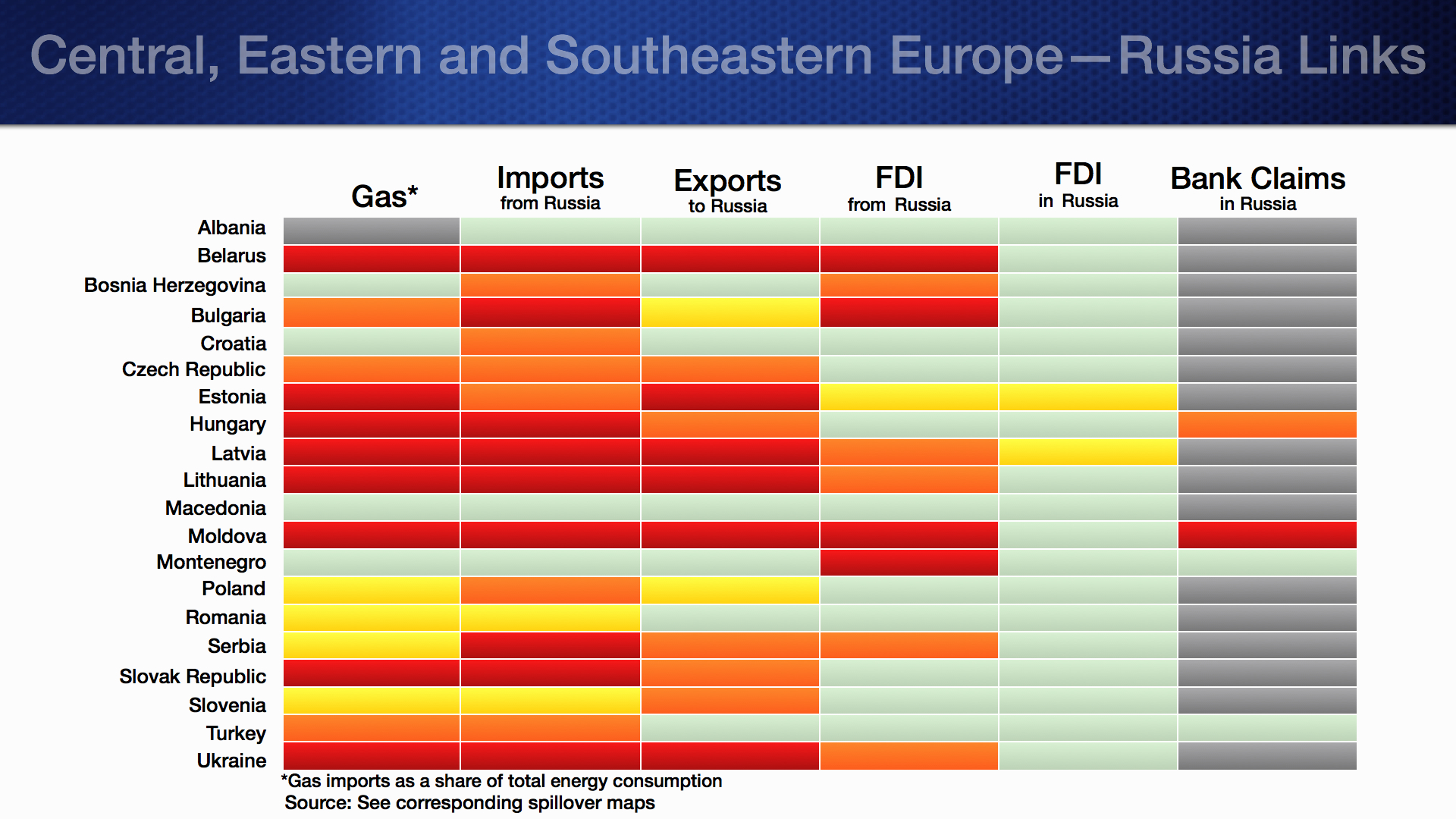
- Eastern European countries have the closest links with Russia and some of them could be seriously affected by a sharp slowdown of the Russian economy or a ratcheting up of sanctions and countersanctions.
- Western European countries are relatively less linked but some could also see significant effects.
- Conclusions are based broadly on potential channels rather than a quantitative estimate of impact; confidence effects from geopolitical tensions could dominate actual outcomes.
Trade links
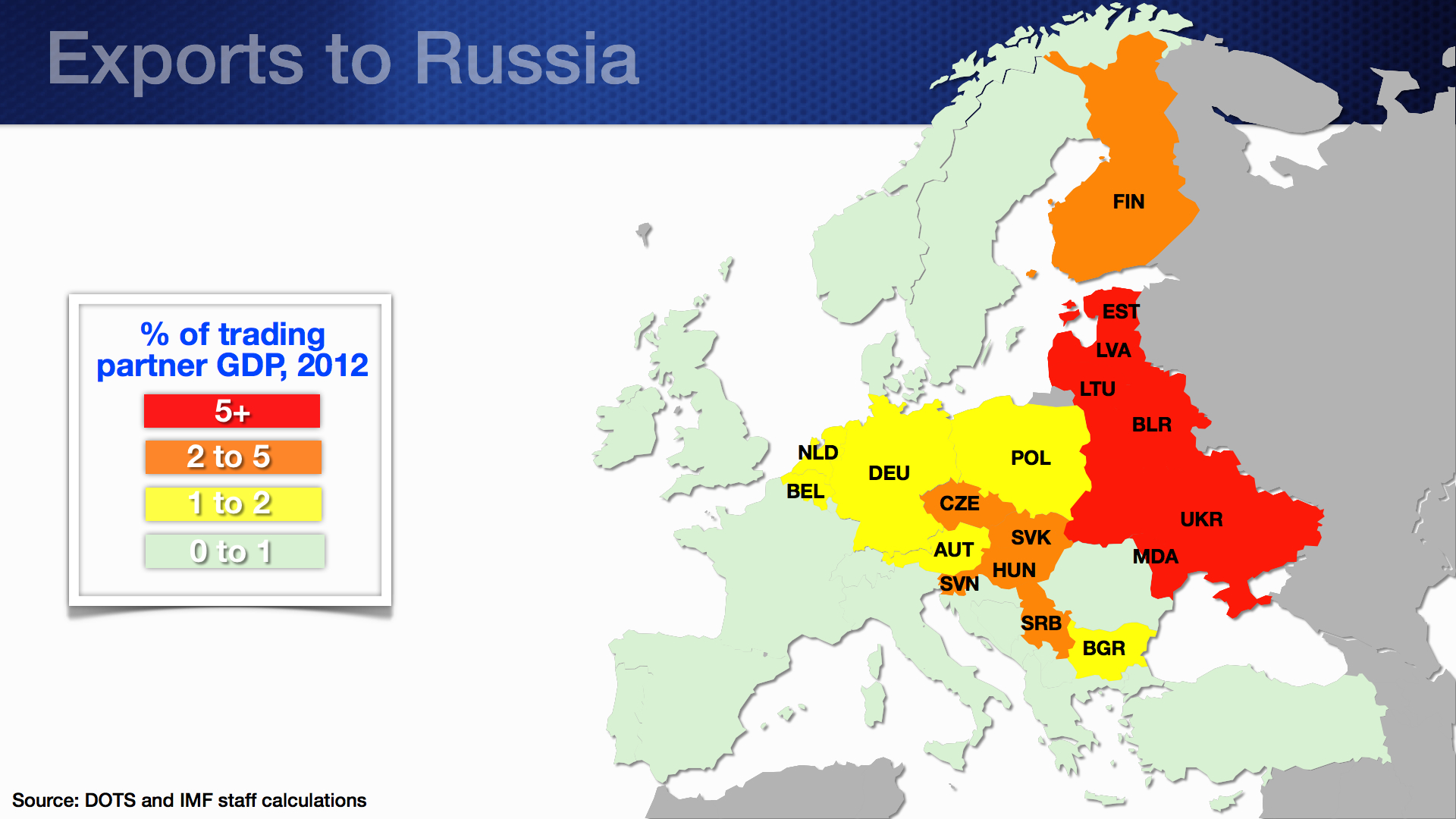
- For most European countries, Russia is not a major export market.
- However, immediate neighbors such as Belarus, Ukraine, Moldova, and the Baltics have exports to Russia that exceed 5 percent of their respective GDP.
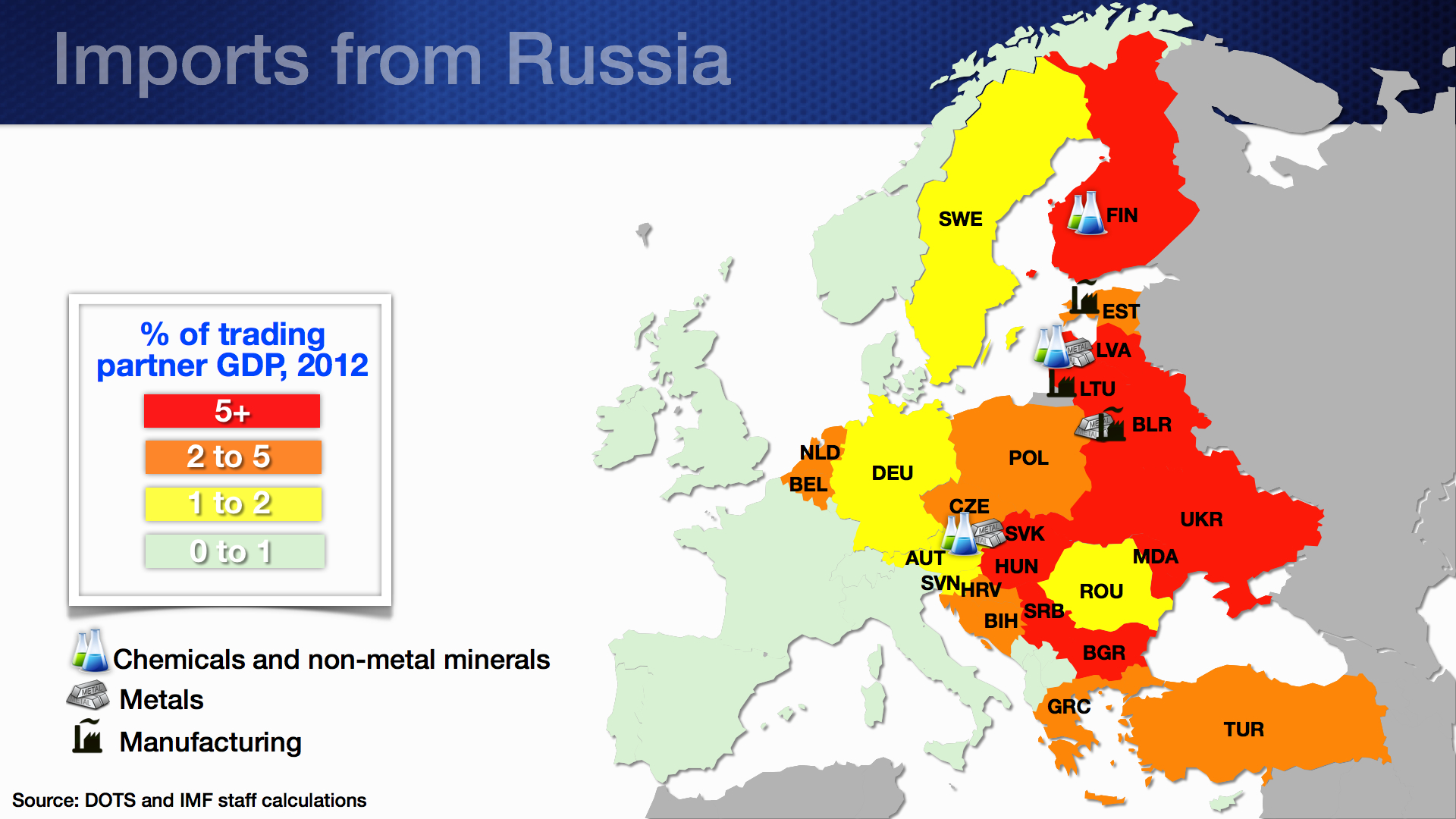
- European countries depend more on Russia on the import side—particularly gas and oil.
- Certain industries (chemicals and minerals, metals, and manufacturing equipment) rely heavily on inputs from Russia and could face disproportionate impacts from trade disruptions or price increases on energy imports from Russia.
Energy supply
- Europe imports over one third of its natural gas from Russia through several major pipelines.
- Russian gas accounts for over 50 percent of total gas consumption in virtually all countries in Eastern Europe and several advanced economies in Europe as well.
- As a share of total energy consumption (rather than gas), Russian gas is somewhat less critical but remains very important for several countries, and especially so for Belarus and Moldova.
- The pipeline via Ukraine has the largest capacity and transports almost half of Europe’s gas imports from Russia; disruption of flow through that pipeline would have potentially serious effects on countries whose energy infrastructure relies heavily on it.
- Many European countries also depend heavily on oil imports from Russia, but oil imports are easier to substitute from other suppliers than gas imports.
Investment flows
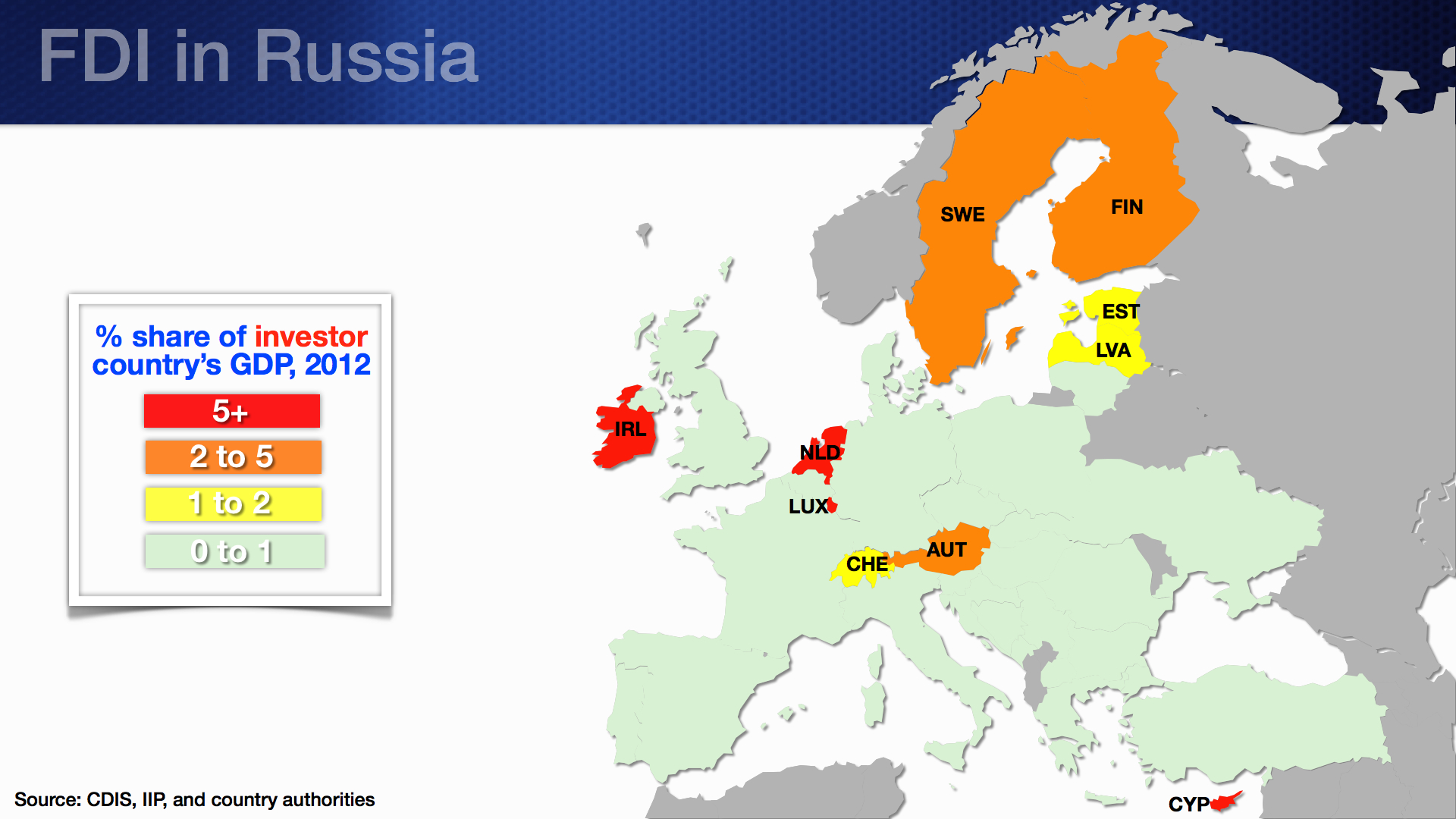
- Foreign direct investment (FDI) from Russia exceeds 5 percent of GDP for Belarus, Bulgaria, Moldova, and Montenegro in industries such as banking, energy, and metal and mining.
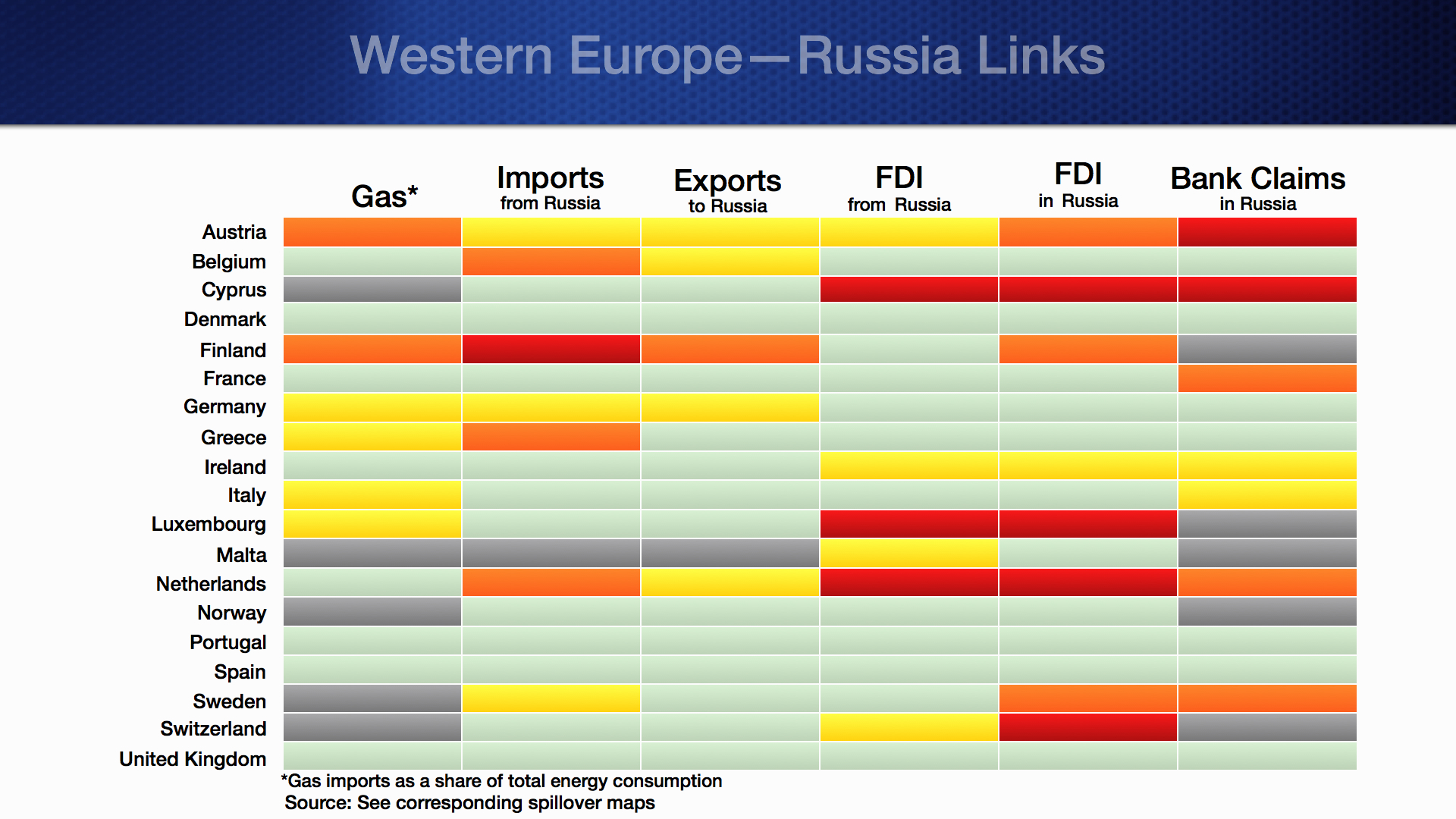
- A number of advanced economies, notably Netherlands and Ireland, have significant FDI in Russia.
- Financial centers such as Cyprus and Luxembourg report high two-way FDI flows.
Financial links
- Many Western banks have sizable exposures to Russia; notably Austrian, Hungarian, French, and Italian banks have subsidiaries in Russia and also lend directly to customers in Russia from their branches outside Russia.
- For some of these banks, their Russian operations have accounted for a large share—in some cases over one third—of their profits in the last few years.
- The same Western banks also lend to other countries in Central, Eastern and Southeastern Europe (CESEE).
- The largest common creditor countries (and their major financial institutions) account for 60 percent of the total cross-border lending to the CESEE region.
- Russia accounts for about one third of the region’s total borrowing from these creditors.
- If a large shock to Russia triggers a reassessment of regional risks by common creditors, it could result in a broad pullback in lending to other countries.
- Foreign portfolio investments to Russia are sizable because Russian assets account for 6–12 percent of emerging market benchmark indices.
- Despite Russia’s spreads widening sharply following developments in Ukraine, spreads of most other CESEE sovereigns drifted lower, and there has been little sign of contagion to other Eastern European markets so far.
Source: Europe’s Russian Connections, IMF blog entry by Aasim M. Husain, Anna Ilyina, Li Zeng (August 1, 2014).
Content in this bundle
- Российские связи Европы; Аасим М. Хусейн, Анна Ильина и Ли Зен; 1 августа 2014 года
References
- https://www.imf.org/wp-content/uploads/2014/08/cesee-blog_7-30-14_final-001.jpg
- blog on Russia-Caucasus and Central Asia links
- https://www.imf.org/wp-content/uploads/2014/08/cesee-blog_7-30-14_final-002.jpg
- https://www.imf.org/wp-content/uploads/2014/08/cesee-blog_7-30-14_final-003.jpg
- https://www.imf.org/wp-content/uploads/2014/08/cesee-blog_7-30-14_final-004.jpg
- https://www.imf.org/wp-content/uploads/2014/08/cesee-blog_7-30-14_final-005.jpg
- https://www.imf.org/wp-content/uploads/2014/08/cesee-blog_7-30-14_final-006.jpg
- https://www.imf.org/wp-content/uploads/2014/08/cesee-blog_7-30-14_final-007.jpg
- https://www.imf.org/wp-content/uploads/2014/08/cesee-blog_7-30-14_final-008.jpg
- https://www.imf.org/wp-content/uploads/2014/08/cesee-blog_7-30-14_final-009.jpg
- https://www.imf.org/wp-content/uploads/2014/08/cesee-blog_7-30-14_v2_cesee.jpg
- https://www.imf.org/wp-content/uploads/2014/08/cesee-blog_7-30-14_v2_ae.jpg